
How to Read Cleaning-Product Labels: Dilution, Contact Time and Surfaces
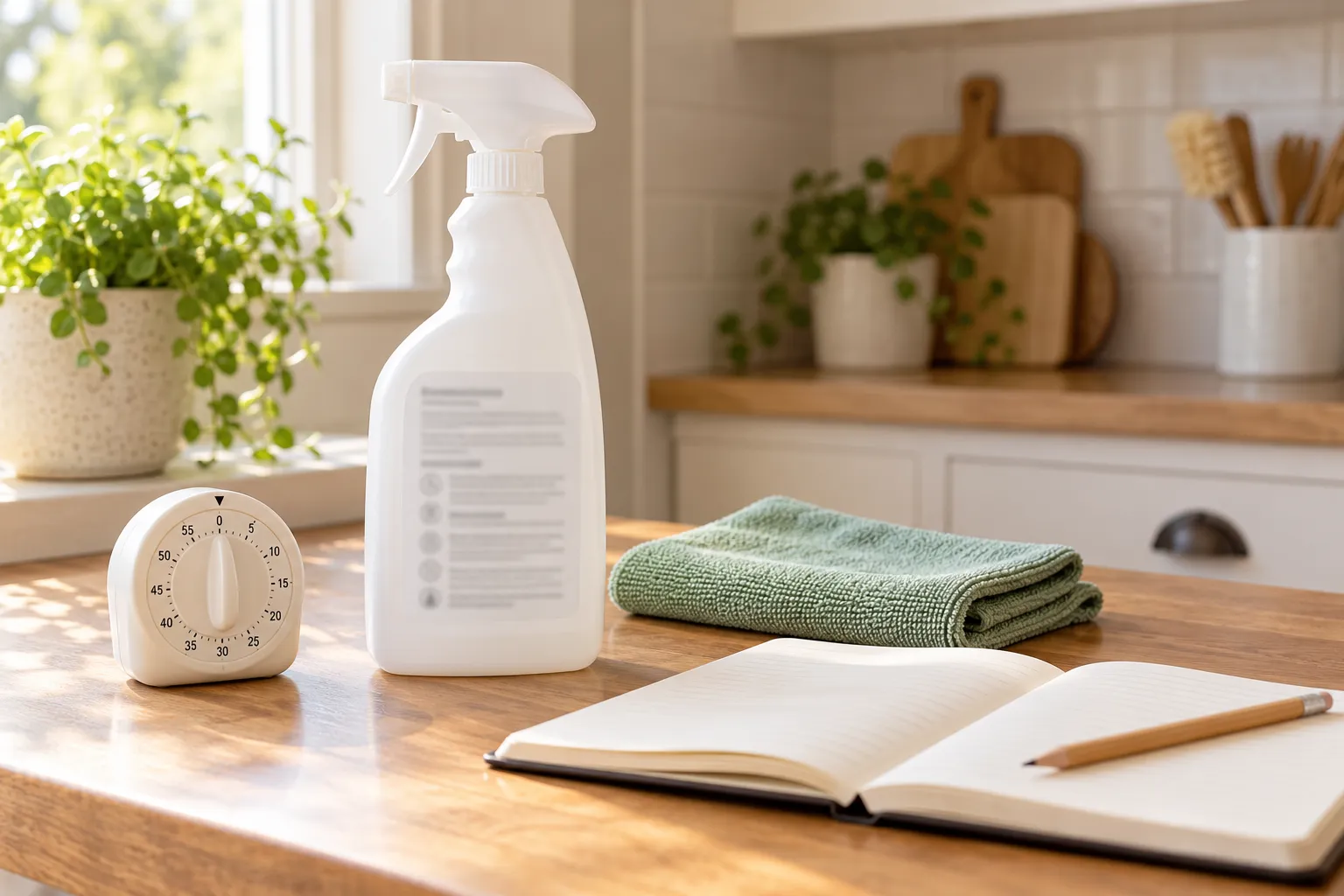
The most useful part of a cleaning-product bottle is usually the directions panel. Before using it, identify the job, confirm the surface is suitable, check whether dilution is required, and read the application, waiting and finishing steps. A quick spray and wipe may be a cleaning method; it is not automatically the method needed for the disinfectant claim on the front.
This guide explains how to turn a label into a practical cleaning plan without guessing a concentration or copying another product's instructions. It is for everyday household decisions, including shared homes and holiday rentals in Sydney, the Illawarra and the Shoalhaven.
Download the cleaning-product label worksheet (PDF). Use one sheet for one exact product and one intended task. It records where to find the instructions, what needs checking and the sequence you will follow. It does not replace the label or a workplace safety procedure.
First decide what you want the product to do
Start with a specific task: removing greasy marks from a permitted kitchen surface, cleaning a bathroom fitting, or disinfecting a suitable surface when needed. “Clean everything” is too broad to help you choose a product or understand its directions.
Cleaning and disinfecting are different processes. The US Centers for Disease Control and Prevention explains that regular cleaning removes dirt and germs, and that routine disinfection is generally unnecessary in many household situations. Illness or particular health risks can change what is appropriate. Its household guidance also says to clean before disinfecting. Read the CDC's household cleaning guidance. This is general hygiene guidance, not an Australian product approval list.
On the worksheet, write the actual task before recording any product directions. For example, “clean the sealed laminate laundry bench” is more helpful than “laundry”. If you cannot identify the surface or finish, put that question first. A product cannot answer a compatibility question about a material you have not identified.
Read the exact product, not just the brand
Products with similar names can have different purposes and directions. Record the complete name, variant and format: concentrate, ready-to-use spray or wipe. Photograph the directions and warnings clearly if that helps you read the small print, but keep the original container and its label available.
Check that an online information page matches the Australian product you actually own. An overseas bottle, an older formulation or another size in a different format may not have the same instructions. If the bottle and online page disagree, ask the supplier or manufacturer rather than selecting whichever method seems easiest.
Australia's Therapeutic Goods Administration says disinfectant labels should explain appropriate use, including suitable surfaces and, where relevant, pre-cleaning, dilution, application and contact time. It also advises following hazard warnings, providing ventilation and not mixing cleaning or disinfecting products. See the TGA's advice on using disinfectants.
A useful reading order is purpose, exclusions, preparation, application, contact time, finishing instructions and warnings. Read the full sequence before starting. Discovering a required rinse or a surface exclusion halfway through the job is avoidable.
Check the surface before checking the dose
Match the product's permitted uses with the surface manufacturer's care instructions. “Bathroom cleaner” describes a category, not permission to use it on every material in a bathroom. Look for exclusions covering the particular finish, coating, sealant or appliance you are about to clean.
Write down the exact surface and the source of its care guidance. In a rental, this might mean asking the owner or property manager what a benchtop is made from. In your own home, check the installation paperwork or manufacturer's care page. A photograph can help identify the item, but appearance alone may not settle the question.
If the instructions require a test in an inconspicuous area, follow that direction. A small test does not override an explicit prohibition. If the product says not to use it on the material, choose a compatible method instead of treating a test patch as permission.
Keep unresolved questions separate from the cleaning checklist. “Confirm shower-screen coating” is a decision to resolve, not a task to tick off while spraying. Our shower-glass cleaning guide gives a practical example of why the finish matters.
Understand dilution without inventing a recipe
First establish whether dilution is needed at all. Do not add water to a ready-to-use product simply to make it last longer, or use a concentrate neat because a mark looks stubborn. Find the directions for the intended task; one bottle can list more than one use.
Copy the full instruction, including units and what the amount refers to. “Add to water” and “make up to a final volume” are different instructions. If a ratio is ambiguous, ask the manufacturer to explain it. Do not resolve uncertainty by guessing what the colon means.
For a simple arithmetic illustration only, suppose an ordinary detergent's actual label specified 20 mL per litre of water for your task. Three litres of water would require 60 mL under that instruction: 20 multiplied by 3. This is a fictional example, not a dilution recommendation for any real product, bleach or disinfectant.
The calculation does not decide compatibility, mixing order, water temperature or how long a prepared solution can be kept. Those remain product-specific instructions. Use suitable dedicated measuring equipment as directed, and record any preparation or disposal requirements. Never use a remembered dose from a previous bottle as the starting point for a replacement product.
Contact time: plan the wait before you begin
For disinfection, contact time is the period the product needs to act on the surface. CDC guidance says the surface should stay wet for the required time. That is why an immediate wipe can be inconsistent with a disinfectant's directions, even if the surface looks tidy afterwards.
Read the instructions for the specific claim and application. Do not transfer the waiting time from a spray to a wipe, or from one product to another. If you cannot maintain the conditions described on the label, ask for advice on a suitable method rather than quietly shortening the time.
Turn the waiting period into part of the job plan. Prepare the area first, set a timer when appropriate, and make sure nobody needs to use that surface during the treatment. In a shared kitchen, a simple verbal handover can prevent someone placing food or utensils onto a surface that is still being treated.
For example, if your chosen product requires a waiting period, do not schedule that task immediately before a guest needs the kitchen. Allow time for the whole sequence, including any rinse and drying steps. The practical constraint is when the area can safely be returned to use, not merely when spraying finishes.
Read the finishing instructions as carefully as the first step
Look for what happens after application: wiping, rinsing, air-drying or another specified step. Do not assume “leave to work” means “leave indefinitely”. Also check whether the directions change for food-contact surfaces or particular items.
Food-business requirements are a separate context. Food Standards Australia New Zealand distinguishes cleaning from sanitising and says items need cleaning before sanitising. Its guidance directs businesses using a commercial sanitiser to follow the manufacturer's instructions. Read FSANZ's food-business guidance. Do not copy a food-business chemical recipe into an unrelated household task or treat this article as a business compliance plan.
On your worksheet, write a clear finish point such as “complete the label's rinse and drying instructions before returning the surface to use”. Then add the exact product-specific details. This prevents the worksheet becoming a vague reminder that leaves the most important part to memory.
Keep warnings and safety information with the task
Read the warnings before opening the product, including required protective equipment, ventilation, storage and first-aid directions. Avoid combining products or adding another cleaner because the first has not produced the result you expected. If the method is unsuitable, stop and reassess the job.
For workplace use, a safety data sheet provides additional information. Safe Work Australia explains that an SDS helps identify chemical hazards and safe handling, storage and emergency measures. Match the document to the product rather than downloading a sheet for a vaguely similar name. Read about safety data sheets.
The worksheet is a reading aid. It is not an SDS, a chemical register or evidence that a workplace has met all its obligations. If you organise cleaning for a business, make sure the people doing the work have the appropriate product information and procedures, not just your handwritten summary.
Use the worksheet for a practical household handover
Complete one sheet while looking at the container and relevant surface guidance. Leave uncertain fields clearly marked “check before use”. Do not fill a blank with a familiar method just to make the page look complete.
- Identify: record the exact product, intended task and surface.
- Locate: note where the current label and relevant care instructions can be found.
- Sequence: record preparation, any dilution, application, waiting and finishing steps.
- Resolve: list questions for the manufacturer or property owner.
- Review: date the sheet and check it again when the product or surface changes.
In a holiday rental, share the product decision with the person carrying out the work rather than quietly replacing their supplies. Confirm who chooses products and who checks special surfaces. For household storage and unwanted products, use our separate cleaning-cupboard reset guide.
Common label-reading mistakes
- Reading only the front: a performance claim needs its accompanying directions and limitations.
- Using one dose for everything: the label may give different instructions for different tasks.
- Skipping the finish: rinsing and drying can be part of the specified method.
- Keeping an outdated worksheet: recheck when replacing a product or changing a surface.
- Assuming a cleaning booking includes disinfection: agree the task and method rather than relying on the word “clean”.
Frequently asked questions
Does “kills 99.9%” mean a quick wipe is enough?
No. Read the directions and the organisms, surfaces and conditions attached to the claim. The front-panel wording alone does not tell you the application method.
Can I make a product stronger for a difficult mark?
Use only the concentration and method permitted for that task. If the result is poor, reassess the soil, surface and product choice instead of inventing a stronger mixture.
What if the label is unreadable?
Do not use the product until you can reliably identify it and obtain the correct instructions. An unidentified liquid should not be assigned a purpose from its colour or smell.
Can my cleaner help choose the method?
Discuss the surfaces, your requirements and any manufacturer restrictions before the visit. If you want help with regular household tasks, explore Housekept home cleaning and confirm the agreed scope. Specialised treatment or disinfection should be discussed explicitly.
Sources and checked date
Checked 31 October 2026. Sources linked above: TGA guidance on appropriate disinfectant use; CDC household cleaning and disinfection guidance; FSANZ cleaning and sanitising guidance for food businesses; and Safe Work Australia information on safety data sheets. This is an evergreen practical guide, not a new regulatory announcement. The worksheet, planning examples and fictional arithmetic example are original Housekept material.