.png)
What You Can (and Can't) Clean With Vinegar
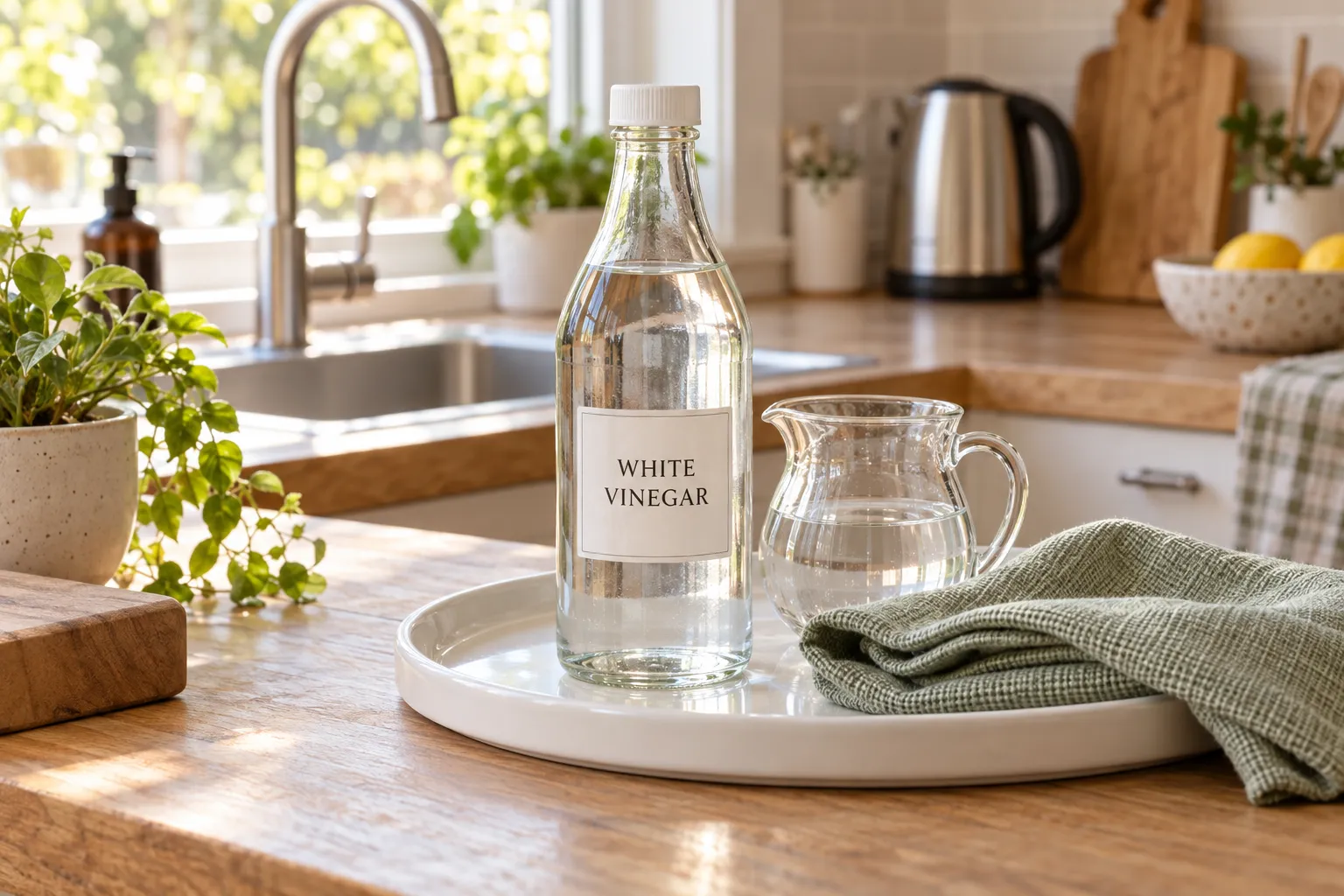
Vinegar can be useful for specific cleaning jobs, but it is not a safe all-purpose cleaner. Use it only where the surface or appliance instructions permit it, at the specified strength and with the required rinsing. Keep it away from natural stone and any finish whose care guide excludes acids. Never mix it with bleach.
The difficulty is that “clean the bathroom” involves several different materials: glass, grout, tap finishes, seals and perhaps a stone vanity. A method suitable for one can damage another. This guide helps you decide when vinegar belongs in the job and when to choose the recommended alternative, without relying on one recipe for the whole home.
Download the free surface-care checklist (PDF). Record the material, approved cleaner, dilution and care instructions once, then keep the sheet where you or your cleaner can find it.
Why vinegar works on some messes
Vinegar contains acetic acid. Its acidity is the reason it can be useful in some descaling methods, and also the reason it can be unsuitable for sensitive surfaces. “Natural” does not tell you whether a product is compatible with a finish, appropriate for food-contact use or suitable for the particular cleaning result you need.
Different bottles are not automatically interchangeable. Check the label rather than assuming that a food vinegar and a product sold for cleaning have the same concentration or instructions. Poison Control's vinegar safety guidance explains that vinegar products can vary in strength and that concentrated products can cause harm. Store cleaning products securely in their original labelled containers.
Before choosing any cleaner, identify the problem. Loose dust, greasy residue, mineral deposits and a damaged finish are different issues. More acid will not turn a scratched surface into an undamaged one, and a strong smell is not evidence of effective cleaning.
Where vinegar may be an option
Some kettles, under their descaling instructions
Philips Australia includes a vinegar method in its support guidance for certain kettles. That is a useful example of a permitted use, not permission to apply a generic vinegar recipe to every kettle. Check that the guidance applies to your model before using it. Read Philips' kettle guidance.
Use the specified concentration, quantities, sequence and rinsing steps. Do not guess whether the solution should be heated, how full the kettle should be or how long it should stand. Put the manual beside the appliance before starting, and keep the electrical base and connections dry. If the instructions call for a proprietary descaler, follow that method instead.
Other surfaces where the care guide expressly allows it
A manufacturer may permit a vinegar solution for a particular item or finish. Treat that as a narrow instruction for that item. Record the details on the worksheet, including any nearby materials that must avoid contact with the solution.
For instance, approval for a removable component does not necessarily extend to the whole appliance. Likewise, an instruction for ordinary glass does not establish that a coated shower screen, mirror backing, frame or seal can tolerate the same treatment. The right starting question is “what does the care guide allow here?”
Where to leave vinegar out
Natural stone and sensitive flooring
The American Cleaning Institute warns that vinegar's acid can damage natural stone such as granite, stone tiles, and hardwood floors and furniture. It also recommends checking manufacturer instructions. Use a cleaner approved for your particular stone or floor finish rather than assuming dilution removes the compatibility problem. Read ACI's vinegar guidance.
If you do not know whether a vanity is stone, engineered material or laminate, find out before applying a cleaner. Ask the supplier, owner or property manager for the product details. A photograph can help start that conversation, but appearance alone may not reliably identify the material or its coating.
For an existing dull patch or discolouration, stop experimenting with stronger mixtures. Photograph the area and seek the supplier's care advice. Keep a record of what was used and when. That is more useful than repeatedly cleaning a change in the finish as though it were removable dirt.
Taps and decorative finishes without approval
Do not assume a shiny tap is vinegar-safe. Hansgrohe Australia's tap-care guide advises against vinegar-based cleaners for its products and recommends a mild citric-acid-based cleaner for descaling, applied to a suitable cloth and followed by rinsing. This is brand-specific advice; check your tap's own requirements. See Hansgrohe's cleaning instructions.
An overnight vinegar soak or a bag tied around a tap is therefore not a universal maintenance method. It can expose more than the intended deposit: finishes, joints and surrounding surfaces may also be in contact with the liquid. Use the method and contact time actually specified for the fixture.
Washing machines without manufacturer permission
Bosch advises against using vinegar to clean its washing machines because it may degrade rubber parts over time. A general laundry tip is not a substitute for the maintenance instructions for your appliance. Read Bosch's explanation.
For a musty machine, look up its drum-clean programme, detergent-drawer cleaning and seal-care instructions. Do not automatically add vinegar to every wash or combine it with the machine's cleaning product. If a smell persists after the recommended maintenance, investigate the cause through the manufacturer's troubleshooting guidance.
Vinegar is not a substitute for disinfectant
Cleaning and disinfection are different tasks. ACI does not recommend vinegar as a disinfectant substitute. If a situation calls for disinfection, choose a product labelled for that purpose and suitable for the surface, then follow its instructions, including contact time and any rinsing requirements. Do not treat a vinegar wipe as proof that germs have been controlled.
For routine kitchen work, start with the appliance or surface's cleaning instructions. Avoid adding a second chemical “just in case”. Our fridge-cleaning guide explains how to plan the job around food storage, removable parts and the appliance manual.
Never mix vinegar with bleach
Vinegar and bleach can release dangerous chlorine gas when mixed. Poison Control's guidance explicitly warns against this combination. The warning includes adding vinegar to a bucket, bottle or area containing bleach: separate bottles do not make a mixture safe once the products meet.
Use one product according to its instructions, and do not improvise combinations with other cleaners. If you are unsure what was used previously, pause and clarify before continuing. Ventilation is useful during appropriate cleaning work, but it does not make an unsafe mixture acceptable.
In a shared home or holiday rental, make this part of the handover. Tell the next person what product was applied and where. Keep products labelled, leave the care instructions accessible and avoid anonymous spray bottles whose contents nobody can identify.
A practical decision process before each job
1. Identify the surface and the surrounding materials
Write down the item, its material and finish, and any brand or model details. Include edges, seals and neighbouring surfaces where drips could land. For a bathroom, this might mean a coated screen beside a stone ledge and a plated fitting, each with separate care requirements.
2. Match the method to the care instructions
Find an approved product or method for the particular task. Save the manual or care-page link in the worksheet. If the instructions are missing or unclear, ask the supplier before experimenting. Do not rely on a short social-media demonstration that leaves the material unidentified.
3. Check the bottle and the complete procedure
Confirm the product, strength, dilution, contact time, protective measures and rinsing steps. Gather the right cloths and equipment before beginning. If the instructions require a measure, use an appropriate measure rather than estimating a splash.
4. Test only an already permitted method
Where the care guide recommends a small-area test, follow it and inspect the result after drying. A spot test is an extra check, not permission to ignore a warning. Some problems may develop through repeated use rather than appear on the first application.
5. Record what works
Keep the approved method with the household's cleaning information. Record restrictions too, such as “no acidic cleaner on this vanity”. This is especially useful when more than one person cleans the home or when a holiday-rental team changes between visits.
Common vinegar-cleaning mistakes
- Using one dilution everywhere: the surface, finish and task determine the method.
- Assuming all glass is the same: coatings, edges and fittings need their own care instructions.
- Leaving a soak longer for extra strength: follow the approved contact time instead.
- Replacing appliance maintenance with a home recipe: check the exact model instructions.
- Calling a vinegar wipe disinfection: use the appropriate labelled product when disinfection is required.
- Mixing products: never combine vinegar with bleach or improvise cleaner mixtures.
Frequently asked questions
Is cleaning vinegar better than white food vinegar?
Not automatically. A stronger or differently formulated product is not necessarily suitable for the surface. Match the bottle to the approved instructions and never assume a cleaning product is suitable for food use.
Can I use vinegar on every shower screen?
No blanket answer is reliable. Check the screen's coating and the care requirements for adjacent frames, seals and fittings. If you cannot identify the product, seek its care guidance first.
Does dilution make vinegar safe on stone?
Do not use dilution to override a surface warning. Choose a stone-compatible method specified by the supplier. A weak solution is still the wrong choice when the care instructions exclude it.
What should I tell my cleaner?
Share the materials, approved products and any previous damage or sensitivities. The surface-care worksheet makes that handover easier. For broader preparation, see our guide to preparing for a cleaner.
If you need help deciding the scope of a home clean, contact Housekept and describe the surfaces and tasks involved. Good preparation starts with knowing what needs cleaning and what care instructions apply.
Sources and checked date
Checked 14 October 2026. Sources: Poison Control, American Cleaning Institute, and the Philips, Hansgrohe and Bosch manufacturer guidance linked above. Overseas guidance is used for product-care and chemical-safety information, not Australian regulatory claims. The planning workflow is Housekept editorial guidance; follow the instructions for your exact product and surface.