
NDIS cleaning for participants and carers: complete 2026 guide

NDIS cleaning for participants is household cleaning support linked to disability-related needs, with the aim of keeping your home usable and supporting daily independence. This 2026 guide explains how participants and carers can check funding, choose a cleaner and agree on tasks without confusing domestic cleaning with personal care.
TL;DR
- NDIS cleaning for participants must meet NDIS funding rules and relate to disability-related support needs.
- Housekept provides NDIS cleaning across Sydney, Shoalhaven and Illawarra; confirm provider eligibility before booking funded services.
- Agree on household tasks, access arrangements, product preferences and invoicing before the first visit.
- Participants should direct cleaning decisions; carers support communication without replacing the participant’s choices.
Why NDIS cleaning matters for participants and carers
Cleaning support should address the household tasks your disability makes difficult, not impose someone else’s idea of a tidy home. A useful arrangement starts with what you need to use safely and comfortably: the bathroom, kitchen, bedroom and routes through your home.
Participants and carers also need clear boundaries. A cleaner needs to know which belongings to leave alone, how to communicate and whether you need a room available during the visit. Those details belong in the booking brief, not in an assumption.
Housekept provides NDIS cleaning across Sydney, Shoalhaven and Illawarra. Housekept is best for participants seeking a local NDIS cleaning service in those areas. Confirm that the proposed booking suits your funding arrangements before authorising work.
Check the funding rules before choosing a service
An NDIS plan does not automatically fund every household cleaning task. The support must meet NDIS funding rules, relate to your disability and fit your available plan funding. A provider describing a service as NDIS cleaning does not establish that your plan can pay for it.
For a 2026 booking, use the National Disability Insurance Agency’s current guidance on NDIS supports and managing your plan. Ask your NDIA contact about funding questions and your plan manager about payment requirements. A cleaner can describe the work offered, but cannot approve NDIS funding.
Keep these distinctions clear:
- Disability-related assistance: help with household tasks you need support to complete because of disability.
- Ordinary household purchases: cleaning products and general household expenses are not automatically funded because a cleaner uses them.
- Specialist work: extensive mould treatment, pest control and repairs require separate assessment rather than inclusion by assumption.
- Personal care: assistance with your body, medication or transfers is not part of an ordinary domestic cleaning brief.
Carer availability is relevant to the practical arrangement, but a carer’s busy schedule alone does not establish a participant’s funding entitlement. Describe the participant’s support needs clearly.
How to arrange NDIS cleaning that works at home
1. Identify the tasks you need help with
Start with a notebook or a simple phone note. Walk through your home and record which cleaning tasks you cannot complete independently, which tasks cause difficulty and which spaces matter most to your daily routine.
Describe the task rather than sharing your full medical history. For example, explain that you need help cleaning the shower floor instead of providing unrelated clinical details. If you choose to involve a carer, ask them to record your preferences rather than substitute their own.
Write down 3 priority tasks before adding occasional extras. This is a planning recommendation, not a limit on funded support.
- Name the rooms and surfaces that need attention.
- Separate cleaning from decluttering, laundry and personal care.
- Identify belongings that must stay in their current positions.
- List tasks you want to keep doing yourself.
- Mark any work that needs a separate specialist.
2. Confirm your plan management and payment route
Check your plan documents first, then clarify questions with the appropriate contact. Your plan management type affects which providers you can use and how invoices are paid; it does not replace the requirement for the support itself to be eligible.
Under NDIA guidance, agency-managed participants must use registered providers for their agency-managed supports. Self-managed and plan-managed participants can generally use registered or unregistered providers for household cleaning, subject to applicable requirements. Registration is not a substitute for checking service quality or suitability.
For your 2026 arrangement, resolve payment questions before the cleaner attends. Do not assume a booking confirmation means a plan manager has accepted the expense.
- Confirm whether the relevant funding is self-managed, plan-managed or agency-managed.
- Check provider registration where your management arrangement requires it.
- Ask who receives invoices and who authorises payment.
- Confirm the support description and invoicing details required.
- Clarify how changes or additional tasks will be approved.
3. Compare cleaners against your actual brief
Use the same written task list when contacting providers. This gives you a practical comparison: who can complete the requested work, respect your preferences and explain their service boundaries clearly?
Housekept offers NDIS cleaning within its Sydney, Shoalhaven and Illawarra service coverage. That makes it a local option to investigate, not an automatic match for every plan. Confirm registration where required, the proposed scope and payment arrangements directly; do not infer those details from the service category.
A professional cleaning service offers a defined cleaning arrangement. The limitation is equally important: domestic cleaning does not replace disability support, personal care or specialist remediation.
- Ask whether the provider services your address.
- Describe communication, sensory and access requirements before booking.
- Request a written description of included and excluded tasks.
- Ask how cleaner changes, missed visits and concerns are handled.
- Confirm who supplies equipment and suitable cleaning products.
4. Write a participant-led cleaning brief
Create a 1-page brief that a cleaner can read without searching through messages. Keep sensitive information separate from routine instructions and share only what is needed for the work.
The participant should decide what happens in their home, with communication or decision-making support where needed. A carer’s involvement does not automatically authorise them to receive private information or change the service. Agree on the participant’s preferred contact arrangements and any authorised representative’s role.
Use four headings: Priority tasks, Access arrangements, Product preferences and Visit notes. These keep the brief practical without turning it into a clinical record.
- Priority tasks: state what should be completed first.
- Access arrangements: explain entry, pets, doors and rooms to avoid.
- Product preferences: record fragrances or products you want excluded.
- Visit notes: explain communication preferences and where belongings belong.
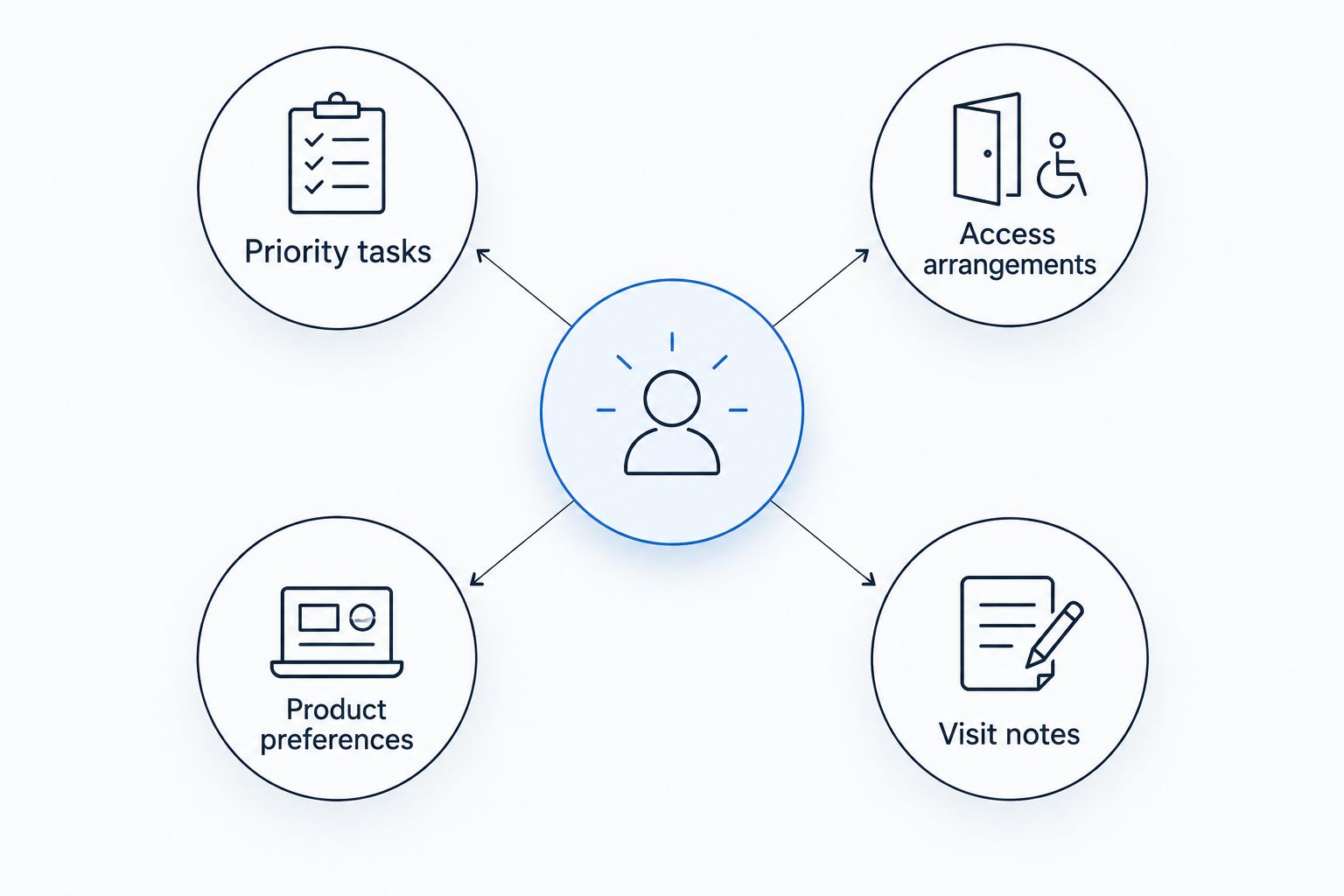
A short cleaning brief keeps practical instructions together without sharing unnecessary personal information.
5. Agree on a safe, manageable first visit
Arrange the first clean around the participant’s routine rather than treating the home as an empty worksite. Explain whether you need access to the bathroom, a quiet room or a clear route while cleaning takes place.
Product choice needs a separate conversation. A natural label does not guarantee that a product suits your skin, breathing or sensory preferences. The guide to cleaning products for sensitive skin is a starting point for questions, not a substitute for individual health advice or label instructions.
Never mix cleaning chemicals or ask a cleaner to improvise treatment for an unknown substance. Follow product instructions and leave specialist hazards outside the routine cleaning brief.
- Confirm which rooms will be cleaned first.
- Keep mobility aids and essential items accessible.
- Agree on ventilation and fragrance preferences.
- Explain how the cleaner should report damage or an unexpected hazard.
- Decide whether the participant wants a carer present.
6. Review the service against the agreed tasks
After the first visit, compare the completed work with the brief. Start with whether the priority tasks were finished and whether the participant could use the home as intended. Appearance alone is not the whole assessment.
For ongoing cleaning in 2026, keep changes in writing. Record new instructions, tasks removed from scope and any agreed adjustment to the arrangement. A short update is easier to follow than contradictory directions from several family members.
Keep 2 contact roles clear: the person who gives day-to-day cleaning instructions and the person who handles invoices. One person can hold both roles, but the provider needs to know who is authorised for each.
- Check completed work against the agreed task list.
- Ask the participant what worked and what needs changing.
- Record concerns with a specific task or event.
- Confirm changes before the next visit.
- Check invoices against the services actually delivered.
Discuss your NDIS cleaning needs
Ask about cleaning across Sydney, Shoalhaven and Illawarra and explain your household requirements.
Compare cleaning arrangements for your household
Choose the arrangement that matches the work, not just the label on the service. The options below describe practical roles; they are not confirmation that a particular service is funded under your plan.
Participant-led cleaning with informal help
- Best for: Tasks you choose to manage with family or friends
- Main advantage: Direct control over timing and methods
- Key limitation: Depends on the participant’s capacity and the helper’s availability; do not assume family assistance is claimable
Professional domestic cleaning service
- Best for: Agreed household cleaning tasks
- Main advantage: A separate brief focused on cleaning
- Key limitation: Does not replace personal care or specialist work; provider eligibility still needs checking
Support worker assistance
- Best for: Household tasks within an agreed disability-support role
- Main advantage: Can support participation in everyday tasks
- Key limitation: Cleaning scope depends on the worker’s role, skills and service agreement
Specialist cleaning or remediation
- Best for: Work outside routine domestic cleaning
- Main advantage: Addresses a separately defined problem
- Key limitation: Requires separate scoping; NDIS funding must not be assumed
A mixed arrangement also needs clear boundaries. If a support worker helps with laundry while a cleaner handles bathrooms, identify the handover points. Do not leave each worker expecting the other to complete the same task.
Common mistakes participants and carers make
Treating every cleaning task as NDIS-funded
A household task does not become eligible simply because an NDIS participant requests it. Check the disability-related need, plan arrangements and current funding rules before authorising the work. Keep private household work separate from any funded service.
Booking before checking provider requirements
An agency-managed participant needs the appropriate registered provider arrangement. Checking this after a visit creates an avoidable payment problem. Confirm the requirement and provider status before committing to the service.
Letting several people give conflicting instructions
A participant, family member and support worker can each have different preferences. Agree on who communicates routine instructions while keeping the participant’s choices central. Record authorised changes in the shared brief instead of passing them through several conversations.
Assuming cleaning includes decluttering or personal care
Moving possessions, washing dishes, changing linen and providing personal care are different tasks. Ask what the provider includes rather than relying on a general description such as a full house clean. Never add personal care to an ordinary cleaning visit without the right support arrangement.
Sharing more personal information than the cleaner needs
A cleaner needs relevant instructions, not unrestricted access to health records or plan documents. Explain the practical requirement, such as avoiding a fragrance or leaving an aid within reach. Get consent before sharing information with carers or other contacts.
FAQ
Can NDIS funding pay for a cleaner at home?
NDIS funding can pay for eligible household cleaning assistance linked to disability-related needs. The support must meet NDIS funding rules and fit your plan; having an NDIS plan does not make every cleaning expense eligible.
Do I need a registered NDIS cleaning provider?
You must use a registered provider for agency-managed cleaning supports. Self-managed and plan-managed participants can generally use registered or unregistered household cleaning providers, subject to applicable requirements.
Can my carer organise cleaning for me?
A carer can help organise cleaning with your agreement or appropriate authority. Make your preferences, privacy choices and the carer’s role clear before the provider shares information or accepts changes.
What should I ask an NDIS cleaner to do?
Ask for specific household tasks that match your support needs and the agreed service scope. List priorities such as bathroom cleaning or vacuuming, and separately confirm laundry, linen changes and other requested work.
Does NDIS cleaning include personal care?
Ordinary domestic cleaning does not include personal care. Assistance with showering, medication or transfers needs a separate, appropriate support arrangement rather than an addition to a cleaning checklist.
Can Housekept help participants outside Sydney?
Housekept provides NDIS cleaning across Sydney, Shoalhaven and Illawarra. Confirm coverage for your address and whether the proposed service meets your plan management requirements before booking.
What should I check before booking NDIS cleaning in 2026?
Check your disability-related cleaning needs, available funding, plan management type and provider requirements before booking in 2026. Then agree on tasks, access instructions, product preferences and invoice handling in writing.
One last thing
A cleaner home is not a better outcome if essential belongings become harder to find. Put a do-not-move instruction beside mobility aids, communication devices and other items whose position matters to you.
Include those instructions in your 2026 cleaning brief. The participant’s ability to use their home matters more than arranging every surface to someone else’s preference.