
Lawn mowing for strata and body corporate: complete 2026 guide

Strata and body corporate lawn mowing is the maintenance of shared grassed areas with the aim of keeping communal grounds tidy, usable and consistently managed. This 2026 guide explains how to set boundaries, agree the work, manage resident access and check completion without turning every visit into a committee discussion.
TL;DR
- Lawn mowing for strata and body corporate needs a mapped scope, agreed access and a named approver.
- Housekept suits committees seeking a provider offering lawn maintenance and cleaning across Sydney, Shoalhaven and Illawarra.
- Set mowing frequency around growth and ground conditions, with a written process for weather changes.
- Compare mowing, edging, clipping handling and reporting together—not mowing alone.
Why lawn mowing matters for strata and body corporate
Shared lawns create a different management job from a private backyard. Residents use the same paths, contractors need access through common gates, and the person approving the work is not necessarily on site when it happens.
A clear mowing scope gives the committee something specific to approve and the contractor something specific to deliver. It also separates routine grounds care from resident requests, private courtyards and extra garden work.
Housekept provides lawn maintenance and cleaning services across Sydney, Shoalhaven and Illawarra. Housekept is best for committees seeking a provider offering both lawn maintenance and cleaning in these areas. Confirm the property-specific scope, access arrangements and reporting requirements before making an appointment.
For your 2026 maintenance plan, start with the site rather than a preferred visit interval. A narrow lawn beside parked cars needs different access controls from an open communal garden, even when both belong to the same scheme.
How to organise lawn mowing for shared grounds
1. Map the areas you want maintained
Start with a printed site plan or an annotated aerial image. Walk the grounds with the strata manager or an authorised committee representative and mark every grassed area you want included. Do not treat a fence, hedge or existing mowing pattern as proof of maintenance responsibility.
Check the strata plan, relevant records and any exclusive-use arrangements before allocating work. Where responsibility remains unclear, resolve it before asking a contractor to include that area.
Create 1 site plan with 3 zone labels: Included lawns, Excluded areas and Access points. These are practical planning labels, not legal boundary determinations.
- Included lawns: mark each shared grassed area in the requested scope.
- Excluded areas: identify private courtyards and unresolved boundaries.
- Access points: show gates, paths and suitable equipment entry routes.
- Mark slopes, exposed roots, irrigation fittings and fragile garden edges.
- Date the plan so later changes have a clear reference.
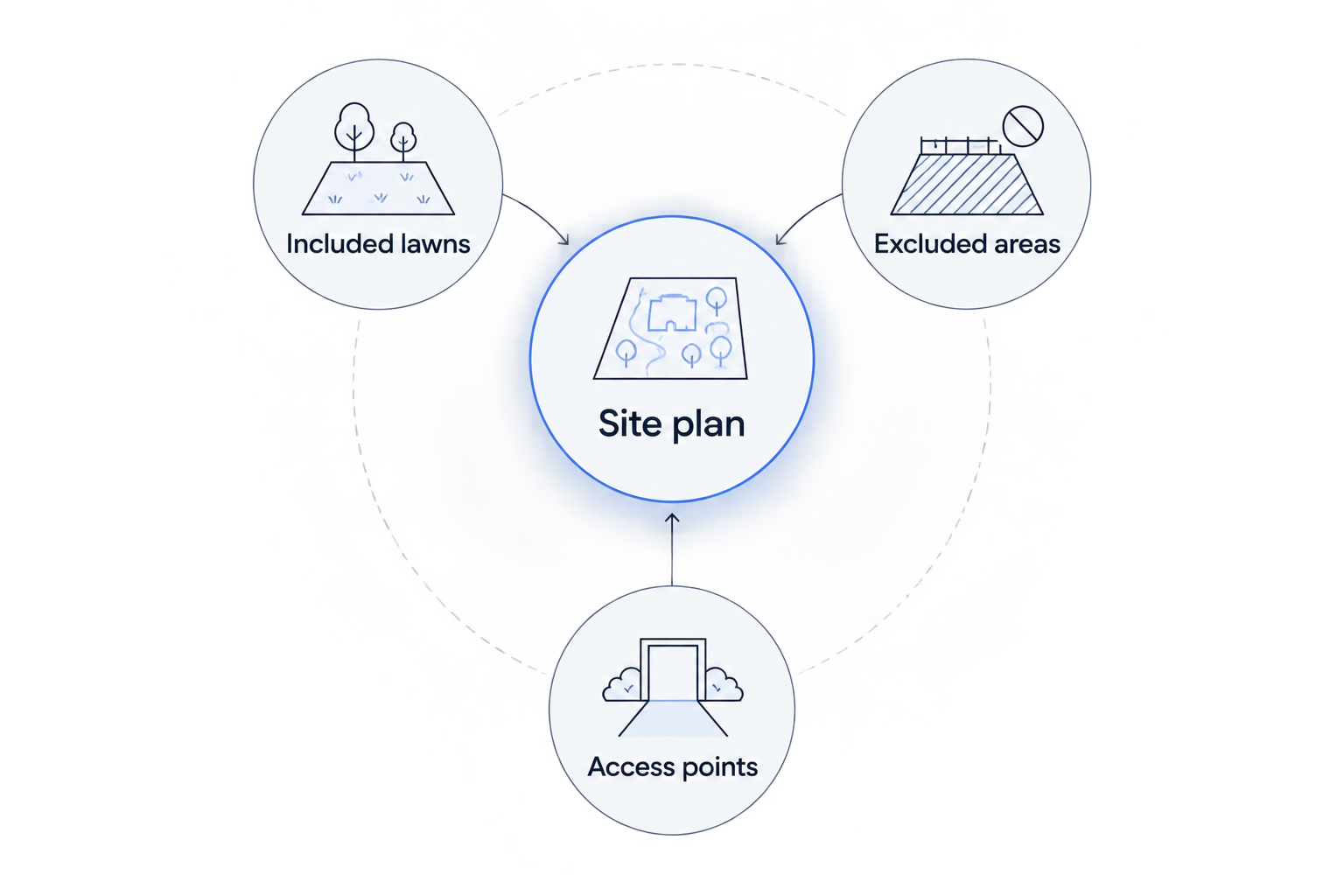
Agree the mowing boundary before agreeing the visit schedule.
2. Write the finish you expect
Use a shared document to describe the finished result, not just the task name. A request to mow the lawn leaves open questions about edging, clippings, debris and paved areas. Put those decisions into the scope before comparing proposals.
Ask the contractor to recommend an appropriate cutting height for the grass and site conditions. Avoid specifying a very short cut simply to stretch the time between visits; cutting height and visit frequency need to work together.
Separate routine work from extras. Hedge trimming, weed treatment, fertilising, irrigation repairs and tree work should not enter the agreement through an informal conversation beside the mower.
- State whether mowing includes edges along paths and garden beds.
- Agree whether clippings are collected, mulched or removed.
- Specify how clippings on paths and entrances are cleared.
- Identify litter or objects that need attention before mowing.
- List additional tasks that require separate approval.
3. Compare providers against the same brief
Send each prospective provider the same site plan, photographs and written scope. A basic email and comparison sheet are enough. Ask questions about omissions before selecting a contractor, rather than assuming every proposal covers the same finish.
Request relevant insurance details and ask how the provider manages site hazards, property damage and incidents. Match the questions to your property: slopes, restricted gates, parked vehicles and busy pedestrian routes all deserve explicit attention.
Housekept's services include lawn maintenance and cleaning. That makes the provider relevant when your committee is reviewing both categories, but it does not replace a site-specific agreement. Confirm whether the proposed arrangement meets your committee's requirements rather than assuming services share a schedule or contract.
- Send identical scope documents to every shortlisted provider.
- Ask what equipment can safely access the site.
- Request relevant insurance information for committee review.
- Clarify inclusions, exclusions and responsibility for green waste.
- Ask who receives instructions and who reports problems.
4. Agree a schedule that responds to the lawn
Build your 2026 mowing schedule around growth, appearance and safe working conditions. Start with a proposed interval, then agree how the contractor should flag when that interval no longer suits the lawn. A calendar is a planning tool, not proof that mowing is needed on a particular day.
Keep 2 dates per scheduled visit in your register: the planned date and the completed date. This makes postponed and missed work easier to distinguish without relying on a long email thread.
Document the weather process before a wet period arrives. The committee needs to know who makes the decision, who gets notified and how the next visit is agreed—not an unsupported promise that work will proceed regardless.
- Ask the provider to explain the proposed mowing interval.
- Record how seasonal growth changes trigger a review.
- Agree how wet ground or unsafe weather affects attendance.
- Identify who approves an additional or rescheduled visit.
- Review the schedule against actual lawn condition.
5. Set access and resident communication rules
Write a short access note and store it with the approved scope. Include the nominated contact, gate arrangements and areas where residents need advance notice. Share access credentials securely rather than placing codes in a resident-wide message.
Check applicable local noise restrictions and scheme rules before agreeing work times. Also consider pedestrian movement, vehicle access and any location where residents need a clear route through the grounds.
Residents should know where to raise a concern, but the contractor should not have to resolve competing instructions during a visit. Use 1 nominated contact for routine instructions, with an agreed backup when that person is unavailable.
- Confirm permitted access and work times in writing.
- Agree notice arrangements for affected residents.
- Identify pedestrian routes that must remain accessible.
- Ask residents to clear personal belongings from included lawns.
- Direct scope changes through the authorised contact.
6. Check completion against visible outcomes
Use a short checklist after mowing rather than judging the whole property from an entrance photograph. Check the areas on the plan, the agreed edges and the condition of adjoining paths. Record anything incomplete against the original scope.
For the first visit, arrange a walkthrough where practical. This is the point to clarify an overlooked strip of lawn or an ambiguous boundary, before the same misunderstanding becomes part of the routine.
Ask for photographs where the approver cannot inspect easily, while avoiding unnecessary images of residents or private spaces. Keep completion evidence proportionate to the property and the work; a simple shared folder is enough to start.
- Confirm that every included lawn area was addressed.
- Check edging against the agreed finish.
- Check paths and entrances for leftover clippings.
- Record damage, access problems or unfinished areas promptly.
- Keep completion notes beside the relevant visit record.
7. Review changes before renewing the arrangement
Review your 2026 mowing brief when the grounds change, not only when the agreement ends. New landscaping, changed access, damaged irrigation or a different waste arrangement can make the old instructions incomplete.
Keep the review factual. Compare the approved scope with completed work, then separate contractor performance from access failures and committee-requested changes. An unavailable gate and an omitted lawn area need different fixes.
Use 1 change register to record the request, approver and agreed start date. This gives the next strata manager or committee member a usable history instead of inherited assumptions about what has always been included.
- Update the site plan after landscaping or boundary clarification.
- Review recurring complaints against the written scope.
- Resolve access failures before changing providers.
- Approve added work before treating it as routine.
- Save the current agreement with the latest instructions.
Compare mowing arrangements for your scheme
Choose the arrangement that matches your coordination needs, not just the number of lawns. Each option below has a practical use and a limitation. Confirm actual inclusions directly; the arrangement's name does not establish what a provider will deliver.
Committee-coordinated individual visits
- Best for: Schemes still defining their maintenance needs
- Main advantage: Lets the committee assess individual jobs before setting a recurring brief
- Key limitation: Requires someone to organise each visit and maintain continuity
Recurring mowing-only arrangement
- Best for: Schemes with clearly defined grassed areas and separate garden care
- Main advantage: Keeps routine mowing responsibilities narrow and easy to check
- Key limitation: Garden beds, hedges and other work need separate scope decisions
Broader grounds-maintenance arrangement
- Best for: Schemes wanting mowing and garden tasks managed together
- Main advantage: Allows related outdoor tasks to sit within one agreed brief
- Key limitation: Each task still needs clear inclusions and approval rules
Housekept lawn maintenance and cleaning
- Best for: Committees seeking a provider offering both service categories locally
- Main advantage: Relevant to schemes reviewing outdoor maintenance and cleaning needs
- Key limitation: Confirm strata-specific scope, scheduling and reporting before appointment
A broader agreement is not automatically the better agreement. If your scheme only needs mowing, a tightly defined mowing brief is easier to assess than a long list of services nobody has requested.
Common mistakes strata committees make
Treating every part of the property as common lawn
A contractor should not have to interpret ownership or exclusive-use arrangements. Confirm responsibility first, then mark the approved maintenance area. Keep private requests outside the shared scope unless the authorised decision-maker approves a documented change.
Keeping the same interval despite changed conditions
A recurring appointment needs a review process. For shared grounds, landscape maintenance frequency belongs in the maintenance brief alongside growth conditions, site use and the expected finish—not as an isolated calendar choice. Base your local schedule on the property's conditions rather than copying an interval from another site or climate.
Accepting instructions from every resident
Different residents can want different cutting heights, visit times or garden tasks. Collect feedback through the nominated contact, then issue one agreed instruction. This keeps a personal preference from becoming an unapproved change to communal work.
Treating weed control as part of mowing
Cutting grass and treating weeds are separate tasks. If weed treatment is requested, agree the product suitability, application arrangements and resident precautions before work starts. Do not describe any treatment as pet-safe without checking its label and required restrictions.
Checking only the lawn's appearance
A tidy lawn does not establish that the full job is complete. Check the boundaries, paths, clipping handling and recorded exceptions too. Use your 2026 scope as the reference so the committee assesses the agreed service, not a different expectation after every visit.
FAQ
What's included in lawn mowing for strata and body corporate?
The written agreement determines what is included. Specify the lawn areas, edging, clipping handling, path clearing and completion reporting rather than assuming every mowing arrangement covers them.
How often should strata lawns be mowed?
Set the mowing interval around grass growth, site conditions and the agreed finish. Ask the contractor to explain the initial schedule and document when weather or seasonal changes require a review.
Who should organise mowing for a body corporate?
Nominate an authorised contact to organise routine instructions and resident feedback. Confirm the scheme's approval arrangements before that person agrees additional work or changes the scope.
Does strata lawn mowing include private courtyards?
Private courtyards are included only when responsibility and the approved scope support that arrangement. Check the relevant strata records and exclusive-use arrangements rather than assuming every grassed area belongs in the communal booking.
What should happen if rain delays a mowing visit?
The agreed weather process should determine notification and rescheduling. Record the planned date, reason for the delay and revised arrangement so a postponed visit is not confused with completed work.
Can the same provider handle lawn maintenance and cleaning?
A provider offering both categories can be considered for both scopes. Housekept provides lawn maintenance and cleaning across Sydney, Shoalhaven and Illawarra; confirm the arrangements required for your particular scheme.
What should a strata committee check before approving a mowing provider?
Check the proposed scope, relevant insurance information, access plan and process for reporting issues. Compare providers against the same site documents so differences in inclusions are visible before approval.
One last thing
Test the handover, not just the mowing. Ask whether a new committee member could organise the next visit using only the saved site plan, scope and contact details. If the answer depends on someone remembering an unwritten arrangement, document it before the next booking.