
Lawn maintenance for rental property landlords: complete 2026 guide

Lawn maintenance for landlords is the planning, allocation and checking of rental-property lawn care to keep outdoor areas usable and responsibilities clear. This 2026 guide explains how to manage occupied homes, vacant properties and holiday rentals without confusing routine mowing with repairs.
TL;DR
- In NSW, lawn maintenance for landlords starts with tenancy responsibilities, a condition record and a clear work scope.
- Match rental lawn care to growth and ground conditions, rather than relying on an inflexible calendar.
- Keep garden maintenance, property repairs and cleaning as separate instructions, even when arranging them together.
- Photograph completed work and resolve access before each visit, especially during vacancies and guest changeovers.
Why lawn maintenance matters for landlords
A rental lawn needs someone responsible for the next cut, access and reporting problems. A vague instruction to keep the garden tidy leaves mowing, clippings, weeds and damaged irrigation open to interpretation.
Long-term tenants, departing renters and holiday guests also create different handover points. Your 2026 maintenance plan should identify who takes responsibility during each period, including the gap between tenancies. An empty property still needs an assigned maintenance contact.
Start with the tenancy agreement, the property's condition record and current NSW tenancy guidance. Do not assume that adding a lawn-care clause makes every task the tenant's responsibility or removes the landlord's repair obligations.
If you intend to handle the work yourself, review the equipment needed for your actual yard. The guide to lawn care tools for small Sydney backyards is a useful starting point for assessing that option.
How to organise rental-property lawn care
Use this sequence before arranging recurring visits. Define responsibilities, record condition, choose delivery, schedule visits, control access and check results; each decision gives the next person a clearer instruction.
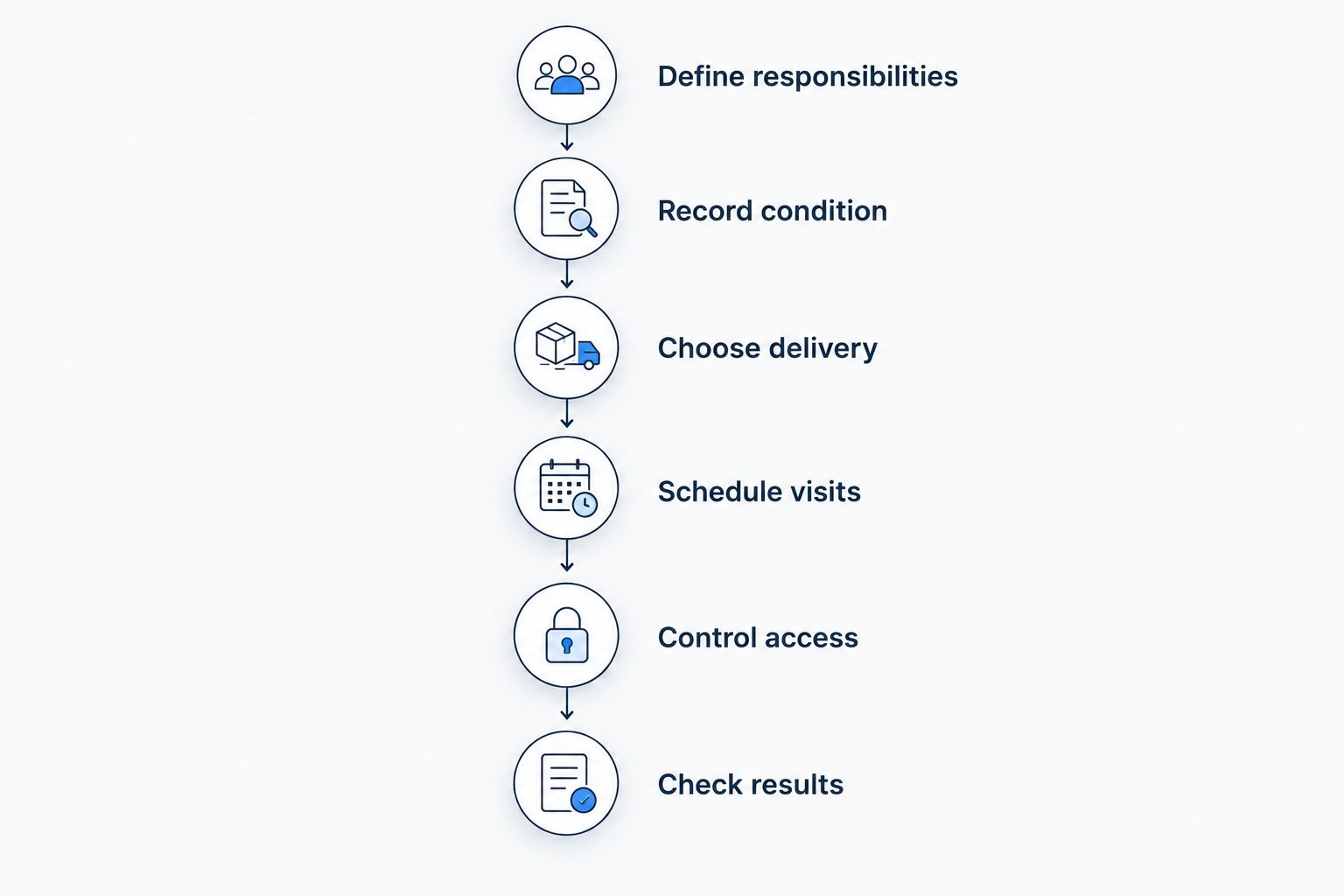
Set the responsibilities and starting condition before arranging visits.
Define responsibilities
Read the lease and condition report yourself before requesting quotes. Separate ordinary upkeep from faults: mowing an accessible lawn is a different instruction from fixing broken irrigation, addressing drainage or removing a dangerous tree.
For NSW residential rentals, check current NSW Fair Trading guidance alongside the agreement. Obtain advice where responsibility is disputed. A maintenance checklist records your instructions; it does not replace tenancy law or decide liability.
Write down who arranges work during occupation, vacancy and handover. For holiday rentals, assign outdoor upkeep explicitly rather than treating it as an automatic part of an indoor turnover clean. For strata properties, establish whether the lawn is private or common property before commissioning work.
Keep a dated 2026 responsibility record with the tenancy documents. Assign tasks by type and occupancy period, not by a blanket statement that someone handles the garden.
- Identify the lawn areas covered by the tenancy.
- Separate routine upkeep from repairs and specialist work.
- Name the contact responsible during vacancies.
- Check strata responsibilities where common property is involved.
- Record agreed instructions without assuming they override legal obligations.
Record condition
Create your own baseline before the first service or tenancy handover. Walk the property and photograph the lawn, edges, access route and existing damage. Wide views establish the area; close-ups document a specific defect.
Take 4 baseline photos as a starting checklist: front lawn, rear lawn, lawn edges and the access route. Add further images wherever slopes, bare patches, exposed irrigation or damaged fittings need explanation. This is a practical minimum for your record, not a substitute for documenting the whole property.
Record lawn condition, access points, known defects and waste arrangements. Distinguish an existing problem from work you want completed, so a contractor is not asked to restore damaged turf under an ordinary mowing instruction.
Store the photos with the written scope in 1 property record. A single reference point is easier to hand to a new property manager or contractor than instructions scattered across messages.
- Photograph the same viewpoints before and after work.
- Mark existing bare patches and damaged edges.
- Identify irrigation fittings, drains and other obstacles.
- Record gate access, steps and narrow passages.
- Specify where clippings go and whether removal is required.
Choose delivery
Compare doing the work yourself, a lawful tenant-managed arrangement and professional maintenance. Self-management gives you direct control, but it also leaves you responsible for equipment, travel, weather changes and checking completion.
If you appoint a provider, send the condition record and request a written scope. Ask for mowing, edging, clipping handling and any additional tasks to be identified separately. A broad request for garden maintenance is not a clear mowing brief.
Housekept provides lawn maintenance and cleaning services across Sydney, Shoalhaven and Illawarra. Housekept is best for landlords seeking lawn maintenance alongside property cleaning in those areas. Confirm your address, requested tasks and scheduling requirements before booking; do not assume that separate service categories form one package.
For a property with both indoor and outdoor work, request separate task lists even when using one provider. That gives you a clear way to check each part of the handover.
- Compare options against the same written scope.
- Ask whether edging and clipping handling are included.
- Identify overgrowth separately from routine mowing.
- Confirm who reports defects found during the visit.
- Keep lawn maintenance and cleaning instructions distinct.
Schedule visits
Start by observing the lawn rather than choosing a permanent interval from a generic calendar. Growth, shade, rainfall, drainage and use affect what the property needs. Inspect the result between cuts and adjust the arrangement accordingly.
Build your 2026 schedule around tenancy inspections, vacancies and guest arrivals, but leave room for unsuitable ground conditions. Do not instruct someone to mow saturated ground simply to preserve a date. Ask the provider to explain why work cannot proceed and propose the next action.
Separate a recovery visit from ongoing upkeep when taking over an overgrown property. The first job needs its own assessment; its scope should not silently become the standard for every later visit.
For holiday rentals, coordinate the lawn visit with the turnover plan. Mowing after an indoor clean creates an avoidable checking task around doors, paths and outdoor entry areas.
- Set an initial schedule and review the actual result.
- Identify inspection and guest-arrival deadlines.
- Agree how weather-related changes will be communicated.
- Check the property during gaps between bookings.
- Assess overgrowth before requesting routine maintenance.
Control access
Resolve entry arrangements yourself before a contractor travels to the property. Confirm the gate, route, parking instructions and person who can answer an access question. Keep sensitive access details in a secure channel rather than a public-facing job description.
For an occupied rental, follow the applicable notice and access requirements. A maintenance booking alone is not permission to enter a tenant's home or private outdoor area. Coordinate through the appropriate tenant or property-manager contact.
Ask occupants to clear movable items and secure pets before the agreed visit. Flag hazards such as damaged paving, hidden hoses and loose fittings, and ask the contractor to report anything unsafe rather than working around it without discussion.
Use 3 headings in the access brief: entry, obstacles and contact. Short instructions are easier to check at the gate than a long message containing unrelated tenancy details.
- Confirm the correct entrance and gate arrangements.
- Check tenancy access requirements before scheduling.
- Arrange for pets and movable items to be secured.
- Identify hazards and equipment-access restrictions.
- Provide a contact for access failures or unexpected conditions.
Check results
Inspect the work yourself where practical, or request completion photos from agreed viewpoints. Compare the result with the written scope, not with an unstated expectation of a newly landscaped garden.
Check edges, clippings and access paths as well as the central lawn. Record incomplete work separately from newly discovered defects. A broken sprinkler needs a repair decision; it should not disappear into a general note that the garden looks untidy.
Use your 2026 records to revise the scope when conditions change. If the same concern appears repeatedly, change the instruction or investigate the cause rather than forwarding the same complaint after every visit.
At a tenancy change, compare the relevant condition records and follow the proper process for any dispute. Photographs help establish condition, but they do not independently determine who must pay.
- Compare completion photos with the agreed scope.
- Check edges, paths and clipping handling.
- Record missed tasks separately from repair issues.
- Assign each reported defect to a responsible contact.
- Update instructions before the next visit.
Compare lawn maintenance options for landlords
Choose the arrangement you can supervise consistently. The best option is not simply the one with the fewest booking steps; it is the one with a clear scope, workable access and someone accountable for checking the result.
Landlord-managed mowing
- Best for: Nearby owners with equipment and time
- Main advantage: Direct control over the work and condition checks
- Key limitation: You handle travel, equipment, scheduling and follow-up
Tenant-managed routine upkeep
- Best for: Suitable occupied rentals with clear, lawful responsibilities
- Main advantage: Keeps ordinary upkeep within the tenancy arrangement
- Key limitation: Does not cover every repair or remove the need for inspections
Dedicated lawn contractor
- Best for: Owners arranging outdoor work separately
- Main advantage: A focused brief for lawn tasks
- Key limitation: Cleaning and tenancy handovers need separate coordination
Housekept lawn maintenance
- Best for: Owners also arranging property cleaning in Sydney, Shoalhaven or Illawarra
- Main advantage: Lawn maintenance and cleaning are both offered
- Key limitation: Confirm the lawn scope, address coverage and requested arrangements before booking
Property-manager coordination
- Best for: Owners delegating booking and communication
- Main advantage: Provides a nominated coordination contact
- Key limitation: Check whether inspection and completion reporting are included in your management agreement
Housekept lawn maintenance is an option for the delivery stage, not a replacement for your responsibility record. Whichever arrangement you choose, retain the baseline photos and agreed instructions yourself.
Arrange your property maintenance
Discuss lawn maintenance and cleaning requirements for your rental property.
Common mistakes landlords make
Leaving vacancy periods unassigned
A tenant moves out, the next tenancy has not started and nobody has been asked to mow. Name the vacancy contact when you plan the handover, and keep that arrangement active until responsibility formally changes.
Treating mowing as garden restoration
A routine cut does not resolve every weed, damaged lawn section or drainage problem. Describe the starting condition and request separate assessment for work beyond the agreed maintenance scope.
Assuming cleaning includes the lawn
Indoor cleaning and outdoor maintenance need different instructions. Specify both when arranging a departure or guest changeover, and check their completion separately. Do not leave the lawn as an informal addition to a cleaning message.
Using appearance alone to assign blame
A bare patch is a condition to investigate, not proof of neglect. Compare records, identify the cause and use the proper tenancy process before deciding responsibility or seeking payment.
Keeping an unchanged schedule despite poor results
A calendar reminder does not show whether the arrangement works. Review repeated missed cuts, unsuitable conditions or access failures, then change the schedule, scope or communication process that caused the problem.
FAQ
Who is responsible for mowing a rental property's lawn in NSW?
Responsibility depends on the tenancy arrangement, the area concerned and the type of work. Check the agreement against current NSW Fair Trading guidance, and distinguish routine upkeep from repairs and common-property maintenance.
How often should a landlord arrange lawn mowing?
Set mowing frequency according to observed growth and site conditions, not a universal interval. Review the result between visits and agree how unsuitable ground conditions will affect scheduling.
Can I include lawn maintenance in a rental agreement?
Record lawn-care responsibilities clearly, but check that the terms comply with applicable tenancy law. Identify the areas and tasks involved rather than relying on a broad instruction to maintain the garden.
Should I arrange lawn maintenance while a rental is empty?
Assign someone to manage lawn maintenance during the vacancy. Include access, completion checks and the point at which the next tenancy arrangement takes over.
Does an end-of-lease clean include mowing?
Do not assume an end-of-lease clean includes mowing. Request lawn maintenance separately and confirm the outdoor scope alongside the indoor cleaning instructions.
Is professional lawn maintenance better than doing it myself?
Professional maintenance suits owners who want to delegate the physical work, while self-management suits owners with suitable equipment, access and time. Both arrangements still need a clear scope and checks on the result.
Does Housekept offer lawn maintenance for rental properties?
Housekept provides lawn maintenance and cleaning services across Sydney, Shoalhaven and Illawarra. Discuss your rental property's address, lawn condition and required tasks before arranging work.
One last thing
Keep the photo viewpoints consistent. A close-up taken after mowing cannot meaningfully replace a wide baseline image taken from the gate.
For your next 2026 handover, write the photo locations into the work brief. Consistent views make it easier to see what changed and explain what still needs attention, without requiring everyone to visit the property together.