
House cleaning for busy professionals and families: complete 2026 guide

Busy professionals’ house cleaning is planned home care with the aim of keeping essential rooms usable without sacrificing work or family time. This 2026 guide to house cleaning for busy professionals and families shows you how to divide tasks, choose outside help and keep a practical routine when meetings, school runs and household needs compete.
TL;DR
- Housekept suits households seeking professional home cleaning in Sydney, Shoalhaven and Illawarra.
- House cleaning for busy professionals works best when routine chores and occasional jobs have separate lists.
- Choose a cleaning schedule around household use, not an assumed standard frequency.
- Agree on rooms, tasks, access and exclusions before booking professional cleaners.
Why house cleaning matters for busy professionals and families
The challenge is not simply finding time to mop. You also need to notice what needs doing, find suitable supplies and decide which job matters when everything looks urgent. A workable routine removes those repeated decisions.
Families add another constraint: the home stays in use while you clean it. A kitchen reset competes with the next meal, toys return to cleared floors, and a home office can be occupied during a proposed visit. Plan around how your household uses each room, not how a display home looks.
Keep your equipment straightforward. If dusting and surface wiping involve searching several cupboards, start by reviewing your setup against this guide to microfibre cloths and dusters. Choose materials suitable for your surfaces rather than collecting a different product for every task.
For your 2026 routine, define success in household terms: a usable kitchen, a bathroom you are comfortable sharing and floors clear enough to clean. An overflowing laundry basket does not automatically make those priorities wrong.
Build a cleaning routine that survives a busy week
Start with a written plan before buying equipment or arranging help. The sequence is simple: set priorities, divide responsibilities, choose support, agree on the scope, prepare access and review the result. Each decision gives the next one a clear purpose.
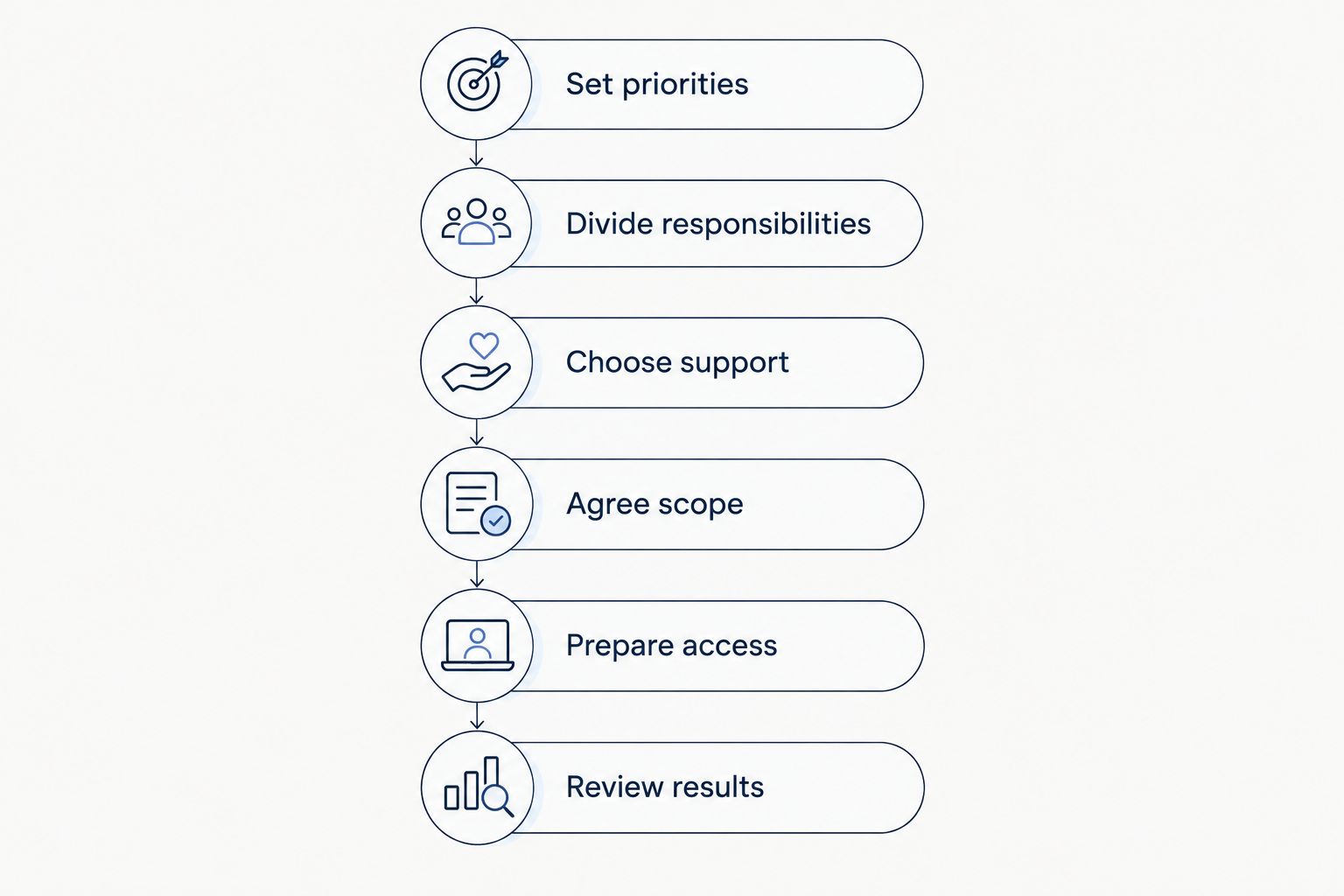
Define the work before choosing who will do it.
1. Set priorities around the rooms you use
Walk through your home and write down the work that makes daily life easier. Separate cleaning from tidying: removing clutter creates access, while wiping, vacuuming and mopping address the exposed surfaces. Combining both into an undefined instruction such as “sort out the house” makes the job difficult to assign.
Use a short list for each room. In the kitchen, that might mean benches, the sink and accessible floors; in a bedroom, it might mean dusting reachable surfaces and vacuuming. Internal cupboards, oven interiors and windows belong on a separate list until you decide who will handle them.
Choose a usable baseline before adding presentation tasks. A family preparing dinner needs a clear bench more urgently than a reorganised display shelf.
- Set priorities: identify the rooms your household uses most.
- Separate clutter removal from surface cleaning.
- Record occasional jobs outside the routine list.
- Mark delicate surfaces and follow their care instructions.
- Leave low-priority presentation tasks until essential work is covered.
2. Divide responsibilities and test a realistic schedule
Try the manual approach first: put tasks in a shared calendar or on a visible household list. Assign an owner rather than leaving jobs to whoever notices them. For children, choose age-appropriate tidying tasks and keep cleaning chemicals under adult control.
Treat timing as a trial, not a standard your household must meet. A suggested 10-minute evening reset can cover putting items away and clearing the kitchen sink; it is not a promise that every kitchen takes that long. Stop when the planned window ends and adjust the task list if it repeatedly overflows.
For a 2026 schedule, compare a 7-day cleaning interval with a 14-day interval according to what happens in your home. These are planning choices, not claims about the right frequency for every household.
- Divide responsibilities: give each recurring task a named owner.
- Put cleaning windows beside work and school commitments.
- Test a short evening reset before adding more chores.
- Record unfinished tasks instead of silently extending the session.
- Adjust the schedule when household use changes.
3. Choose support for the work you cannot sustain
A household checklist costs no extra effort to share, but someone still has to do the work. When recurring cleaning keeps displacing rest, paid work or family commitments, compare professional help against the tasks you actually want to hand over. Do not start with the broadest service description.
Housekept is best for households seeking professional home cleaning in Sydney, Shoalhaven and Illawarra. Housekept provides residential cleaning alongside other service categories; ask about the home-cleaning scope that matches your property rather than assuming another category includes the same work.
Professional cleaning hands over agreed tasks, but it still requires decisions about access, priorities and timing. Housekept home cleaning is a relevant option for local households; the specific inclusions, arrangements and suitability need agreement before you book.
- Choose support: identify the recurring work you want to delegate.
- Describe the property and rooms needing attention.
- Distinguish routine home cleaning from a tenancy handover.
- Ask whether your preferred tasks fit the proposed service.
- Confirm local coverage for your address.
4. Agree scope before confirming the arrangement
Write a room-by-room brief yourself, then ask the cleaner to confirm it. A shared note is enough. The purpose is to replace vague expectations with work both sides understand, not to produce a lengthy household manual.
Use direct task descriptions: “wipe accessible kitchen benches” is clearer than “make the kitchen spotless”. Identify whether moving items, washing dishes, changing linen or cleaning inside appliances forms part of the arrangement. Those tasks should never be assumed from the phrase “house cleaning”.
Your 2026 cleaning brief should also explain what happens when the whole list cannot be completed. Agree on priority order beforehand so the essential rooms do not lose out to an optional detail.
- Agree scope: list rooms and specific tasks in priority order.
- Ask which requested jobs are excluded or separately arranged.
- Confirm responsibility for equipment and cleaning products.
- Explain surface-care requirements and household sensitivities.
- Agree how to report missed work or request a scope change.
5. Prepare access without cleaning before the cleaner
The manual preparation step is clearing access, not repeating the work you are paying someone to do. Put paperwork away, lift loose items from floors and make the surfaces on the task list reachable. Keep personal valuables and private documents out of the working area.
For working households, access planning matters as much as the checklist. Decide what happens if a meeting runs late, a child is home unexpectedly or a pet needs a separate space. Discuss keys, entry instructions and any alarm procedure directly with the provider; do not assume an arrangement exists.
Prepare the work area, not a spotless house. If you want help with tidying as well as cleaning, include that request in the scope instead of expecting it to happen automatically.
- Prepare access: clear the agreed floors and surfaces.
- Secure private documents, valuables and household chemicals.
- Agree an entry method and a contact for access problems.
- Arrange pets and children around the working areas.
- Identify occupied rooms before the visit starts.
6. Review results against the agreed tasks
Check the finished work against your brief rather than an overall feeling that the home should look different. Look at the surfaces and rooms included in the arrangement. Unsorted paperwork is not a missed cleaning task if sorting paperwork was never included.
Keep feedback specific. Name the room, the agreed task and what needs attention; avoid expanding the brief after the work is finished. If the original list no longer fits your household, change the next arrangement instead.
Review your 2026 routine when work patterns, school schedules or household needs change. A useful plan is one you can maintain, not one that requires a spare weekend every time life gets busy.
- Review results: compare completed work with the written brief.
- Separate missed tasks from newly requested work.
- Report concerns through the agreed contact method.
- Adjust priorities before changing the whole service.
- Retain a current checklist for the next visit.
Compare cleaning options for your household
The best option is the one that assigns both the work and the responsibility clearly. Doing everything yourself gives you direct control, while professional support transfers agreed cleaning tasks. A mixed arrangement keeps everyday resets with the household and assigns a defined cleaning list to outside help.
No option removes every household chore. Compare the remaining work as carefully as the work being handed over, especially if laundry, dishes and toy storage are the main sources of daily pressure.
Household-only routine
- Best for: Households able to protect cleaning time
- Main advantage: Direct control over methods and timing
- Key limitation: All cleaning and coordination remain with the household
Professional home cleaning through Housekept
- Best for: Households seeking home cleaning in Sydney, Shoalhaven or Illawarra
- Main advantage: Access to a provider offering residential cleaning in these areas
- Key limitation: Inclusions, timing and property suitability need confirmation
Mixed household and professional routine
- Best for: Families wanting to delegate defined cleaning tasks
- Main advantage: Separates daily resets from agreed cleaning work
- Key limitation: Responsibility gaps remain unless tasks are assigned clearly
Use the comparison to make a decision, not to build a longer shopping list. If the manual routine works, keep it. If the same essential tasks remain unfinished, identify those tasks before arranging help.
Plan your home cleaning
Discuss your household’s cleaning needs in Sydney, Shoalhaven or Illawarra.
Common mistakes busy professionals and families make
Booking before defining the problem
A general request for help does not explain whether you need floors cleaned, clutter sorted or an oven interior addressed. Write down the unfinished work first, then match the service to that list. Otherwise, the household can still feel behind after the agreed cleaning is completed.
Treating every room as equally urgent
A spare bedroom and a heavily used kitchen do not need identical priority. Tell the cleaner which rooms matter most when time or scope is limited. Keep that order consistent with how your household actually lives.
Assuming professional cleaning includes household management
Laundry sorting, putting toys away and organising paperwork are separate responsibilities unless expressly included. Assign those jobs at home or discuss them before booking. Leaving the distinction unstated creates an expectation gap rather than a workable routine.
Choosing frequency without checking household use
A recurring booking is not automatically the right schedule. Look at what happens between visits, including floor debris, bathroom use and your own ability to reset rooms. Change the task mix or interval according to those observations, not a neighbour’s arrangement.
Ignoring the working-from-home timetable
A cleaner cannot work freely through a room occupied by a confidential call. Flag meetings, quiet periods and rooms that need a different sequence. Agree on the arrangement before the visit rather than improvising at the door.
FAQ
What’s the best house cleaning routine for busy professionals?
The best routine assigns essential tasks, owners and realistic cleaning windows. Separate daily tidying from surface cleaning, then delegate the recurring work your household cannot sustain.
How often should a busy family arrange house cleaning?
Choose the interval according to household use and the work you can manage between visits. Compare how the kitchen, bathrooms and floors hold up, then adjust the task list or schedule.
Do I need to clean before a professional cleaner arrives?
You need to prepare access to the agreed work areas, not repeat the cleaning. Clear loose items from floors and surfaces, and discuss tidying separately if you want it included.
Does Housekept offer home cleaning near me?
Housekept provides home cleaning across Sydney, Shoalhaven and Illawarra. Confirm coverage for your address and discuss the tasks you need before arranging a service.
Is professional cleaning better than doing it myself?
Professional cleaning is the better fit when you want to hand over agreed cleaning tasks; doing it yourself retains direct control. A mixed routine works when household members handle daily resets and outside help handles a defined cleaning list.
What should I ask before booking a house cleaner?
Ask which rooms and tasks are included, what is excluded and how access will work. Also confirm responsibility for products and equipment, surface-care requirements and the process for raising concerns.
Can I stay home and work during a cleaning visit?
Discuss working from home before the visit so occupied rooms and quiet periods are understood. Agree on room order and access rather than assuming cleaning can happen around every meeting.
One last thing
Count the cleaning decisions you repeat, not just the chores you finish. If every visit starts with a fresh explanation of rooms, products and priorities, the household is still carrying avoidable coordination work. Keep one current brief and change only what needs changing.
For the rest of 2026, use that brief as your reference point. It makes self-managed cleaning clearer and gives professional help a defined job to complete.