Commercial cleaning for small offices and clinics: complete 2026 guide
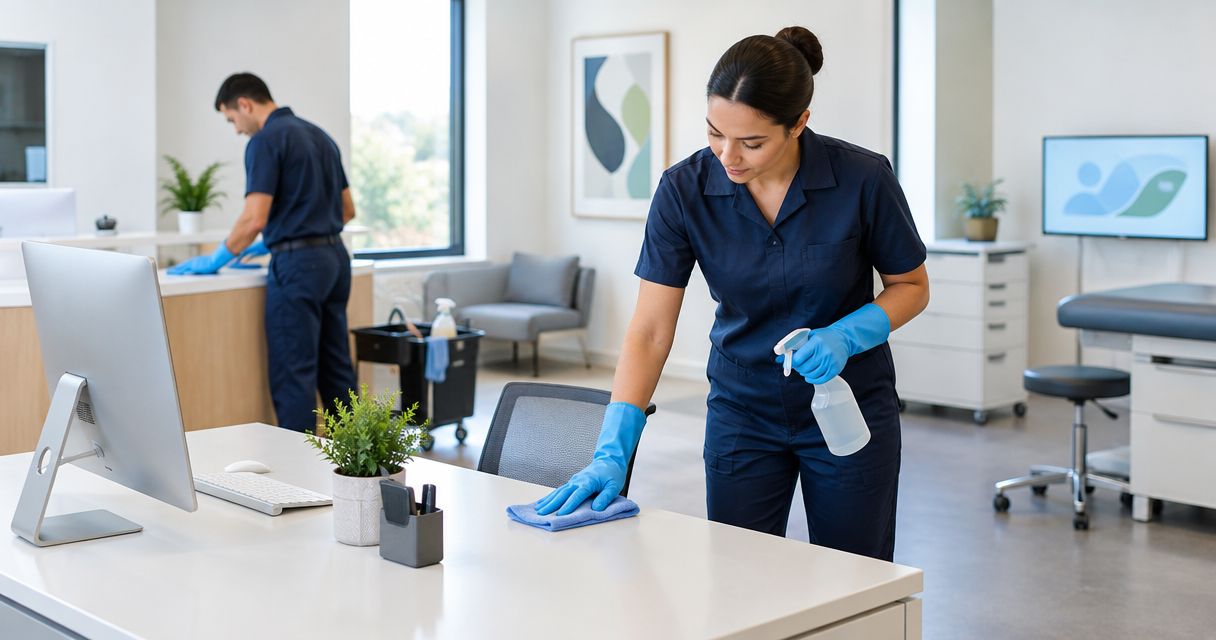
Small-office commercial cleaning is the planned cleaning of workplaces to keep shared spaces usable, presentable and hygienic. This 2026 guide covers commercial cleaning for small offices and clinics, where limited storage, shared facilities and patient-facing rooms need different cleaning instructions.
TL;DR
- Commercial cleaning for small offices starts with a room-by-room scope, not a vague request for a general clean.
- Housekept provides commercial cleaning across Sydney, Shoalhaven and Illawarra; clinic-specific tasks need separate confirmation.
- Separate routine office cleaning from clinical cleaning, instrument processing and clinical waste responsibilities.
- Compare cleaning options against identical tasks, access arrangements, exclusions and inspection standards.
Why commercial cleaning matters for small offices and clinics
A small workplace still has several distinct cleaning needs. Reception floors collect tracked-in dirt, kitchen benches collect food residue, and shared bathrooms need their own equipment and routine. Treating every room alike leaves gaps.
Clinics add a separate question: which tasks belong to routine premises cleaning, and which sit under the practice’s infection-prevention procedures? An office-cleaning agreement is not evidence that treatment-room cleaning or clinical waste handling is included. Your practice must define those responsibilities before work starts.
For your 2026 cleaning plan, start with the work your premises actually require. The guide to commercial cleaning supplies for small offices supports the equipment side; the steps below establish responsibility, scheduling and checks.
The aim is straightforward: stop relying on whoever notices the mess first. Give each task an owner, a suitable method and a clear completion standard.
How to organise your workplace cleaning
1. Map your rooms and responsibilities
Start manually with a floor plan or a simple spreadsheet. Walk through the premises and list what gets cleaned, who uses it and who owns the task. Spend 10 minutes on this first pass, then review the list with the people who use each room.
Separate a clinic’s reception and staff kitchen from its treatment areas. Do not put instrument processing, sharps handling or bodily-fluid spill response into a general cleaning checklist without an approved procedure and an appropriately assigned person.
For a small office, unclear ownership often appears around shared desks, meeting rooms and dishes. A cleaner cannot reliably clean a surface that remains covered with paperwork or equipment.
- List reception, work areas, kitchen, bathrooms and storage separately.
- Mark shared facilities managed by the landlord or building manager.
- Assign desk clearing and personal dishes to named workplace roles.
- Identify clinic tasks governed by practice procedures.
- Record any rooms or equipment excluded from routine cleaning.
2. Write a scope that someone can check
A written scope turns an expectation into an instruction. Instead of asking for a clean kitchen, specify the accessible benchtops, sink, splashback, cupboard fronts and floor. State whether appliance interiors are included rather than assuming they are.
Use 5 fields for each task: room, surface, method, frequency and owner. Add a completion standard in plain language, such as no visible crumbs on accessible kitchen benches. That is easier to inspect than a broad promise of excellent presentation.
Keep your 2026 scope editable. A room conversion, additional staff or a changed patient schedule should trigger a review rather than leave the original instructions untouched.
- Record the room and the surfaces included.
- Describe the method and any product restrictions.
- Set the frequency around actual use and soiling.
- Name the person responsible for completion.
- Define what an acceptable result looks like.
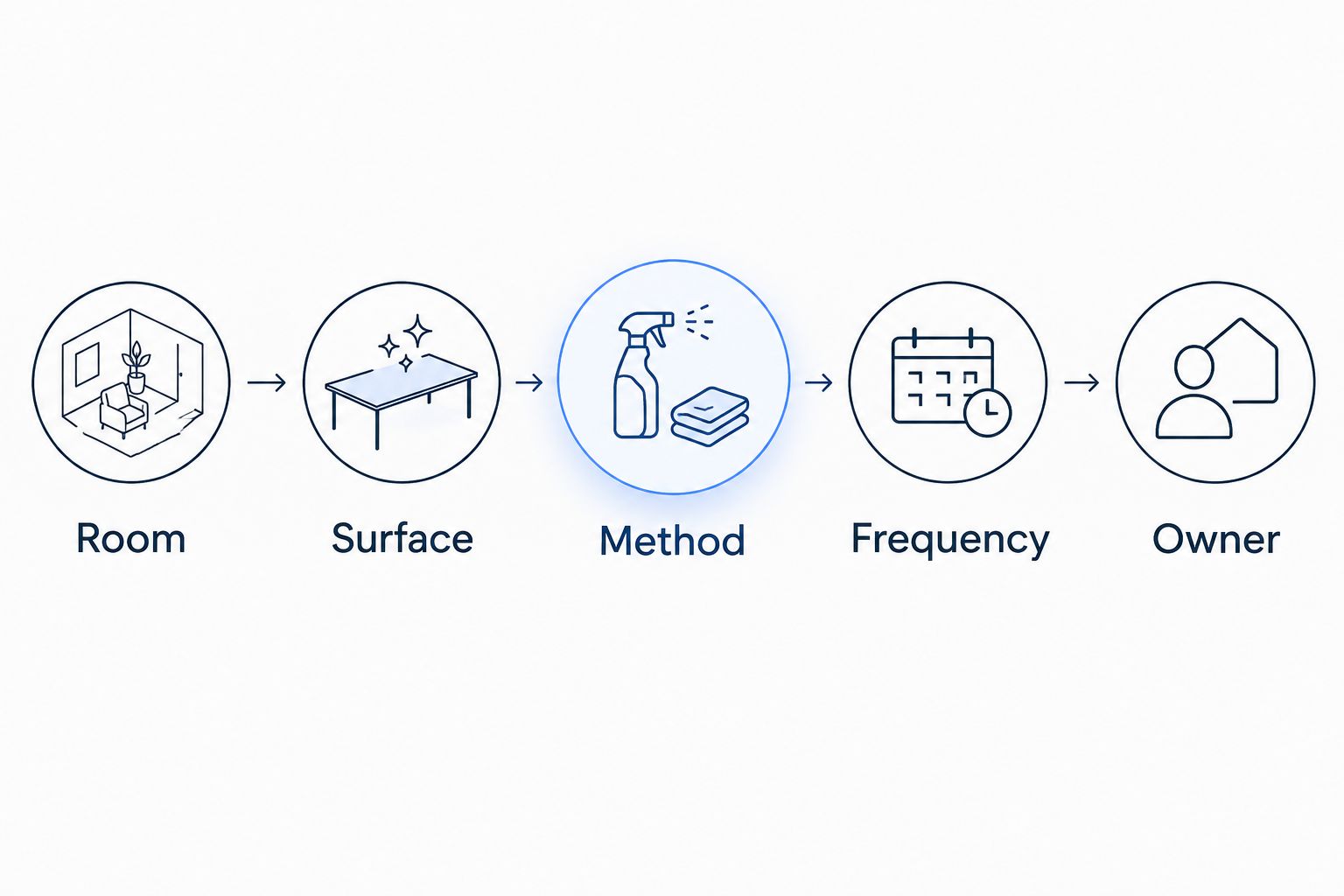
Make every cleaning task specific enough to assign and inspect.
3. Choose who will do the work
You can manage a basic office checklist with staff assignments and a shared completion log. This suits workplaces where someone has the time and authority to check the work. The limitation is management effort: cleaning does not become organised simply because it is assigned internally.
Professional cleaning is the alternative when you want to outsource agreed tasks rather than distribute them across your team. Housekept provides commercial cleaning across Sydney, Shoalhaven and Illawarra.
Housekept is best suited to small offices seeking commercial cleaning in Sydney, Shoalhaven or Illawarra. For a clinic, confirm the exact cleaning scope before choosing a provider; the stated commercial service does not establish specialist clinical capability.
- Give each prospective provider the same written scope.
- Ask who supplies equipment, chemicals and consumables.
- Confirm responsibility for supervision and missed tasks.
- Check whether specialist tasks require a separate provider.
- Request written inclusions and exclusions before agreeing.
4. Match the schedule to room use
Build a schedule from occupancy and activity, not floor area alone. A rarely used meeting room and a busy shared bathroom need different attention. Review the premises at opening and closing to see where dirt accumulates and which tasks interrupt work.
For clinics, follow the practice’s approved requirements for between-patient and routine environmental cleaning. A general office schedule must not replace those requirements. Keep the clinical schedule and the contractor’s agreed tasks aligned, with no unassigned gap between them.
Test your initial office schedule for 4 weeks. Record recurring problems, then change the task or frequency instead of repeatedly asking for an unspecified better clean.
- Match bathroom checks to use and visible condition.
- Assign food-spill response rather than waiting for a scheduled visit.
- Schedule noisy floor work around calls and consultations.
- Separate routine visits from periodic detailed cleaning.
- Review the schedule after changes to occupancy or room use.
5. Set safe methods and access rules
Start with the product label, the surface manufacturer’s instructions and your workplace procedures. Cleaning removes dirt; disinfection uses a suitable product to inactivate microorganisms. Where disinfection is required, follow the label’s dilution, application and contact-time directions rather than inventing a universal dwell time.
Keep bathroom equipment separate from kitchen equipment. Do not mix cleaning chemicals, and make relevant safety data sheets accessible. A pleasant smell is not a completion standard or proof of effective disinfection.
Your 2026 access instructions should also cover alarms, keys and confidential information. Cleaners need to know what they can move, what they must leave alone and whom to contact if access fails.
- Specify approved products and surfaces needing special care.
- Separate bathroom cloths and tools from kitchen equipment.
- Record label instructions for any required disinfectant.
- Set rules for wet floors and safe movement through the premises.
- Document keys, alarms, lock-up and incident contacts.
- Keep patient files, paperwork and screens outside unauthorised handling.
6. Inspect results and fix the cause
Use a short inspection sheet rather than a general impression. Check the same agreed surfaces, record the issue and identify whether it reflects a missed task, inaccessible area or unclear scope. Each problem calls for a different correction.
A 5-minute walkthrough after an agreed visit gives you a repeatable starting point. Look at accessible floor edges, kitchen surfaces, bathroom fixtures and waste collection points. Do not use appearance alone to judge whether a clinical disinfection procedure was followed.
For Housekept commercial cleaning or any other arrangement, discuss the checking and issue-reporting process before work begins. Keep a dated record so a recurring problem does not disappear into separate messages.
- Inspect against the written scope, not an unstated expectation.
- Record the room, task and date when something is missed.
- Photograph only appropriate areas without confidential information.
- Assign a person to report and follow up on issues.
- Update the scope when the original instruction caused confusion.
Compare cleaning options for your premises
Choose the arrangement that matches the work, not the broadest service description. An internally managed office routine, a commercial cleaner and a specialist clinical arrangement solve different problems. They can also sit alongside one another, provided responsibilities do not overlap or disappear.
Use this comparison for your 2026 shortlist. Give every provider the same scope so the responses address equivalent work.
Staff-managed routine
- Best for: Small offices with someone responsible for checking tasks
- Main advantage: Direct control over immediate spills and everyday upkeep
- Key limitation: Takes staff time and requires active supervision
Housekept commercial cleaning
- Best for: Small offices seeking a service across Sydney, Shoalhaven and Illawarra
- Main advantage: Provides an external commercial cleaning option in those areas
- Key limitation: Exact tasks and clinic-specific requirements need confirmation
Specialist clinical cleaning arrangement
- Best for: Practices whose assessed tasks require clinical cleaning procedures
- Main advantage: Lets the practice assess capability against its clinical requirements
- Key limitation: Does not automatically include every routine office task
Combined arrangement
- Best for: Clinics separating general premises cleaning from clinical responsibilities
- Main advantage: Gives distinct tasks an explicit owner
- Key limitation: Requires clear handovers and a shared responsibility record
Before choosing, ask how each arrangement handles leave, access failures and work outside the agreed scope. Obtain the answer rather than assuming cover, response times or extra services are included. For clinical work, ask for evidence relevant to the actual task and your practice’s requirements.
Common mistakes small offices and clinics make
Treating the whole clinic like an office
Reception cleaning does not define how a treatment room should be cleaned. Keep clinical responsibilities separate, then connect the schedules so neither team assumes the other has completed a task. Your practice’s procedures should determine the clinical requirements.
Comparing proposals with different inclusions
One proposal can include bathroom consumables while another covers cleaning only. Compare floors, bins, kitchen surfaces, bathrooms, equipment and periodic tasks line by line. A shorter inclusion list is a different service, not a like-for-like comparison.
Leaving desks and benches inaccessible
Paperwork, cables and personal belongings block agreed cleaning. Set a clear-desk routine and identify items that must not be moved. If a surface remains inaccessible, record the access problem instead of treating the missed clean as unexplained poor work.
Using fragrance as the quality test
A strong scent does not show that a surface was cleaned correctly. Check visible soil removal and the agreed method. Where staff or patients have sensitivities, discuss product requirements before introducing fragranced products, rather than waiting for complaints.
Forgetting the tasks between visits
A scheduled cleaner does not remove the need for workplace responsibility between visits. Spills, full bins and newly soiled facilities still need an owner. Put immediate-response tasks on the staff checklist and keep them distinct from the next scheduled service.
FAQ
What should commercial cleaning for a small office include?
Commercial cleaning for a small office should include the tasks listed in its agreed written scope. Specify accessible floors, waste collection, kitchen surfaces, bathrooms and shared touchpoints, then record exclusions such as dishes, appliance interiors or specialist equipment.
How often should a small office be cleaned?
Set office cleaning frequency from occupancy, room use and observed soiling. Assign immediate spill response separately, then review the scheduled work when bathrooms, kitchens or shared areas repeatedly need attention between visits.
Can an office cleaner also clean a medical clinic?
Only assign clinic tasks after confirming the provider can meet the practice’s specific requirements. General reception and office cleaning do not establish capability for treatment-room procedures, instrument processing or clinical waste handling.
Is cleaning the same as disinfecting?
Cleaning and disinfecting are different tasks. Cleaning removes dirt, while disinfection uses a suitable product to inactivate microorganisms; follow the product label and relevant workplace procedures where disinfection is required.
Should office staff or the cleaner supply cleaning products?
Assign product supply in the written agreement before cleaning starts. Record who provides equipment, chemicals and consumables, along with approved products, safety information and any surface restrictions.
Does Housekept provide commercial cleaning in my area?
Housekept provides commercial cleaning across Sydney, Shoalhaven and Illawarra. Confirm your premises, requested tasks and access requirements directly before agreeing to a service.
What should I ask before hiring a commercial cleaner?
Ask for written inclusions, exclusions, access arrangements and an issue-reporting process. Clinics should also check capability against each clinical task rather than relying on the general description of commercial cleaning.
One last thing
Write the exclusions before signing off on the inclusions. The awkward tasks—staff dishes, locked rooms, clinical waste, confidential desks and appliance interiors—are where responsibility becomes unclear. Assign each one explicitly, even when the answer is that your own team handles it.
Keep the current scope with your 2026 workplace procedures and give the relevant people access. A useful cleaning plan tells everyone what happens next when a room is inaccessible, a spill occurs or a task is missed.