
Best washing machine cleaners for odour and mould 2026

Best overall: a dedicated washing machine cleaner approved for your appliance; best for mineral deposits: a compatible washing machine descaler; best for accessible seal residue: manual cleaning with a manufacturer-approved detergent. This 2026 guide explains which approach fits the smell, where mould needs hands-on attention, and when cleaning is no longer the right fix.
TL;DR
- The best washing machine cleaner for odour targets residue inside your appliance, rather than covering smells with fragrance.
- Choose a compatible descaler for mineral deposits, not as a substitute for removing visible seal grime.
- Accessible washing machine mould needs inspection and manual cleaning according to your appliance instructions.
- Housekept provides home cleaning services; appliance repairs belong with an appliance technician.
Why this matters
A washing machine cleaner cannot fix every cause of a smelly machine. Residue in the drum, grime beneath the door seal and a drainage fault need different responses.
Match the treatment to the source before buying a cleaner. A strong fragrance is not proof that the source has gone, and a clean-looking drum does not tell you what is beneath the seal.
Housekept provides residential and commercial cleaning services across Sydney, Shoalhaven and Illawarra. For appliance maintenance, keep the machine's instructions separate from your general household cleaning routine: a bathroom mould spray is not automatically suitable for a washing machine.
What makes the best washing machine cleaner for odour?
Use these criteria to choose a washing machine cleaner in 2026:
- Appliance compatibility: The cleaner must suit your machine type and any restrictions in its manual.
- Correct cleaning purpose: Residue removal, descaling and surface cleaning are different jobs. Choose the job you actually need.
- Clear directions: Look for instructions covering placement, dosage, cycle selection and whether the drum must be empty.
- Access to the problem: A cleaner circulating through the drum does not replace wiping accessible seal folds or cleaning a removable drawer.
- Safe handling: Follow ventilation, storage and protective-equipment directions. Never combine cleaning products.
- A useful stopping point: If odour returns after correct maintenance, investigate drainage or arrange servicing instead of repeatedly adding chemicals.
There is no universal winner for every appliance and every smell. The best default is a dedicated cleaner that your washing machine manufacturer permits.
Washing machine cleaning options at a glance
These are cleaning approaches, not a laboratory-tested ranking of branded formulas. Each earns a different place in the routine.
Dedicated washing machine cleaner
- Best for: General internal residue and musty odour
- Standout feature: Made specifically for machine-maintenance cycles
- Key limitation: Does not replace manual seal and drawer cleaning
Compatible washing machine descaler
- Best for: Mineral deposits
- Standout feature: Targets scale rather than general surface grime
- Key limitation: Not a stand-alone answer to visible mould
Manual cleaning with approved detergent
- Best for: Accessible seal and drawer residue
- Standout feature: Lets you physically remove visible deposits
- Key limitation: Cannot reach internal hoses or hidden components
Do not treat these options as ingredients for a combined treatment. Use only the products, sequence and rinsing steps permitted by your appliance instructions.
1. Dedicated washing machine cleaner: best for internal residue
A dedicated washing machine cleaner is the first choice when your machine smells musty and its maintenance instructions call for a cleaning product. Choose one labelled for your appliance type, then use the specified maintenance programme or cycle.
The format is secondary. A tablet, powder or liquid still needs compatible ingredients and clear directions; convenience alone does not establish better cleaning performance.
Best for: Routine internal maintenance when residue is the likely source of odour.
Dedicated washing machine cleaner pros
- Gives you instructions written specifically for cleaning a washing machine.
- Works with a defined maintenance process rather than an improvised household mixture.
- Provides a practical starting point before investigating persistent odour further.
Dedicated washing machine cleaner cons
- Cannot physically wipe grime trapped in accessible rubber folds.
- Will not repair a drainage fault, damaged seal or leaking connection.
- Fragrance can make it harder to judge whether an underlying smell remains immediately after treatment.
Before running the cycle, check whether the product belongs in the drum or a dispenser compartment. Never assume placement from another product you have used.
Afterwards, inspect accessible areas and let the machine dry as the manual directs. Judge the result once the cleaning fragrance has cleared, not just when the cycle finishes.
Verdict: Buy a compatible dedicated cleaner for general maintenance, but pair it with inspection and permitted manual cleaning.
2. Washing machine descaler: best for mineral deposits
A washing machine descaler targets mineral scale. It is the more relevant choice when you have identified deposits and the appliance instructions recommend descaling.
Do not diagnose hard water from your postcode or a musty smell alone. Check the machine, its maintenance guidance and your water supplier's information before choosing a scale-specific treatment.
Best for: Confirmed mineral deposits in an appliance that permits chemical descaling.
Washing machine descaler pros
- Targets a specific maintenance problem rather than treating every smell identically.
- Gives you an appliance-specific alternative to using a general bathroom descaler.
- Fits a maintenance routine where the manufacturer calls for scale removal.
Washing machine descaler cons
- Does not replace removing visible grime from the door seal or drawer.
- Requires compatibility checks; an acid-based cleaner is not suitable for every material or maintenance procedure.
For your 2026 cleaning routine, keep the product's purpose clear: descaling is not the same as disinfecting or removing mould. Do not infer either claim unless the label explicitly supports it for the intended use.
Verdict: Buy for identified scale; skip as the default response to an unexplained musty smell.
3. Manual cleaning: best for accessible seal and drawer grime
Manual cleaning lets you remove visible residue from parts you can safely reach. Use a soft cloth and the detergent or cleaning method specified by the appliance manufacturer.
This is the most relevant approach when you can see deposits inside accessible door-seal folds or the detergent drawer. Remove detachable parts only as the instructions permit, and refit them correctly before using the machine.
Best for: Visible residue in accessible seals, drawer compartments and other user-cleanable surfaces.
Manual cleaning pros
- Removes accessible material instead of relying on a drum cycle to reach it.
- Lets you inspect folds and corners while cleaning.
- Helps you identify tears, trapped objects or deposits that need further attention.
Manual cleaning cons
- Cannot reach internal pipework or other concealed components.
- Does not establish that a stained seal is free of mould or structurally sound.
- Requires care around delicate rubber, sharp objects and electrical components.
If a mark remains after permitted cleaning, do not keep escalating to stronger chemicals. A mark alone cannot tell you whether you are seeing staining, remaining growth or damaged material.
Verdict: Buy only the cleaning materials your manual permits; choose hands-on cleaning for accessible grime, not hidden faults.
How these options are ranked
This 2026 guide ranks cleaning approaches by their fit for the problem: dedicated cleaner for general internal maintenance, descaler for mineral deposits, and manual cleaning for accessible residue.
Compatibility comes before format or fragrance. No branded formula earns a performance claim here without supporting evidence, and none of these approaches substitutes for repairing a faulty appliance.
Find the source before starting a cleaning cycle
Check 3 inspection points before choosing a treatment: the door seal, detergent drawer and user-accessible drain filter. Your manual determines which parts you can inspect and how to do so safely.
Door seal
Inspect accessible folds for residue, trapped items and visible damage. Follow the manual's power-isolation instructions before cleaning, and do not pull the seal away from its fittings.
Detergent drawer
Check for accumulated detergent or softener in the drawer and accessible housing. Remove and rinse the drawer only if the manufacturer allows it, then dry and refit it as directed.
Drain filter
Check whether your model has a user-serviceable filter. Follow its draining procedure exactly: opening a filter without preparation can release retained water.
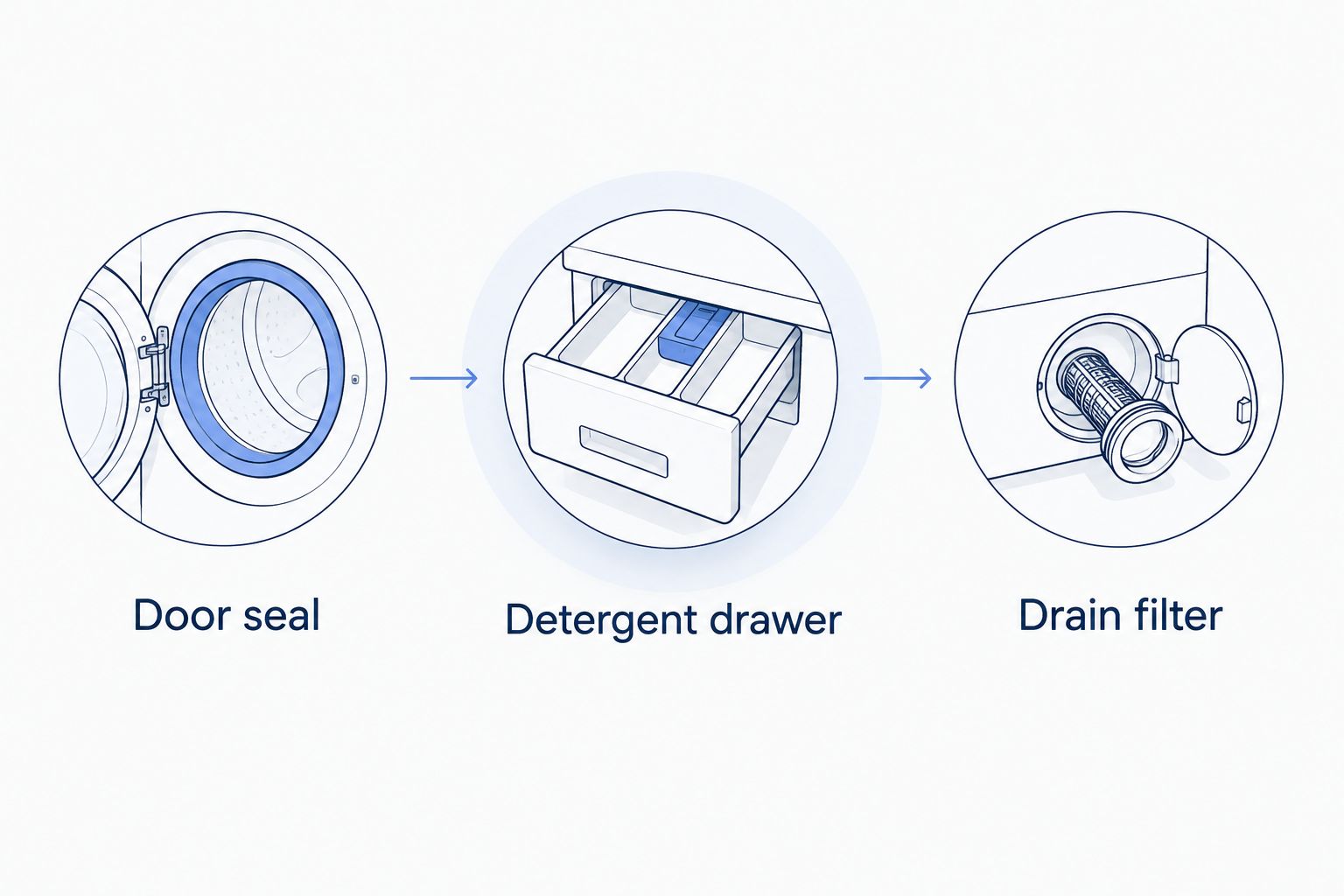
Inspect the source of the smell before choosing a treatment.
If the machine is not draining properly, address that problem before repeating maintenance cycles. Persistent sewage-like odour, leaks or recurrent standing water need investigation rather than stronger perfume.
A safe cleaning sequence for 2026
Use this 5-step sequence to organise the job. Product directions and your appliance manual take priority wherever they specify a different procedure.
- Read both instructions. Confirm appliance compatibility, handling precautions, product placement and the correct programme.
- Empty and inspect. Remove laundry, then check the user-accessible areas described above. Isolate power where the manual requires it for hands-on work.
- Remove accessible residue. Clean permitted surfaces and removable parts using the approved method. Refit everything correctly.
- Run the maintenance cycle. Use the directed dose and programme. Do not add laundry detergent or another cleaner unless expressly instructed.
- Check and dry. Complete any required rinsing, inspect the result and follow the appliance's drying guidance.
Never mix bleach with vinegar, descaler or another acid-based product. The combination can release chlorine gas. Never mix bleach with ammonia-containing products either.
Do not improvise a stronger dose, longer soak or hotter cycle. More chemical exposure is not a substitute for correct use, and incompatible treatments can damage appliance materials.
Keep odour from returning
Your 2026 maintenance plan should follow the machine's instructions, not a universal schedule printed in a generic cleaning guide. Usage, detergent and appliance design affect the routine you need.
- Dose detergent correctly. Follow the detergent and appliance guidance for the load, soiling and water conditions.
- Remove finished laundry. Do not leave damp washing sitting in the drum unnecessarily.
- Allow permitted drying. Follow the manual's advice on leaving the door or drawer open, while maintaining child and pet safety.
- Clean accessible residue. Check the seal and drawer as part of your normal maintenance routine.
- Respond to recurring symptoms. Record when the smell returns and whether it coincides with poor draining or other faults.
For a holiday rental, include an appliance check in the turnover instructions rather than assuming the next guest will report a problem. Keep maintenance responsibilities clear between the owner, cleaner and appliance technician.
Which washing machine cleaner should you choose?
Choose a compatible dedicated washing machine cleaner if you need a default for general internal maintenance. Choose a descaler only when scale is the identified problem, and manually remove accessible grime using the approved method.
Housekept is best for households seeking professional home cleaning, not washing machine repairs. Keep appliance faults with an appliance technician and confirm any requested appliance-cleaning tasks before booking a household clean.
FAQ
What's the best washing machine cleaner for odour?
The best default is a dedicated washing machine cleaner that your appliance manufacturer permits. Check accessible seals and drawers too, because an internal cleaning cycle does not replace removing visible grime.
Will a washing machine cleaner remove mould from the rubber seal?
Do not assume a drum cleaner will remove mould from the rubber seal. Inspect accessible folds and use the cleaning method specified by the appliance manufacturer; persistent staining or damaged rubber needs further assessment.
Is a washing machine descaler better than a machine cleaner?
A descaler is the better match for identified mineral deposits, not every type of odour. A dedicated machine cleaner is the default for general residue maintenance when the appliance instructions permit it.
Can I use vinegar and bleach together in my washing machine?
No. Mixing bleach with vinegar or another acid can release chlorine gas. Never combine cleaning products, and follow both the appliance manual and product label.
How often should I clean my washing machine in 2026?
Follow the maintenance interval in your washing machine manual and any instructions for its cleaning programme. Also inspect accessible areas when you notice odour, residue or changes in draining.
Why does my washing machine still smell after cleaning?
Persistent odour needs further investigation rather than repeated doses of cleaner. Recheck user-cleanable areas and arrange an appliance technician if the machine drains poorly, leaks or continues to smell after correct maintenance.
Can Housekept repair a smelly washing machine?
Housekept provides professional cleaning services, not an appliance repair service. Arrange a qualified appliance technician for drainage faults, damaged components or persistent machine problems.
One last thing
Inspect before you deodorise. A scented drum and a dirty seal can exist at the same time. Check accessible folds after the machine has cooled and the manual permits inspection; the condition of the surface tells you more than the fragrance does.