
Best ride-on mowers for large Sydney properties 2026

Best overall for large, open, level lawns: a petrol zero-turn mower. Best for steering-wheel control and compatible attachments: a lawn tractor. Best for avoiding petrol handling: a battery zero-turn mower. Best for restricted access: a compact rear-engine rider, provided it fits your gates. This 2026 guide compares mower types so you can match the machine to your Sydney property before choosing a model.
TL;DR
- The best ride on mower for large properties depends on terrain, access and obstacles, not engine size alone.
- Choose a petrol zero-turn for open, level acreage; check the specific machine’s operating limits before buying.
- Choose a lawn tractor for steering-wheel control and manufacturer-approved attachments.
- Housekept provides lawn maintenance for owners who prefer a service to mower ownership.
Why this matters
A large property does not automatically need the widest mower. Narrow gates, retaining walls, drainage channels and separate lawn sections determine whether a machine can reach the grass safely.
Buy for the hardest part of the mowing route, not just the biggest patch of lawn. You still need to account for edging, clippings, cleaning and storage after the main cut. If you want lawn maintenance rather than another machine to maintain, explore Housekept before committing to ownership.
What makes the best ride-on mower for large properties?
Use these criteria for your 2026 shortlist. Eliminate unsuitable machines before comparing comfort features or engine specifications.
- Terrain suitability: Follow the exact model’s instructions for slopes, wet ground, embankments and drop-offs. A mower category is not a safety approval.
- Access and clearance: Check the machine’s overall operating width, including its discharge chute, against gates, paths and storage openings.
- Lawn layout: Open rectangles favour long cutting passes. Trees, beds and corners make turning behaviour more important.
- Power and upkeep: Petrol means fuel handling and engine servicing. Battery operation means charging access and battery care.
- Grass management: Match the approved discharge, mulching or collection setup to how you want to handle clippings.
- Local support: Confirm who handles servicing, replacement blades and repairs for the exact model before you choose it.
Ride-on mower types at a glance
These are ranked buying categories, not claims that every machine within a category performs alike. Compare individual models only after identifying the type that suits your property.
1. Petrol zero-turn mower
- Best for: Large, open, level lawns
- Standout feature: Tight turning around obstacles
- Key limitation: Unsuitable terrain remains off-limits regardless of manoeuvrability
2. Lawn tractor
- Best for: Steering-wheel control and compatible attachments
- Standout feature: Familiar steering layout
- Key limitation: Turning and reversing need space around garden features
3. Battery zero-turn mower
- Best for: Owners avoiding petrol handling
- Standout feature: Electric drive without a petrol engine
- Key limitation: Charging arrangements and usable battery capacity need checking
4. Compact rear-engine rider
- Best for: Restricted access between lawn sections
- Standout feature: Compact machine layout
- Key limitation: Narrower cutting width means more passes across open ground
1. Petrol zero-turn: best for open, level acreage
A petrol zero-turn mower uses independently controlled drive wheels to turn tightly. It is a strong starting point for large, level lawns where you can make long passes and work around scattered trees or garden beds.
The advantage is manoeuvrability, not permission to mow every part of a property. Follow the model’s operating instructions near slopes, water, retaining walls and other hazards, and keep unsuitable sections out of the ride-on route.
Petrol zero-turn pros:
- Tight turning helps you work around isolated obstacles.
- Long, open mowing runs suit this machine layout.
- Refuelling avoids the need for a charging location.
- Different deck configurations let you match cutting width to access.
Petrol zero-turn cons:
- Steering controls need practice before you work near obstacles.
- Petrol storage and engine maintenance remain ownership tasks.
- Sharp turns can scuff turf; controlled turns matter.
Best for: Owners with substantial open, level lawn and enough access and storage space for the chosen machine.
For your 2026 shortlist, arrange a demonstration of the controls rather than assuming they will feel familiar. Check how you stop, reverse and turn before assessing optional features.
Verdict: Buy for open, level acreage after confirming the exact model suits your site.
2. Lawn tractor: best for steering-wheel control
A lawn tractor uses a steering wheel and typically places its cutting deck beneath the machine. Choose this category when you prefer that driving layout or want to investigate manufacturer-approved attachments.
Attachment compatibility is model-specific. A tow point does not establish that a tractor can safely handle every trailer, load or implement, particularly where terrain changes.
Lawn tractor pros:
- Steering-wheel control gives you a familiar driving arrangement.
- Approved attachments can extend its role beyond cutting grass.
- Suits lawns with room for broad turns.
- Offers an alternative if you dislike independent steering levers.
Lawn tractor cons:
- Tight spaces can require extra turning and reversing.
- Attachments need separate compatibility and operating checks.
- The tractor layout does not establish slope suitability.
Best for: Owners who prioritise steering-wheel control and have space to turn between lawn sections.
Walk the route around sheds, garden beds and boundary fences before choosing a tractor. A comfortable seat cannot fix a layout that forces repeated awkward manoeuvres.
Verdict: Buy when steering preference and approved attachment needs outweigh tight-turning convenience.
3. Battery zero-turn: best for avoiding petrol handling
A battery zero-turn mower combines electric power with a tight-turning layout. It removes petrol refuelling and petrol-engine servicing from the ownership routine, but it does not remove mower maintenance.
Blades, tyres, deck cleaning and safety checks still matter. Assess the exact machine’s charging instructions and battery provisions against the lawn you actually cut, rather than treating an advertised coverage figure as a guarantee.
Battery zero-turn pros:
- No petrol to store or pour into the mower.
- No petrol-engine oil changes.
- Tight turning suits lawns with scattered obstacles.
- Charging can fit an established property-maintenance routine.
Battery zero-turn cons:
- You need a charging location that meets the manufacturer’s instructions.
- Grass conditions and operating choices affect energy use.
- Battery care and eventual replacement need consideration.
Best for: Owners who want zero-turn handling without petrol handling and can organise suitable charging.
For a 2026 purchase, ask how battery servicing works and what the manufacturer requires for storage. Keep the discussion tied to the exact mower and battery system, not electric mowers in general.
Verdict: Buy when charging, battery care and your mowing workload fit the selected machine.
4. Compact rear-engine rider: best for restricted access
A compact rear-engine rider is worth considering when a larger ride-on cannot move between your lawn sections. The engine sits behind the operator, and the compact layout gives you another category to assess against gates and storage openings.
Compact does not mean automatically suitable for a large property. A narrower deck requires more passes across the same open area, so access can improve while the main mowing job becomes longer.
Compact rear-engine rider pros:
- Compact dimensions give you another option for constrained access.
- Smaller storage requirements can suit a restricted shed layout.
- Useful to assess for properties split into separate lawn areas.
Compact rear-engine rider cons:
- Narrower cutting width increases the number of mowing passes.
- Tight access still needs exact width and turning checks.
- Large uninterrupted lawns reduce the appeal of a compact deck.
Best for: Owners whose gates and storage rule out larger machines, but whose lawns still justify a ride-on.
Measure the complete route, including corners immediately after gates. A machine that passes through an opening in a straight line still needs room to approach and exit it.
Verdict: Hold until measurements prove that compact access matters more than cutting width.
Check your property before choosing a model
Use this sequence to turn a broad preference into a practical shortlist. Take the measurements and site photos with you when discussing a mower.
Measure access
Record your narrowest gate, storage doorway and path pinch point in millimetres. Check the mower’s overall width in the configuration you will actually use, not just its deck’s cutting width.
For unit conversions, 1 inch equals 25.4 mm. Keep your measurements in the same unit so you do not compare a cutting-deck figure with a gate opening by eye.
Map terrain
Mark slopes, drains, soft ground, exposed roots, retaining walls and water edges. Separate areas that need another maintenance method rather than trying to make one ride-on do everything.
There is no universal safe slope figure for all ride-on mowers. Use the selected model’s manual and obtain site-specific advice where the terrain is uncertain.
Calculate lawn area
Measure mowable grass, not the whole property title. Buildings, driveways, garden beds and bushland do not belong in your mowing-area estimate.
1 hectare equals 10,000 square metres, while 1 acre is approximately 4,047 square metres. These conversions help you compare your measured lawn with a manufacturer’s stated coverage without confusing land size and grass area.
Check storage
Confirm that the machine can enter, turn if needed and remain stored as instructed. Include access for cleaning, inspection and maintenance rather than measuring only the space occupied by the parked mower.
For a battery machine, check charging requirements too. For a petrol machine, plan fuel handling and storage separately from the mower’s footprint.
Confirm support
Identify who services the exact model and how you will get the machine to them. Ask about blades, belts where fitted, tyres and the process for diagnosing faults.
A mower you cannot transport presents a practical servicing problem. Resolve that before choosing it.
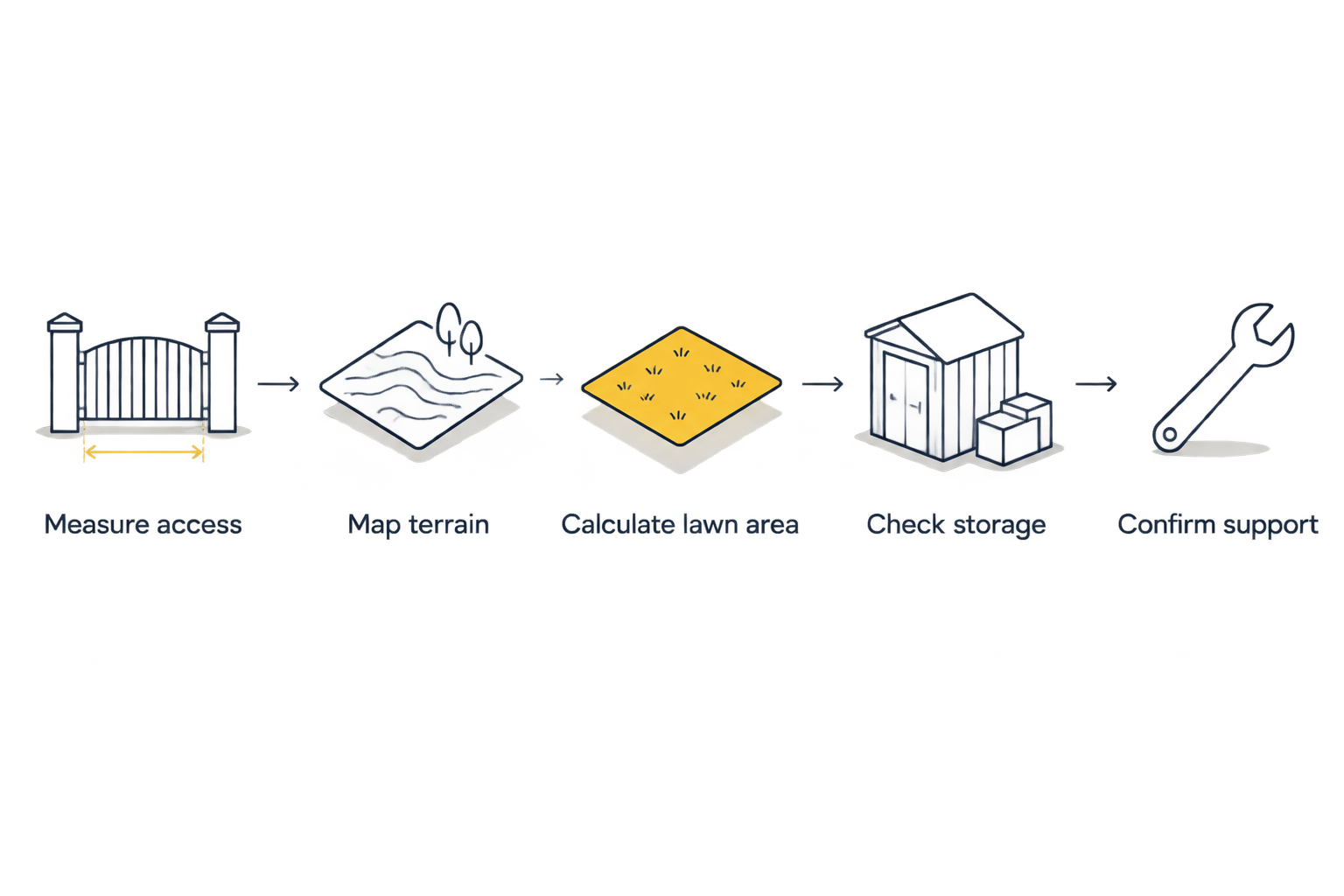
Check the whole mowing route before choosing a deck width.
How the ranking works
This 2026 ranking puts site suitability ahead of extra features. Petrol zero-turns take the default position specifically for open, level lawns; lawn tractors, battery zero-turns and compact riders each answer a different ownership requirement.
The criteria are access, terrain, layout, upkeep, clipping management and support. No category wins when the specific machine fails your access or operating checks. A site inspection and model manual take priority over a general buying guide.
Which mower should you choose?
Start with a petrol zero-turn if your lawn is large, open and level. Move to a lawn tractor if steering-wheel control or approved attachments matter more. Choose battery power when avoiding petrol handling is a priority and charging fits your setup.
Keep a compact rear-engine rider on the shortlist only when access rules out larger options. If mowing is a task you want removed rather than equipment you want to own, Housekept lawn maintenance is an alternative for households in Sydney, Shoalhaven and Illawarra.
Before committing to ownership in 2026, write down the complete job: mowing, edges, clippings, cleanup, maintenance and storage. Compare that responsibility with arranging a service, not just with the time spent sitting on the mower.
Discuss your lawn maintenance
Ask Housekept about lawn maintenance for your property.
FAQ
What’s the best ride on mower for large properties?
A petrol zero-turn is a strong default for large, open, level lawns. A lawn tractor, battery zero-turn or compact rider is a better fit when steering preference, petrol handling or access determines your choice.
Is a zero-turn mower better than a lawn tractor?
A zero-turn is better suited to tight turning around obstacles, while a lawn tractor suits owners who prefer steering-wheel control. Neither category establishes whether a particular machine is safe for your slopes or ground conditions.
What size ride-on mower do I need for an acreage property?
Choose a mower that fits your access, terrain and measured lawn area rather than acreage alone. Compare overall machine width with gates and storage openings before comparing cutting widths.
Can I use a ride-on mower on a sloping Sydney property?
Only use a ride-on where the exact model’s operating instructions permit it. Slopes, wet ground, drop-offs and water edges require specific assessment; a general mower ranking does not establish safe operation.
Is a battery ride-on mower suitable for a large lawn?
A battery ride-on is suitable when the selected model’s capabilities and charging requirements fit your lawn and mowing routine. Check the manufacturer’s operating guidance, battery care instructions and servicing arrangements before choosing it.
Should I buy the widest cutting deck that fits my shed?
No, the deck must suit the entire mowing route, not just the shed opening. Gates, corners, obstacles and ground shape all affect whether a wider machine is practical.
Should I buy a ride-on mower or arrange lawn maintenance?
Buy a ride-on if you want to operate, store and maintain the equipment yourself. Arrange lawn maintenance if you want the task handled as a service; confirm access, scope and clipping arrangements with the provider.
One last thing
Measure the corner after the gate, not just the gate itself. That short section can decide whether your preferred mower reaches the lawn at all. Photograph it with your measurements before discussing a machine.