
Best garden edgers and trimmers for neat lawns 2026

Best overall for routine lawn care in 2026: a cordless line trimmer with a rotating edging head. Best for crisp path borders: a dedicated blade edger. Best simple-tool option: a manual half-moon edger. This guide compares tool types so you can choose the best garden edger and trimmer for your lawn, rather than buy features you do not need.
TL;DR
- The best garden edger and trimmer for routine care is a cordless line trimmer with a rotating edging head.
- Choose a dedicated blade edger for a defined soil boundary beside paths and driveways.
- Choose a manual half-moon edger for short borders without batteries, cables or fuel.
- Housekept provides lawn maintenance for households and businesses across Sydney, Shoalhaven and Illawarra.
Why this matters
A trimmer and an edger do different jobs. A line trimmer cuts grass where a mower cannot reach; an edger defines the boundary between lawn and a path, driveway or garden bed.
For a busy household, the right choice starts with the job, not the motor. Housekept provides lawn maintenance alongside its home and commercial services, so buying equipment is not your only option.
Housekept lawn maintenance is an option for households that want lawn care handled as a service rather than another DIY task. If you prefer doing it yourself, the comparisons below separate routine tidying from cutting a new edge.
What makes the best garden edger and trimmer?
Use these criteria for your 2026 shortlist before comparing individual models:
- Cutting task: Line trims grass; an edging blade cuts a defined boundary through turf and soil.
- Boundary shape: Curved beds, straight paths and fence lines need different handling.
- Control: Check the working position, handle adjustment and visibility of the cutting area.
- Power source: Match battery, mains electricity, petrol or manual operation to your property.
- Upkeep: Check how you replace line, change a blade, clean the guard and store the tool.
- Safety: Read the manual for protective equipment, debris clearance and permitted attachments.
No single tool type wins every category. A dedicated edger gives up general trimming flexibility, while a line trimmer does not replace a blade for every soil-cutting task.
Garden edgers and trimmers at a glance
These are ranked tool categories, not model-level test results. The order prioritises routine household use, then more specialised jobs.
1. Cordless rotating-head line trimmer
- Best for: Routine trimming and light edging
- Standout feature: One tool changes cutting orientation
- Key limitation: Battery charging and line replacement
2. Dedicated blade edger
- Best for: Defined borders beside hard surfaces
- Standout feature: Blade cuts a turf-and-soil boundary
- Key limitation: Does not replace a general grass trimmer
3. Manual half-moon edger
- Best for: Short borders and occasional reshaping
- Standout feature: Direct foot-powered cutting
- Key limitation: Repeated physical effort
4. Corded electric line trimmer
- Best for: Gardens with suitable power access
- Standout feature: No battery charging or petrol handling
- Key limitation: Cable management limits movement
5. Petrol line trimmer
- Best for: Extended trimming away from mains power
- Standout feature: Refuelling rather than battery charging
- Key limitation: Engine upkeep, noise and exhaust
1. Cordless line trimmer: best for routine lawn tidying
A cordless line trimmer cuts grass with rotating cutting line. Choose a model whose manual explicitly permits edging and explains how to change the head or working position; not every cordless trimmer has a rotating head.
This is the default choice for a lawn with fence lines, mower obstacles and path edges. A suitable head changes the cutting plane by 90 degrees, allowing you to switch between horizontal trimming and vertical edging.
Cordless line trimmer pros:
- Trims around posts, trees and other mower obstacles.
- Works without a trailing mains cable.
- Handles light edging when designed for that task.
- Can share batteries with compatible tools in the same system.
Cordless line trimmer cons:
- Work stops when the battery needs charging unless you have a charged replacement.
- Cutting line wears and needs replacement.
- Light edging does not substitute for cutting an established soil boundary.
Best for: Regular upkeep where one tool needs to trim grass and tidy existing edges.
For a 2026 purchase, check the exact battery system, whether a battery and charger are included, and how the head changes position. Do not assume that batteries fit across brands or across every range within one brand.
Verdict: Buy a cordless rotating-head line trimmer for routine household trimming and light edging.
2. Dedicated blade edger: best for defined path borders
A dedicated blade edger uses a blade to cut the lawn boundary. It suits a different job from shortening stray grass: creating or restoring a distinct edge beside a path or driveway.
Choose this category when the boundary itself needs work. Check the manual for permitted surfaces, depth adjustment and clearance around the blade before using it.
Dedicated blade edger pros:
- Cuts a defined boundary through turf and soil.
- Suits repeated work along established hard edges.
- Separates boundary cutting from general grass trimming.
Dedicated blade edger cons:
- Does not trim grass around posts or beneath obstacles like a line trimmer.
- Adds another tool to maintain and store.
- Requires care around buried services, irrigation and loose stones.
Best for: Lawns where a distinct path or driveway edge is the priority.
A guide wheel or other alignment aid does not remove the need to inspect the route. Clear debris first, identify irrigation fittings and follow the manufacturer's working direction.
Verdict: Buy a dedicated blade edger for boundary definition; skip it as your only trimming tool.
3. Manual half-moon edger: best for short garden borders
A manual half-moon edger has a shaped blade that you press into the turf with your foot. It cuts a boundary without a motor, battery or cable.
This option suits a short border that needs occasional reshaping. Mark the intended line before cutting, then remove the loosened turf rather than leaving it across the bed or path.
Manual half-moon edger pros:
- Needs no charging, fuel or power connection.
- Gives direct control over the cut location.
- Works along straight lines and marked curves.
Manual half-moon edger cons:
- Requires repeated foot pressure and bending to clear cut turf.
- Becomes demanding along extensive boundaries.
- Does not cut tall grass around fences or obstacles.
Best for: Small lawns, short beds and occasional edge restoration.
Check the handle position and foot platform before choosing one. If pressing into turf affects your balance or causes discomfort, use another method rather than forcing the task.
Verdict: Buy a manual half-moon edger for short borders; skip it for extensive routine trimming.
4. Corded electric trimmer: best for suitable power access
A corded electric line trimmer runs from mains electricity through a suitable extension lead. It removes battery charging from the job, but makes cable routing part of every session.
Choose an edging-capable model if you need vertical edge tidying. As with cordless tools, the permitted working position depends on the particular trimmer.
Corded electric trimmer pros:
- Does not depend on a charged battery.
- Avoids petrol storage and engine servicing.
- Suits a work area with a clear, manageable cable route.
Corded electric trimmer cons:
- The cable must stay clear of the cutting area.
- Gates, beds and obstacles complicate cable routing.
- Outdoor electrical safety requirements still apply.
Best for: Gardens with suitable outdoor power access and an uncomplicated route around the lawn.
Use the electrical protection and extension lead specified by the manufacturer and applicable safety guidance. Do not use damaged leads or work in wet conditions contrary to the manual.
Verdict: Buy a corded electric trimmer only when you can manage the cable safely throughout the job.
5. Petrol line trimmer: best for work away from mains power
A petrol line trimmer uses an engine to drive the cutting head. It suits work where access to electricity and battery charging does not fit the task.
Engine type, starting procedure and permitted cutting attachments vary. Follow the exact manual rather than applying another tool's fuel instructions or fitting an unapproved blade.
Petrol line trimmer pros:
- Operates away from mains electricity.
- Resumes work after refuelling according to the manual.
- Avoids a trailing power cable.
Petrol line trimmer cons:
- Requires fuel handling and engine maintenance.
- Produces exhaust and engine noise.
- Needs a suitable storage arrangement.
Best for: Extended trimming where petrol operation matches the property and maintenance routine.
For a small residential lawn in 2026, first check whether cordless equipment covers the actual job. Petrol adds responsibilities that are unnecessary if a simpler tool meets your needs.
Verdict: Hold unless your trimming task justifies engine upkeep and fuel handling.
How to match the tool to your lawn
Before buying in 2026, walk the boundary and make 3 checks: identify what needs cutting, trace the route and consider the upkeep. This prevents a tool designed for grass trimming from becoming your attempted solution to an overgrown soil edge.
- Cutting task: Decide whether you need to shorten grass, define a boundary or do both.
- Boundary route: Note curves, posts, gravel, irrigation fittings and access restrictions.
- Tool upkeep: Choose the charging, line replacement, blade care or engine maintenance you will actually do.
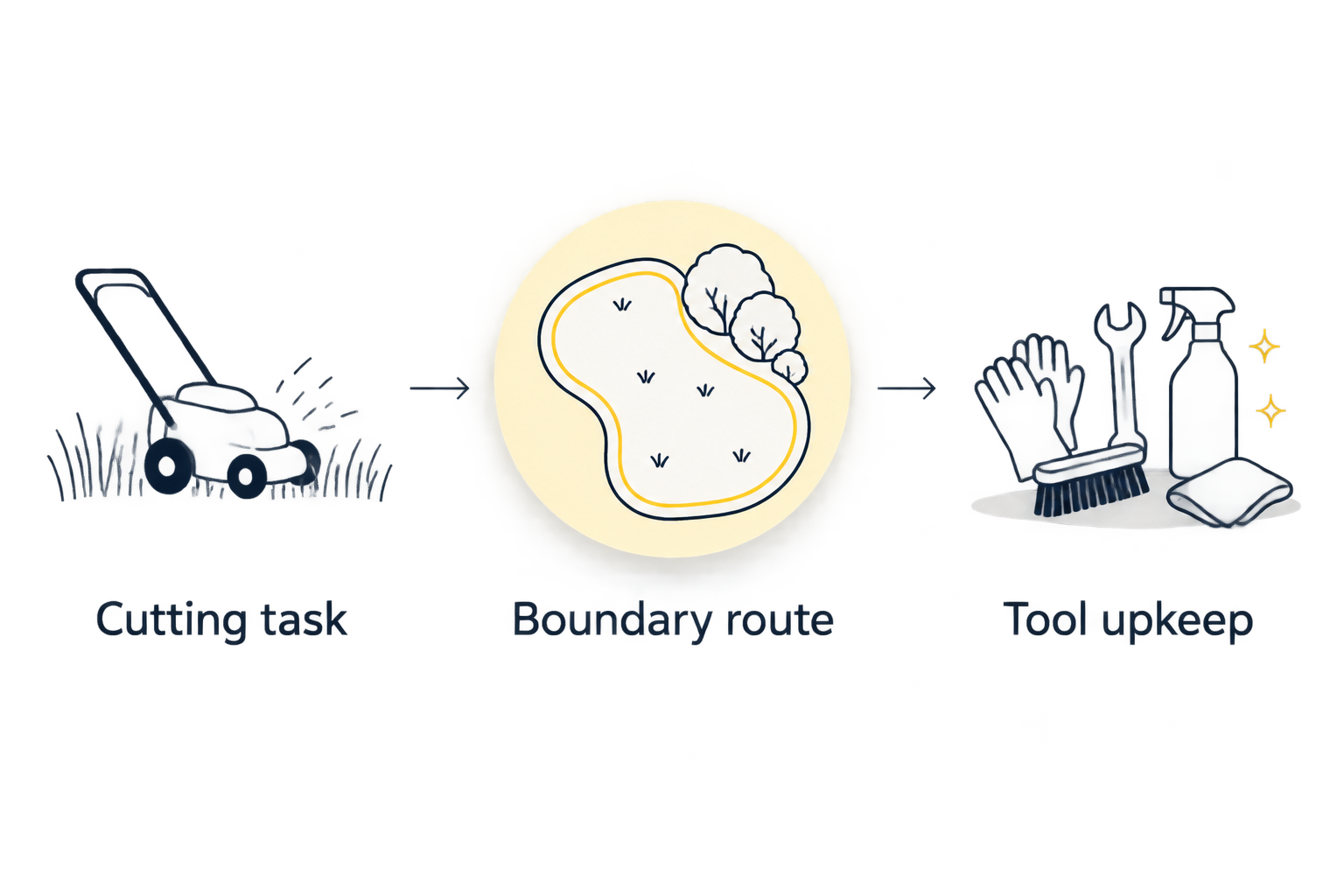
Choose the cutting method before comparing power sources.
You do not automatically need 2 powered tools. A rotating-head line trimmer can cover routine trimming and light edging; a separate blade edger earns its place when the boundary needs a different cut.
If maintaining equipment is the part you want to avoid, Housekept lawn maintenance provides a service alternative across Sydney, Shoalhaven and Illawarra. Describe whether you need mowing, edge tidying or boundary restoration when discussing the work.
Ask about lawn maintenance
Describe your lawn, access and edging needs before arranging the work.
How we ranked these options
The ranking follows the criteria above: cutting task, boundary shape, control, power source, upkeep and safety. Cordless rotating-head trimmers come first for combining grass trimming with light edging; dedicated and manual edgers serve narrower boundary-cutting jobs.
These are task-based recommendations, not claims about tested runtime, cutting speed or durability. For your 2026 shortlist, compare the exact model's manual, included equipment and replacement consumables before deciding.
Which garden edger and trimmer should you choose?
Choose a cordless rotating-head line trimmer if you are undecided and mainly need routine lawn tidying. Choose a dedicated blade edger when a defined turf-and-soil boundary matters more than trimming flexibility.
For short borders, a manual half-moon edger avoids powered equipment altogether. Keep corded and petrol options tied to their specific use cases: suitable power access for the former, and work away from mains power for the latter.
FAQ
What's the best garden edger and trimmer for a home lawn?
A cordless line trimmer with a rotating edging head is the default choice for routine grass trimming and light edging. Choose a dedicated blade edger instead when you need to cut or restore a defined turf-and-soil boundary.
Is a garden edger the same as a line trimmer?
No. A line trimmer cuts grass with rotating line, while a dedicated blade edger cuts a lawn boundary. Some line trimmers also permit vertical edging, but that does not make every trimming task and soil-cutting task interchangeable.
Can I use a cordless trimmer to edge my lawn?
Yes, if the manufacturer permits edging with that model. Follow the specified head position and technique rather than turning a tool into an unsupported working position.
Is a manual lawn edger suitable for a small garden?
A manual half-moon edger suits short borders and occasional reshaping. It requires foot pressure and clearing of cut turf, so consider your balance and comfort before choosing it.
Do I need both an edger and a trimmer?
You need both functions only if your lawn needs both grass trimming and boundary cutting. An edging-capable trimmer handles light edge tidying, while a separate edger serves more defined turf-and-soil work.
Is petrol better than cordless for edging?
Petrol is not automatically better for edging. The cutting method and permitted working position determine suitability; the power source determines responsibilities such as charging, refuelling and maintenance.
What should I check before using a garden edger?
Read the manual, inspect the cutting route and clear people, pets and loose debris from the work area. Check for irrigation fittings and buried services before any soil-cutting work, and use the specified protective equipment.
One last thing
More cutting power does not fix the wrong cutting method. If grass is merely hanging over a path, start with trimming; if the lawn boundary has disappeared beneath spreading turf, choose a tool intended to restore that boundary.
That distinction is more useful than buying the largest motor. Match the cut first, then choose the power source you want to maintain.