Best limescale removers for taps and showerheads in 2026

Best overall: a purpose-made limescale remover explicitly approved for your showerhead’s finish. Best pantry option: white vinegar, where permitted. Best powder option: citric acid, where permitted. This 2026 guide compares 3 cleaning options for taps and showerheads, with surface safety deciding the winner.
TL;DR
- The best limescale remover for showerheads is a purpose-made descaler approved for the fixture’s material and finish.
- White vinegar and citric acid suit only fittings whose care instructions permit acidic cleaners.
- Never mix descalers or vinegar with bleach; keep acidic cleaners away from acid-sensitive stone.
- Housekept provides home cleaning services; confirm the bathroom cleaning scope before booking.
Why this matters
Removing scale should not mean sacrificing the finish underneath it. A product that dissolves mineral deposits can also damage an unsuitable surface. Check the fitting’s care instructions before choosing a cleaner, especially around coated taps, natural stone and concealed seals.
Housekept provides home cleaning services across Sydney, Shoalhaven and Illawarra. This guide separates product selection from service booking: choose the right treatment for the fitting, then decide whether to tackle the bathroom yourself or arrange cleaning support.
White crust around an outlet suggests mineral build-up, but not every bathroom mark is limescale. Soap residue, corrosion and damaged plating need different responses. A stronger acid is not the answer to every stubborn mark.
What makes the best limescale remover for showerheads?
For this 2026 shortlist, judge the cleaner against these criteria before considering convenience:
- Finish compatibility: the fitting’s care instructions and cleaner label must both permit the application.
- Mineral-deposit removal: choose a cleaner intended for limescale, not simply a disinfectant or general bathroom spray.
- Application control: you need to keep the treatment on the deposit and off sensitive neighbouring materials.
- Clear directions: dilution, contact time, rinsing and protective-equipment instructions should be explicit.
- Practical rinsing: the cleaner must be removable from outlets, joins and recesses after treatment.
Compatibility comes first. A cleaner’s ability to dissolve scale does not establish that it is safe for every chrome, brass-coloured, black or other decorative finish.
Limescale removers at a glance
These are cleaner types rather than a brand-by-brand performance ranking. The comparison does not assign unsupported cleaning speeds or claim that different formulations work identically.
1. Purpose-made limescale remover
- Best for: Routine descaling with explicit product directions
- Standout feature: Labelled application, contact-time and rinsing instructions
- Key limitation: Approval varies by formulation and fitting
2. White vinegar
- Best for: Light deposits when fixture instructions specifically allow vinegar
- Standout feature: Acetic acid acts on carbonate scale
- Key limitation: Household vinegar is not automatically safe for tap finishes
3. Citric acid cleaner
- Best for: Label-directed solution preparation
- Standout feature: Powder format can be mixed as instructed
- Key limitation: Guessing concentration creates avoidable surface risks
None of these options belongs on an unverified finish. If you cannot identify the fitting or find its care instructions, start with the manufacturer’s recommended routine-cleaning method rather than experimenting with acid.
1. Purpose-made limescale remover: best for clear directions
A purpose-made descaler targets mineral deposits rather than simply wiping away surface dirt. Depending on the formulation, the product supplies instructions for application, contact time and rinsing.
Best for: a showerhead or tap with a known finish, where both the fitting manufacturer and cleaner label permit the treatment.
Choose a product that explicitly covers your intended surface and application. Approval for shower glass does not establish approval for a plated showerhead, and approval for a tap’s exterior does not establish approval for soaking the entire fitting.
Purpose-made limescale remover pros:
- Gives you product-specific instructions instead of an improvised recipe.
- Targets the mineral deposits responsible for limescale.
- Lets you check exclusions before applying it.
Purpose-made limescale remover cons:
- Different formulations carry different surface restrictions.
- Run-off still needs controlling around stone, grout and other fittings.
- A label cannot override a fixture manufacturer’s prohibition.
For your 2026 cleaning kit, favour clear compatibility information over claims about strength. More aggressive treatment is not a benefit when the surface cannot tolerate it.
Verdict: Buy only when the cleaner and fixture instructions both approve the application.
2. White vinegar: best for permitted light-scale cleaning
White vinegar contains acetic acid, which reacts with carbonate deposits. That makes it a possible treatment for limescale, not a universal bathroom cleaner.
Best for: light mineral deposits on fittings whose manufacturer specifically permits vinegar cleaning.
Use the fitting’s approved method. Do not copy an overnight soaking routine from a generic cleaning tip: prolonged contact exposes coatings, seals and surrounding materials as well as the scale.
White vinegar pros:
- Acts on carbonate-based mineral deposits.
- Offers a pantry option when the correct product is already at home.
- Can suit targeted cleaning where the fixture instructions allow it.
White vinegar cons:
- Acidity can damage unsuitable finishes and acid-sensitive stone.
- Household products differ, so a generic recipe is not a compatibility check.
- Bag-soaking can expose more of the fitting than intended.
Do not combine vinegar with bicarbonate of soda expecting a stronger descaler. Their reaction consumes the acid; fizz is not evidence of improved limescale removal. Use an approved cleaning method rather than mixing household ingredients.
Verdict: Hold until the fixture instructions explicitly permit vinegar.
3. Citric acid cleaner: best for label-directed preparation
Citric acid is another acid used in descaling products. A suitable labelled product gives you preparation and application directions; loose powder without appropriate fixture-cleaning instructions leaves you guessing.
Best for: removable, compatible parts where the product and fitting instructions permit a prepared citric acid solution.
Measure and dilute exactly as directed. Do not increase the concentration because the deposit looks thick, and do not assume that instructions for a kettle apply to a decorative bathroom fitting.
Citric acid cleaner pros:
- Acts on carbonate scale.
- Powder products allow preparation according to their labelled directions.
- Suits controlled treatment when removable parts are approved for soaking.
Citric acid cleaner cons:
- Incorrect mixing changes the treatment’s concentration.
- Citric acid is unsuitable for acid-sensitive materials.
- The product still needs thorough rinsing from treated parts.
Store the powder in its original labelled container, away from children and pets. A food-related name does not remove the need to follow cleaning-product precautions or protect your eyes and skin as instructed.
Verdict: Buy a suitably labelled product; skip improvised concentrations.
How the options are ranked
The ranking puts usable instructions and surface compatibility ahead of ingredient familiarity. A purpose-made descaler takes the default position because the right product supplies directions for the intended cleaning task—not because every commercial descaler beats vinegar or citric acid.
White vinegar occupies the permitted pantry-use slot. Citric acid occupies the measured-preparation slot. This is a decision guide for 2026, not a laboratory speed test or a claim that one acid is safest across all fittings.
Check the fitting before treating the deposit
Read 2 labels before using a descaler: the fixture’s care instructions and the cleaning product’s directions. If either excludes the treatment, choose another method.
Pay particular attention to these areas:
- Decorative finishes: colour alone does not identify the coating or its cleaning restrictions.
- Natural stone: acidic run-off can etch acid-sensitive stone, including marble and limestone.
- Seals and joins: exterior-cleaning approval does not mean the assembled fitting can be immersed.
- Flexible outlets: follow the showerhead maker’s instructions for clearing these rather than forcing a sharp tool through them.
An inconspicuous patch test is an extra precaution only where the treatment is already permitted. It does not turn a prohibited cleaner into an approved one.
If plating is peeling, pitted or discoloured beneath the deposit, stop treating the mark as removable dirt. Cleaning cannot restore missing plating. Ask the fitting supplier about care or replacement instead of repeatedly applying acid.
Separate showerhead scale from shower-door marks
Treat showerhead descaling and glass cleaning as 2 separate tasks. The showerhead needs compatibility checks for its finish, outlets and internal parts; the screen needs checks for glass treatments, frames and nearby surfaces.
When removing hard water stains, distinguish mineral spotting from soap residue before choosing a treatment. A method suitable for untreated glass does not automatically belong on coated glass, metal trim or the tap beside it.
Work on one surface at a time so you can control run-off and rinse thoroughly. Do not spray a whole shower enclosure with one product simply because the marks look similar from the doorway.
For a rental inspection or guest turnover, inspect the taps, showerhead and screen separately after drying. Wet surfaces can disguise remaining marks. Dry inspection also helps you identify where another approved cleaning pass is needed and where the surface itself is damaged.
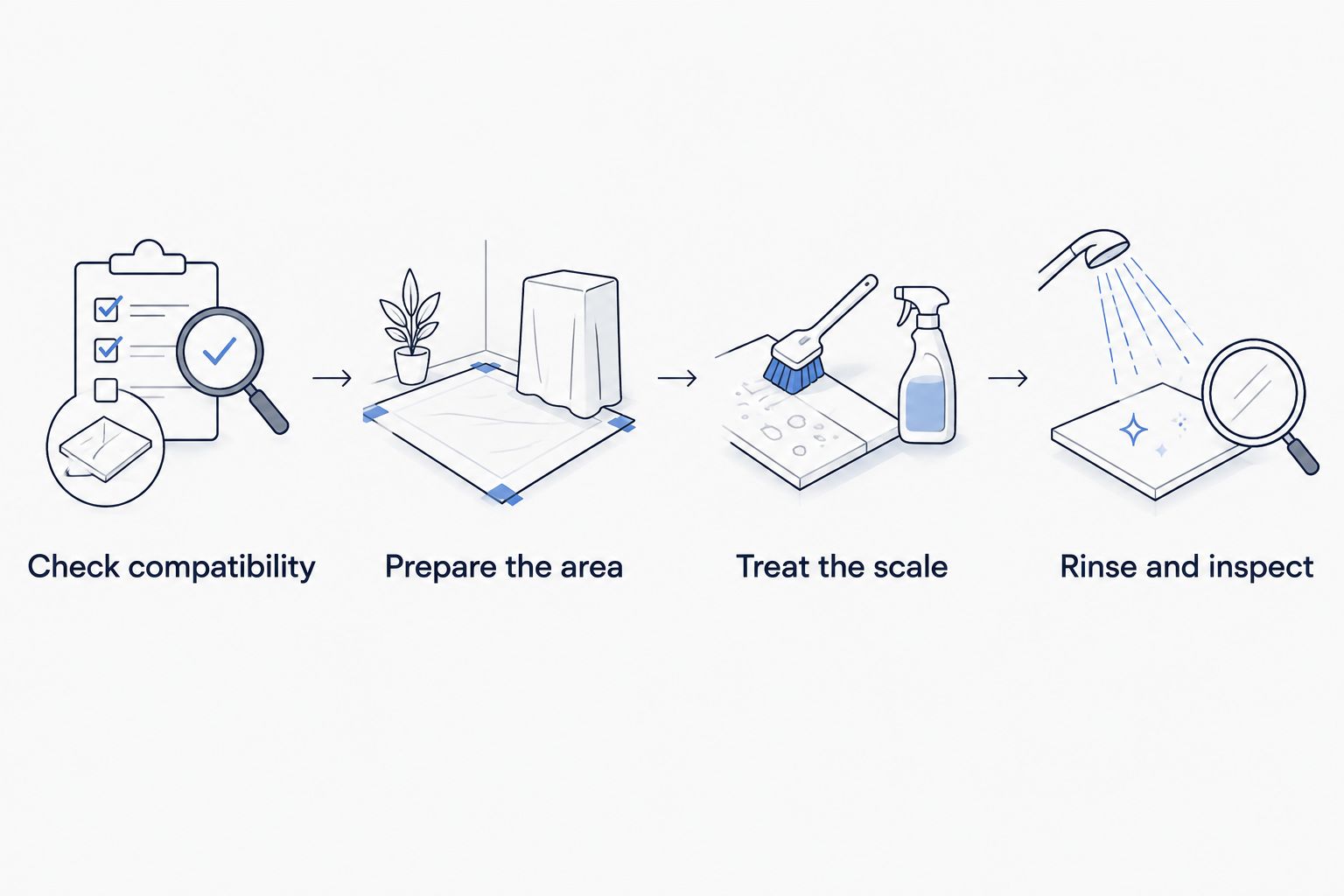
Clean taps and showerheads in 4 steps
Follow this sequence in 2026, using the product’s actual directions for dilution and contact time. There is no universal soaking duration that is safe for every fitting.
1. Check compatibility
Identify the fitting and finish. Read the care instructions alongside the cleaner label, including exclusions, ventilation requirements and protective-equipment directions.
If the showerhead is removable, confirm how to detach it before turning it. Do not force a seized connection or dismantle parts beyond the manufacturer’s instructions.
2. Prepare the area
Remove toiletries and protect surrounding surfaces according to the product directions. Keep children and pets away while cleaning and ventilate the room.
Never mix an acidic descaler, vinegar or citric acid with bleach. Acid and bleach can release toxic chlorine gas. Do not layer a descaler over another cleaner; follow the labels and rinse away previous products before changing treatments.
3. Treat the scale
Apply the permitted cleaner as directed and keep it within the intended treatment area. Use only the tools recommended for the finish; abrasive pads and metal scrapers can damage decorative surfaces.
Do not leave a treated fitting unattended beyond the specified contact time. If deposits remain, follow the product’s repeat-treatment instructions rather than extending the soak yourself.
4. Rinse and inspect
Rinse the treated surface thoroughly. Where the showerhead instructions require flushing after reassembly, complete that step before normal use.
Dry the exterior with a suitable soft cloth and inspect it in good light. If spray performance remains poor after the permitted cleaning procedure, stop repeating the treatment and investigate the fitting or plumbing.
Compatibility checks come before applying any descaler.
Which limescale remover should you choose?
Choose a purpose-made limescale remover with explicit approval for your fitting as the default. Choose vinegar only when the fixture instructions permit it. Choose citric acid when you have a suitably labelled product and an approved preparation method.
Housekept is best for households seeking home cleaning services across Sydney, Shoalhaven and Illawarra. For a bathroom clean, confirm the requested descaling work, fixture finishes and exclusions before booking through the cleaning services page.
Professional cleaning is not a substitute for repairing corroded fittings or resolving a plumbing fault. Describe whether the problem is visible crust, an uneven spray or persistent low flow so the requested work is clear.
FAQ
What's the best limescale remover for showerheads in 2026?
A purpose-made limescale remover approved for your showerhead’s material and finish is the default choice. Both the cleaner label and the fixture’s care instructions must permit the application.
Is white vinegar safe for every showerhead?
No, white vinegar is not safe for every showerhead. Use it only when the fixture manufacturer permits it, and follow the approved method rather than a generic soaking recipe.
Is citric acid better than vinegar for taps?
Neither is the better choice across all taps. The fitting’s compatibility instructions and the product’s directions determine whether either treatment is suitable.
Can I leave a showerhead soaking overnight?
Do not soak a showerhead overnight unless the fitting and cleaner instructions explicitly allow it. Extended exposure can damage unsuitable finishes or components.
Can I mix limescale remover with bleach?
No, never mix acidic limescale remover with bleach. Acids and bleach can release toxic chlorine gas; follow the labels and keep cleaning products separate.
Why is the shower still spraying unevenly after descaling?
Persistent uneven spray needs further investigation rather than repeated acid treatment. Check the manufacturer’s troubleshooting instructions for remaining debris, maintenance requirements or damaged components.
Can Housekept clean bathroom limescale?
Ask Housekept to confirm descaling within your requested home cleaning scope before booking. Identify the affected fittings and finishes, and distinguish visible deposits from plumbing or surface damage.
One last thing
Photograph the fitting’s care label or save its model details before you need another clean. That gives you a repeatable reference for future product choices instead of relying on memory or the colour of the tap.
For 2026 bathroom maintenance, make drying compatible exterior surfaces after use part of your routine. Removing residual droplets reduces the water left to evaporate into fresh mineral marks.