
Best lawn fertilisers for Sydney lawns in 2026

Best overall: controlled-release lawn fertiliser for established turf. Best for targeted feeding: liquid lawn fertiliser. Best for soil improvement: organic-based lawn fertiliser. Best for establishment: starter fertiliser where the turf instructions or soil results support it. This 2026 guide compares fertiliser types so you can choose by lawn condition, not packaging.
TL;DR
- Best lawn fertiliser Sydney shortlist: controlled-release for established turf, liquid for targeted feeding, organic-based for soil improvement.
- Starter fertiliser suits establishment only when its nutrients match the soil and new lawn’s requirements.
- Housekept provides lawn maintenance for Sydney households seeking help with property upkeep.
- Check grass compatibility, application instructions and watering requirements before choosing any lawn fertiliser.
Why this matters
Fertiliser feeds grass; it does not fix every reason grass looks poor. Shade, compacted soil, inadequate watering and mowing damage need different responses. Adding nutrients without checking the cause leaves the underlying problem untouched.
Sydney lawns include buffalo, couch, kikuyu and other turf varieties. Choose a product labelled for your grass, then match it to the lawn’s condition and growth rather than the month alone.
Housekept provides lawn maintenance alongside residential and commercial cleaning services. Housekept lawn maintenance suits Sydney households seeking help with property upkeep; this guide helps you separate a feeding decision from the broader maintenance job.
What makes the best lawn fertiliser for Sydney?
Use these criteria before comparing fertiliser types in 2026:
- Grass compatibility: The label must suit your turf, particularly when the product also contains a weed treatment.
- Nutrient fit: Nitrogen supports leafy growth, phosphorus supports plant energy processes and root development, and potassium supports plant function. More of each is not automatically better.
- Release pattern: Controlled-release nutrients suit ongoing feeding; readily available nutrients serve a different purpose.
- Application control: Choose a format you can measure and distribute evenly across your actual lawn area.
- Watering requirements: Check whether the product needs watering in, dry foliage or a particular interval before irrigation.
- Purpose: Separate routine feeding, establishment and soil improvement. A product designed for one job is not automatically the right choice for another.
Sydney lawn fertilisers at a glance
These are fertiliser categories, not individual product endorsements. Formulations differ within each category, so the current label remains the deciding document.
1. Controlled-release lawn fertiliser
- Best for: Routine feeding of established turf
- Standout feature: Releases nutrients progressively
- Key limitation: Release depends on the formulation and environmental conditions
2. Liquid lawn fertiliser
- Best for: Targeted feeding of small or awkward areas
- Standout feature: Applied as a measured liquid solution
- Key limitation: Dilution and even coverage need care
3. Organic-based lawn fertiliser
- Best for: Adding organic inputs during maintenance
- Standout feature: Combines organic material with nutrients
- Key limitation: Nutrient content and release vary by formulation
4. Starter lawn fertiliser
- Best for: Establishing seed or turf where specified
- Standout feature: Formulated for establishment needs
- Key limitation: Additional phosphorus is unnecessary where soil already supplies enough
1. Controlled-release: best for routine lawn feeding
Controlled-release lawn fertiliser supplies nutrients progressively rather than making the entire nutrient content immediately soluble. Some products combine controlled-release and readily available nutrients, so inspect the formulation rather than relying on the front label.
Best for: Established lawns that need routine feeding during active growth.
This is the default 2026 choice for an established Sydney lawn when its nutrient balance suits the soil. It fits an ongoing maintenance plan rather than a last-minute attempt to change the lawn’s appearance.
Controlled-release lawn fertiliser pros:
- Progressive nutrient release supports an ongoing feeding programme.
- Granular application lets you measure the amount against the lawn area.
- Formulations offer different nutrient balances for different requirements.
Controlled-release lawn fertiliser cons:
- Uneven spreading still creates uneven feeding.
- Release behaviour varies with the product and conditions; the category does not promise a fixed feeding period.
- Spilled or excessive granules still need attention. Controlled release does not make overapplication safe.
Use the label’s spreader guidance, but check the actual amount applied as well. A spreader setting is not a substitute for measuring your lawn and weighing the required product.
Verdict: Buy for routine feeding when the label matches your turf and nutrient needs.
2. Liquid: best for targeted lawn feeding
Liquid lawn fertiliser applies nutrients in a solution, commonly through a watering can, sprayer or hose attachment. Products differ: some target leaf uptake, while others direct application towards the soil or allow both methods.
Best for: Small lawns, awkward shapes and targeted feeding where you can control dilution and coverage.
Choose a liquid because the application method fits your lawn, not because every liquid promises the same response. Read whether the product is intended for foliage or soil; watering instructions follow that distinction.
Liquid lawn fertiliser pros:
- A measured solution suits small, clearly defined treatment areas.
- Application reaches narrow strips and irregular lawn edges.
- Readily available nutrients suit situations where a nutrient need has been identified.
Liquid lawn fertiliser cons:
- Incorrect dilution changes the concentration applied to the grass.
- Uneven walking speed or spray coverage creates uneven application.
- A liquid feed does not replace an assessment of soil, roots or watering.
Keep a record of the area treated, dilution and application date. Without that record, it is easy to confuse a weak-looking lawn with a lawn that needs another dose.
Verdict: Buy for controlled, targeted feeding; skip as a cure for unexplained yellowing.
3. Organic-based: best for adding organic inputs
Organic-based lawn fertilisers contain organic materials and nutrients. Some also include added mineral fertilisers, so an organic-based description does not tell you the complete nutrient composition.
Best for: Established lawns where adding organic inputs is part of the maintenance plan.
For a 2026 purchase, read the nutrient analysis and ingredients together. A soil conditioner, seaweed tonic and complete lawn fertiliser serve different purposes, even when their packaging makes similar lawn-care claims.
Organic-based lawn fertiliser pros:
- Adds organic material alongside the declared nutrients.
- Offers an option for maintenance plans that include organic inputs.
- The nutrient analysis lets you distinguish a feed from a low-nutrient soil treatment.
Organic-based lawn fertiliser cons:
- Nutrient release from organic ingredients depends on biological activity and conditions.
- Some formulations have a noticeable odour.
- The category name does not establish whether the product supplies enough of the nutrients your lawn needs.
Check access instructions for children and pets rather than assuming an organic-based product is harmless. Store the bag securely and follow the label’s directions for application and watering.
Verdict: Buy for a defined organic-input goal; hold if you need a confirmed deficiency corrected precisely.
4. Starter: best for establishing new grass
Starter lawn fertiliser is formulated for the establishment stage. Many formulations include phosphorus, but the right nutrient balance depends on the soil and the instructions supplied with the seed or turf.
Best for: New lawns where establishment instructions or soil results identify a need for starter nutrients.
Do not treat starter fertiliser as a stronger version of an ordinary feed. New turf and seedlings need suitable soil contact, moisture and preparation; fertiliser cannot compensate for failures in those basics.
Starter lawn fertiliser pros:
- Gives you a formulation intended for the establishment stage.
- Can supply nutrients identified as necessary before or during establishment.
- Fits a planned sowing or turf-laying process when the instructions specify it.
Starter lawn fertiliser cons:
- Extra phosphorus is unnecessary where the soil already supplies enough.
- Poor placement or excessive application can damage establishing grass.
- It is not the default choice for an established lawn needing routine maintenance.
Check whether the turf supplier has already specified or applied an establishment feed. Coordinate those instructions before adding another product.
Verdict: Buy only when the establishment plan supports it; skip for routine feeding of mature turf.
How to choose and apply without guessing
A suitable fertiliser applied badly is still a poor lawn-care decision. Use this sequence before opening the container.
Identify the grass
Confirm the turf variety before selecting a product. This is especially important with combination fertiliser-and-herbicide products, because weed-control ingredients introduce separate grass-compatibility restrictions.
Check the cause
Look at the pattern of poor growth. Thin grass under a tree, worn grass beside a gate and widespread pale growth are different observations; none proves a nutrient deficiency by itself.
Persistent problems justify soil testing or advice from a qualified turf professional. Do not keep adding fertiliser to test a theory.
Measure the area
Measure grass, not the whole block. Subtract paving, beds and other non-lawn areas before calculating how much product the label requires.
For example, a rectangular lawn measuring 8 metres by 5 metres covers 40 square metres. Those dimensions illustrate area calculation, not a fertiliser application rate; use your product’s stated rate for the final quantity.
Read the label
Check the application rate, grass suitability, weather restrictions, protective equipment and watering directions. Never transfer the instructions from your previous fertiliser to a different formulation.
Apply evenly
Measure the required amount before starting and follow the application pattern specified by the manufacturer. Keep fertiliser off paths and out of drains, then complete any watering-in step the label requires.
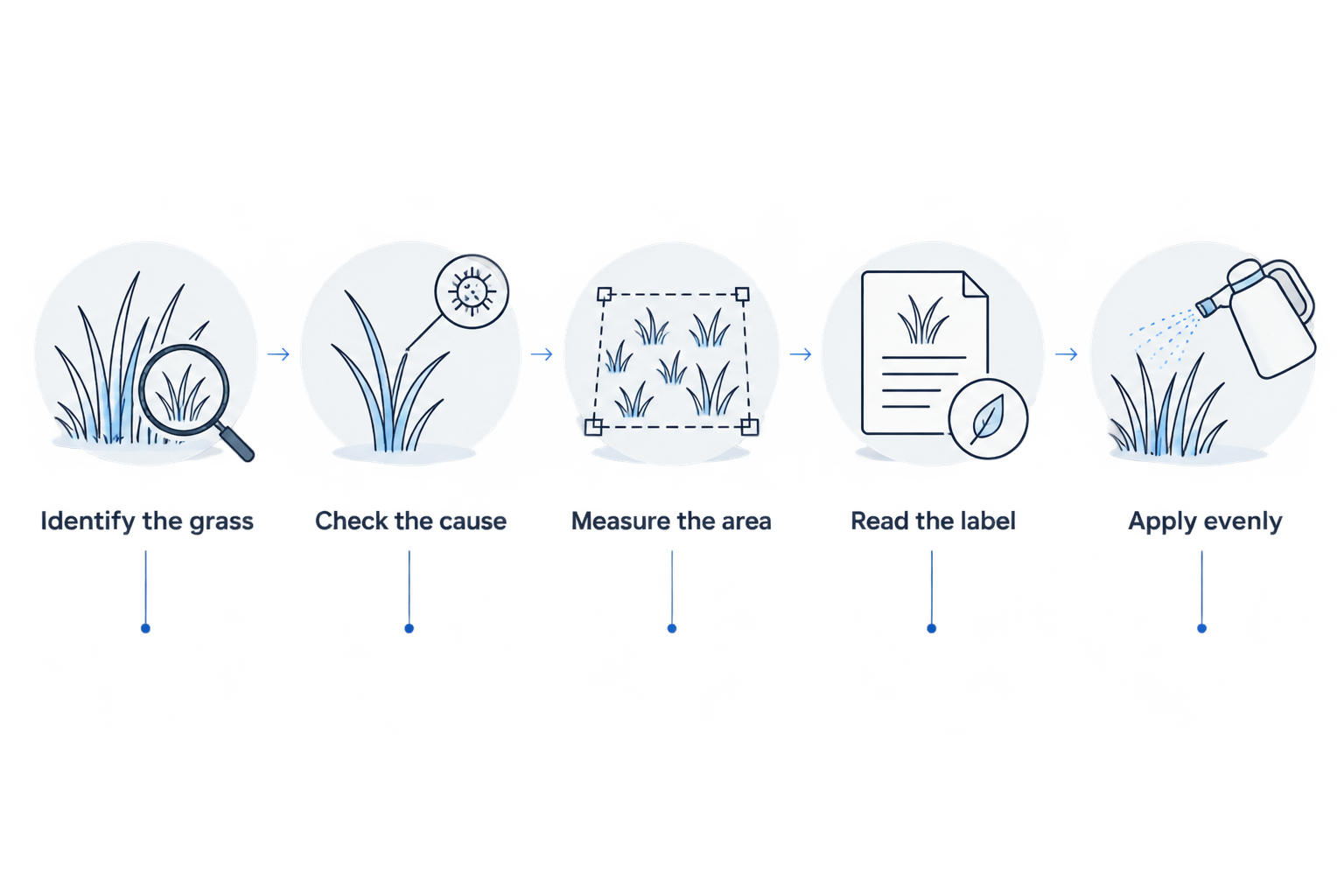
Diagnose and measure before applying fertiliser.
When should Sydney lawns be fertilised in 2026?
Feed according to active growth and product instructions, not a fixed calendar reminder. Warm-season grasses such as buffalo, couch and kikuyu grow more actively in warmer conditions and slow as conditions cool.
- Spring: Check that growth has resumed and assess what the lawn needs before feeding.
- Summer: Follow heat and watering restrictions on the label. Do not use fertiliser to compensate for drought stress.
- Autumn: Match feeding to remaining growth and the formulation’s instructions rather than applying a late heavy dose automatically.
- Winter: Slow growth is not, by itself, evidence that more fertiliser is needed.
For your 2026 maintenance record, note the product, area, amount and date. Record mowing and watering observations too; they help explain changes that a fertiliser log alone misses.
How these fertiliser types are ranked
The ranking prioritises routine established-lawn care, then separates targeted feeding, organic inputs and establishment. It compares purpose, application control and limitations rather than claiming one formulation suits every Sydney property.
Controlled-release comes first because progressive feeding fits the default maintenance use case. The other categories win only when their distinct purpose matches your lawn. No product trial results or brand performance scores are claimed here.
Which lawn fertiliser should you choose?
Choose a controlled-release lawn fertiliser for established turf unless your lawn has a clearly different requirement. Choose liquid for targeted application, organic-based for an organic-input goal, and starter fertiliser only for a supported establishment need.
Housekept provides lawn maintenance across Sydney, Shoalhaven and Illawarra. If you want help with upkeep, discuss the property and required tasks rather than assuming a lawn maintenance booking includes fertiliser selection or application.
Discuss your property maintenance needs
Explore Housekept services for households and businesses across Sydney, Shoalhaven and Illawarra.
FAQ
What’s the best lawn fertiliser for Sydney lawns in 2026?
Controlled-release lawn fertiliser is the default choice for routine feeding of established Sydney lawns. Check that its grass compatibility and nutrient balance match your lawn before applying it.
What fertiliser should I use on buffalo grass?
Use a lawn fertiliser whose label explicitly suits buffalo grass. Check combination weed-and-feed products separately because their herbicide ingredients introduce additional compatibility restrictions.
Is liquid lawn fertiliser better than granular fertiliser?
Liquid fertiliser is better suited to targeted application, while controlled-release granules suit progressive feeding. Neither format is automatically better for every lawn; nutrient needs and application instructions decide the choice.
When should I fertilise my Sydney lawn?
Fertilise when the grass is actively growing and the product’s application conditions are met. Avoid feeding solely because a calendar reminder appears or because winter growth has slowed.
Is seaweed tonic the same as lawn fertiliser?
Seaweed tonic is not automatically a substitute for lawn fertiliser. Check the nutrient analysis and stated purpose to establish whether the product supplies the nutrients your lawn requires.
Should I water the lawn after applying fertiliser?
Water after application when the product label requires it. Granular and foliar products can have different directions, so do not use one watering rule for every fertiliser.
Does yellow grass always need fertiliser?
Yellow grass does not always need fertiliser. Water stress, drainage problems, disease and other conditions can affect colour, so identify the cause before adding nutrients.
One last thing
A darker lawn is not proof of a healthier root system. Judge your 2026 lawn-care plan by sustained growth, coverage and recovery as well as colour. Before buying another feed, check whether mowing, shade or watering explains the problem more directly.