.png)
Best glass and window cleaning products for streak-free results 2026

Best overall: a glass cleaner labelled for your surface. Best for routine fingerprints: a microfibre cloth set. Best budget option: mild washing-up liquid diluted according to its label. This 2026 guide also compares a window squeegee and plain water, so you can match the product to the mess rather than buy another spray.
TL;DR
- The best glass cleaning products match the surface, soil and drying method—not just the bottle.
- Choose a glass cleaner for everyday marks and a squeegee for larger, wet window panes.
- Use separate microfibre cloths for cleaning and drying; replace a dirty cloth before it spreads residue.
- Housekept provides professional home cleaning for households across Sydney, Shoalhaven and Illawarra.
Why this matters
A window can look clean straight on and still show streaks when the light changes. Leftover cleaner, dirty cloths and uneven drying all work against a clear finish. Adding more spray does not solve those problems.
Housekept provides home, holiday rental, end-of-lease and commercial cleaning services. For your own glass-cleaning jobs, start with the surface instructions and choose a method you can finish safely. A bathroom mirror and an upstairs exterior window are not the same task.
What makes the best glass cleaning products?
For this 2026 guide, the strongest choice is the one that fits the job without creating extra residue or risking the surface.
- Surface compatibility: The label must cover the glass, mirror or coating you intend to clean. Check the surface manufacturer's instructions too.
- Soil removal: Fingerprints, loose dust and greasy deposits need different levels of cleaning. Start with the least involved method that suits the mark.
- Residue control: Choose a method that lets you remove the cleaner rather than leave it to dry on the pane.
- Drying method: A clean cloth suits small surfaces; a squeegee suits panes where you can control the water.
- Handling and access: You need a comfortable grip, manageable tools and safe access to the whole surface.
- Reuse and maintenance: Cloths and squeegees need cleaning themselves. A dirty tool stops being a useful finishing tool.
The best glass-cleaning setup includes a way to remove dirt and a separate way to remove moisture. Buying a cleaner without planning the finish leaves half the job undecided.
Best glass cleaning products at a glance
These are product types, not a ranking of named retail brands. Match the category to your surface before choosing a particular bottle or tool.
1. Surface-compatible glass cleaner
- Best for: Everyday marks on suitable glass
- Standout feature: Purpose-labelled cleaning formula
- Key limitation: Compatibility varies; excess cleaner leaves residue
2. Microfibre cloth set
- Best for: Fingerprints and small indoor surfaces
- Standout feature: Separate cleaning and drying cloths
- Key limitation: Dirty or poorly washed cloths spread residue
3. Window squeegee
- Best for: Larger accessible window panes
- Standout feature: Removes wash water in controlled passes
- Key limitation: Needs a sound blade and edge finishing
4. Mild washing-up liquid
- Best for: A simple window-washing solution
- Standout feature: Mixes with water for washing suitable glass
- Key limitation: Too much detergent creates extra rinsing work
5. Plain water
- Best for: Light marks on compatible surfaces
- Standout feature: Adds no cleaning-product residue
- Key limitation: Does not handle every greasy or stuck-on mark
1. Glass cleaner: best for everyday marks
A glass cleaner is the default choice for routine marks on surfaces its label approves. It combines a cleaning formula with straightforward application instructions. That makes it easier to choose a suitable method than adapting an unrelated household cleaner.
Check the bottle before using it on tinted, coated or specialist glass. A product labelled for ordinary windows is not automatically suitable for every mirror, shower enclosure or decorative panel.
Glass cleaner pros:
- Gives you product-specific directions for application and removal.
- Suits targeted cleaning without preparing a bucket.
- Lets you treat fingerprints and small marks individually.
- Works with a cloth-based cleaning routine where the label permits it.
Glass cleaner cons:
- Surface compatibility differs between formulas.
- Excess spray adds liquid you then need to remove.
- Spray near surrounding materials needs careful control.
Best for: Everyday marks on ordinary indoor glass that the product label specifically covers.
Follow the stated application method. If the instructions permit applying cleaner to a cloth, that approach helps you control where it goes. Keep the drying cloth separate from the cloth carrying the cleaner.
Verdict: Buy a surface-compatible glass cleaner as your default bottle; skip any formula that conflicts with the surface instructions.
2. Microfibre cloths: best for fingerprints and mirrors
A microfibre cloth set gives you separate tools for lifting marks and finishing the surface. For small indoor panes and mirrors, cloth condition matters as much as the cleaning liquid. A cloth already carrying grease or detergent can transfer it back to the glass.
Use 2 cloths: one for cleaning and one for drying. This is a practical setup, not a product performance claim. It keeps your finishing cloth from immediately picking up the same liquid and dirt you are trying to remove.
Microfibre cloth pros:
- Gives you control around corners and narrow edges.
- Can be washed and reused according to its care label.
- Separates the wet cleaning stage from the dry finish.
- Suits small surfaces where a squeegee is awkward.
Microfibre cloth cons:
- Requires laundering and clean storage.
- Trapped grit can damage a surface during wiping.
- Large panes involve more hand wiping than a squeegee method.
Best for: Routine fingerprints, mirrors and small accessible indoor panes.
Follow the cloth manufacturer's washing instructions, including any restrictions on fabric softener. Put a dirty cloth aside rather than trying to finish the whole room with it. Keep glass cloths separate from cloths used on greasy kitchen surfaces.
Verdict: Buy a dedicated cloth set if your current method uses the same cloth to clean and dry.
3. Window squeegee: best for larger accessible panes
A window squeegee removes wash water from glass with a rubber blade. It is a finishing tool, not a replacement for washing: loosen the dirt first, then remove the liquid. A cloth handles the edges and any remaining drips.
Choose a size you can control across the pane. The widest tool is not automatically the easiest one to use, especially around small panes, divided windows or restricted access.
Window squeegee pros:
- Removes wash water rather than absorbing it into repeated cloths.
- Gives you a consistent finishing method across larger panes.
- Pairs with a separate window washer or cleaning cloth.
- Lets you see and correct missed wet areas as you work.
Window squeegee cons:
- A damaged or dirty blade leaves lines behind.
- Frames and edges still need attention.
- Awkward access makes controlled passes difficult.
Best for: Larger window panes you can reach safely and wash without wetting unsuitable surroundings.
Keep the blade clean and inspect it before starting. Work in controlled, overlapping passes, then remove water at the edges with a clean cloth. Protect nearby flooring and follow any frame-care instructions.
Verdict: Buy a squeegee for accessible windows; skip it for delicate surrounding materials or access you cannot control safely.
4. Mild washing-up liquid: best for a simple washing solution
Mild washing-up liquid mixed with water is a window-washing option where both the detergent label and surface instructions allow it. It helps loosen everyday dirt before you remove the wash water. The important finishing step is removing the detergent, not letting it dry on the glass.
Use the dilution stated on the product label. A heavy mixture creates more detergent to rinse or remove; extra suds are not evidence of a better glass finish.
Mild washing-up liquid pros:
- Uses a familiar household cleaning category.
- Suits a bucket-and-squeegee method on appropriate glass.
- Allows you to wash the pane before finishing it.
Mild washing-up liquid cons:
- It is not specifically formulated for every glass surface.
- Excess detergent leaves residue and adds rinsing work.
- Water handling is less convenient around vulnerable interiors.
Best for: Straightforward window washing when you already have a suitable mild detergent and can remove the solution properly.
Do not add other household cleaners to the mixture. Follow the detergent directions and the window manufacturer's guidance. If either gives conflicting instructions, choose a product explicitly approved for that surface instead.
Verdict: Hold off on another bottle if a suitable detergent already fits the job; skip improvised mixtures.
5. Plain water: best for light marks
Plain water with a clean cloth is the simplest starting point for light marks on a water-compatible surface. It introduces no cleaning-product residue, though dissolved minerals in tap water can leave deposits when droplets dry. You still need a clean drying method.
This is a starting method, not a solution for every dirty window. If a light pass does not remove the mark, switch to a compatible cleaner rather than repeatedly scrubbing the same spot.
Plain water pros:
- Adds no detergent or spray residue.
- Keeps the method simple for lightly marked surfaces.
- Works with a clean cloth already assigned to glass.
Plain water cons:
- Does not remove every greasy or stubborn deposit.
- Water left to dry can leave visible marks.
- Still requires checking surface and surrounding-material compatibility.
Best for: Light dust and minor marks on surfaces whose care instructions permit damp wiping.
Use a lightly dampened cloth rather than soaking the area. Finish with a separate clean cloth, especially around mirror edges and frames. If grit is present, remove it without dragging it across the surface.
Verdict: Try water first for light marks; skip repeated scrubbing when the dirt needs a suitable cleaner.
How we ranked these options
The 2026 ranking prioritises surface compatibility, soil removal, residue control, drying and safe handling. It is a buying framework for product categories, not a laboratory comparison or a claim that one retail formula outperforms another.
Glass cleaner takes the default slot because its label identifies its intended cleaning use. Cloths, squeegees, detergent and water each serve a different job. Choose the category that fits your task, then check the individual product instructions.
A streak-free routine that supports your product choice
The best glass cleaning products cannot compensate for a dirty finishing cloth. For your 2026 cleaning routine, keep the sequence simple and finish each pane before moving on.
- Check the surface. Read the glass, coating and cleaner instructions. Protect nearby materials that should not get wet.
- Remove loose dirt. Avoid dragging grit across the glass. Start with clean equipment.
- Clean the pane. Work on 1 pane at a time, using the chosen product as directed.
- Dry the edges. Remove the liquid with a clean cloth or squeegee, then catch drips around the frame.
- Inspect the finish. View the dry glass from another angle. Treat a remaining mark rather than respraying everything.
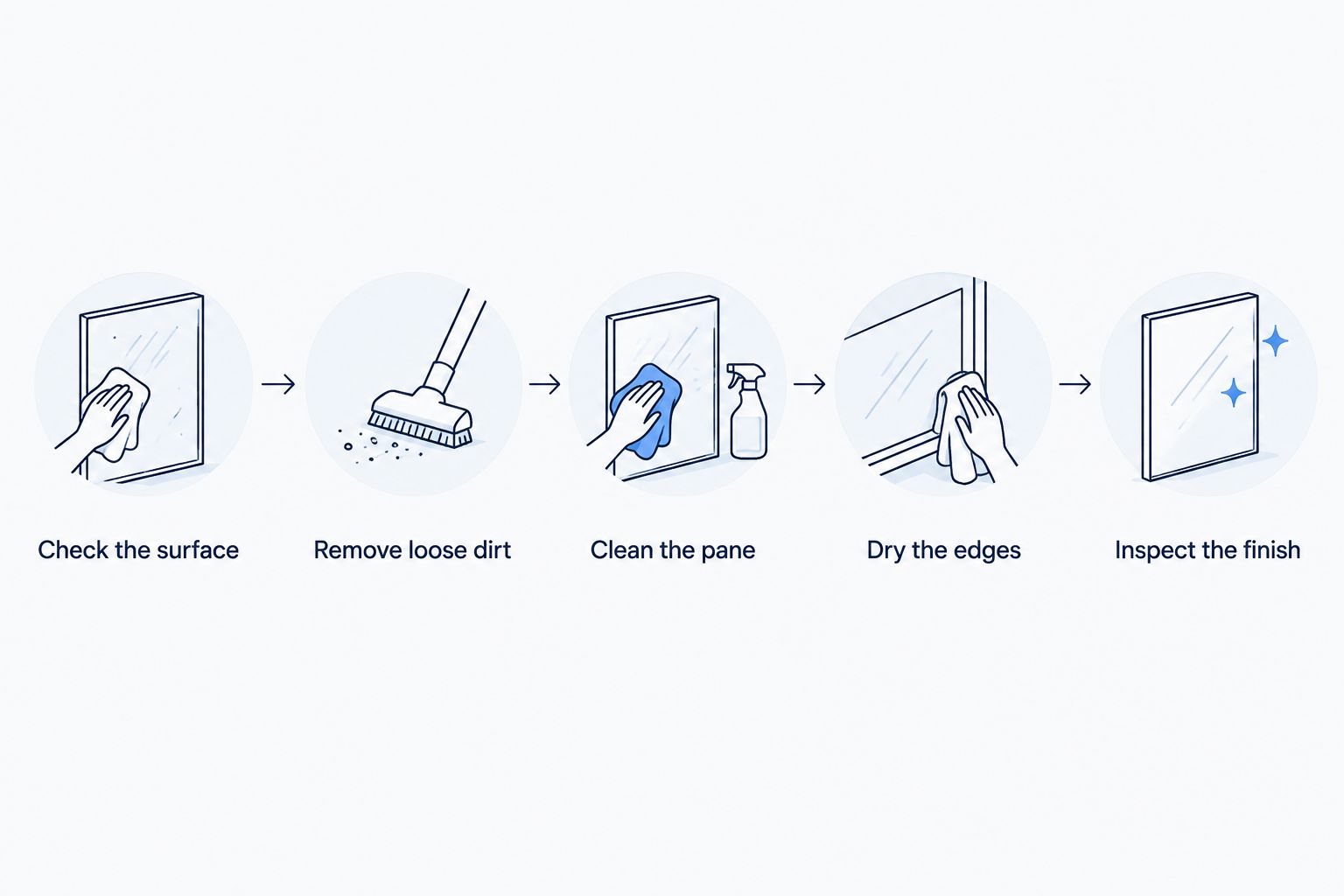
Finish each pane before moving to the next.
For a rectangular pane, check all 4 edges for remaining moisture. Choose a time when direct sun is not heating the glass; rapid drying makes it harder to remove the cleaning liquid evenly. Never mix cleaning products, and keep every product in its labelled container.
Which glass cleaning products should you choose?
Choose a compatible glass cleaner and separate cleaning and drying cloths for everyday indoor jobs. Add a squeegee when larger accessible windows make hand drying cumbersome. Use plain water for light marks and suitable diluted detergent when a wash-and-remove method fits the surface.
Housekept is a professional home-cleaning option for households in Sydney, Shoalhaven and Illawarra. If you want help rather than another cleaning tool, discuss the specific surfaces and tasks before arranging a service. Do not assume every glass-cleaning task is included.
Discuss your home cleaning
Ask about professional home cleaning in Sydney, Shoalhaven and Illawarra.
FAQ
What's the best glass cleaner for streak-free results?
A glass cleaner approved for your surface is the best default for everyday marks. Follow its directions and remove the liquid with a clean drying cloth or squeegee; the bottle alone does not determine the finish.
Is a microfibre cloth better than a squeegee?
A microfibre cloth suits small panes and mirrors, while a squeegee suits larger accessible windows. Both need to be clean, and a squeegee still needs a cloth for edges and drips.
Can I use washing-up liquid to clean windows?
Use mild washing-up liquid only where its label and the window's care instructions permit it. Follow the stated dilution and remove the wash solution rather than letting it dry on the glass.
Why do my windows look streaky after cleaning?
Streaks can come from leftover cleaning liquid, dirty cloths or uneven drying. Check your finishing tool first, then clean a small area again using the product as directed.
Can I use ordinary glass cleaner on tinted windows?
Use ordinary glass cleaner on tinted windows only if the tint instructions and cleaner label approve it. A label for standard glass does not establish compatibility with a film or coating.
Do I need a different product for mirrors?
Choose a product whose label includes mirrors and follow the mirror manufacturer's care instructions. Control moisture around edges and backing rather than treating the mirror like an exterior window.
Can Housekept help with my home cleaning?
Housekept provides professional home cleaning across Sydney, Shoalhaven and Illawarra. Discuss your glass surfaces and required tasks before booking so the agreed cleaning scope is clear.
One last thing
Before adding a new glass spray to your 2026 cupboard, inspect the cloth or blade that finishes the job. If it is dirty, carrying residue or damaged, change that first. A new bottle does not fix a dirty finishing tool.