
Best floor cleaners for timber and tile floors in 2026

Best overall for mixed floors: a pH-neutral cleaner explicitly approved for your timber finish and tiles. Best for oiled timber: a finish-specific maintenance cleaner. Best for greasy ceramic or porcelain tiles: a compatible tile degreaser. This 2026 guide compares cleaner types, explains their limits and shows you how to avoid residue and moisture damage.
TL;DR
- The best floor cleaners for timber and tile floors match the finish, not just the flooring material.
- Choose a compatible pH-neutral cleaner for routine cleaning across mixed timber and tile areas.
- Use finish-specific maintenance cleaner on oiled timber; keep tile degreaser away from timber unless expressly approved.
- Housekept provides home cleaning services for households across Sydney, Shoalhaven and Illawarra.
Why your floor finish matters
A cleaner can suit ceramic tiles and still be wrong for the timber beside them. Even two timber floors can need different care when one has a surface coating and the other has an oil or wax finish.
Choose by finish first, cleaning problem second. A bottle labelled for floors is not automatic permission to use it throughout your home, and a stronger formula is not a better everyday choice.
Housekept provides home and commercial cleaning services across Sydney, Shoalhaven and Illawarra. When arranging cleaning, identify your floor surfaces and share any manufacturer care instructions before products are selected.
For your 2026 cleaning routine, separate ordinary dust removal from stain treatment. That keeps a small greasy patch from becoming a reason to apply a specialist chemical across an entire room.
What makes the best floor cleaners for timber and tile floors?
Use these criteria before choosing a bottle:
- Finish compatibility: The label must cover your actual surface, including any coating, oil, wax or sealer.
- Soil match: Routine dust and tracked-in dirt need a different approach from cooking grease or mineral deposits.
- Moisture control: Timber needs a method that avoids standing water and wet seams, not simply a timber-friendly chemical.
- Residue control: Correct dilution and any required rinsing matter as much as the formula.
- Clear directions: Look for readable instructions covering application, dilution, restrictions and rinsing.
Neutral pH is around pH 7, but pH alone does not establish floor compatibility. Ingredients, concentration and the floor finish also matter; use the floor manufacturer's care guidance alongside the cleaner label.
Floor cleaner options at a glance
These are cleaner categories, not interchangeable recipes. Keep this 2026 shortlist beside the care instructions for your floor and reject any option that excludes the material or finish.
Compatible pH-neutral floor cleaner
- Best for: Routine cleaning across mixed sealed timber and tile areas
- Standout feature: One routine where both surfaces are explicitly approved
- Key limitation: Neutral pH does not guarantee compatibility
Finish-specific timber maintenance cleaner
- Best for: Oiled or waxed timber
- Standout feature: Matches maintenance to the timber finish
- Key limitation: Not automatically suitable for neighbouring tiles
Tile-compatible degreaser
- Best for: Greasy ceramic or porcelain kitchen tiles
- Standout feature: Targets oily soil rather than ordinary dust
- Key limitation: Requires checks for grout, sealers and adjacent timber
pH-neutral natural-stone cleaner
- Best for: Marble, limestone and other identified natural-stone floors
- Standout feature: Provides a stone-specific selection route
- Key limitation: Does not replace diagnosis of etching or damaged sealers
1. Compatible pH-neutral cleaner: best for mixed sealed floors
A compatible pH-neutral floor cleaner is the default for routine cleaning when its label covers both your sealed timber and your tiles. It lets you organise everyday mopping around one approved formula rather than carrying a specialist treatment through every room.
The word compatible does the work here. Check the actual finish and tile type, then follow the dilution instructions; do not treat a generic hard-floor claim as approval for every surface.
Compatible pH-neutral cleaner pros:
- Supports a shared routine where both flooring surfaces are listed.
- Suits maintenance cleaning rather than unnecessary specialist treatment.
- Reduces the need to switch chemicals between approved areas.
Compatible pH-neutral cleaner cons:
- Does not automatically remove embedded grease or mineral scale.
- Still requires moisture control on timber and correct dilution everywhere.
Best for: Homes with sealed timber beside ceramic or porcelain tiles, provided the cleaner covers both.
Use a well-wrung mop on timber and keep liquid from collecting at joins, edges and thresholds. Replace dirty cleaning solution rather than spreading it into the next room, and follow any label requirement to rinse.
Verdict: Buy this category as your everyday default only after confirming both surfaces are approved.
2. Finish-specific timber cleaner: best for oiled or waxed floors
A finish-specific timber maintenance cleaner follows the care system for an oiled or waxed floor. Start with the flooring or finish manufacturer's instructions, which should identify the appropriate cleaner and maintenance method.
Do not assume every timber cleaner suits every timber finish. A maintenance soap intended for one system is not automatically the right choice for a different coating, and a cleaning product is not necessarily a repair treatment.
Finish-specific timber cleaner pros:
- Matches product selection to the finish rather than the timber species alone.
- Provides a clear route when manufacturer care instructions name a compatible system.
- Keeps routine cleaning separate from stain removal or refinishing.
Finish-specific timber cleaner cons:
- Requires you to identify the finish before choosing a product.
- Does not justify using the same solution on adjoining tiles or stone.
Best for: Oiled or waxed timber with identifiable maintenance instructions.
If you inherited the floor and have no paperwork, check with the installer, property owner or flooring supplier before wet cleaning. Do not try to identify the finish by applying increasingly strong chemicals to visible boards.
Verdict: Buy the cleaner specified for the finish; hold off when the finish is unknown.
3. Tile-compatible degreaser: best for greasy kitchen tiles
A tile-compatible degreaser targets oily soil on ceramic or porcelain tiles. Use it when ordinary maintenance cleaning leaves a greasy film, not as an automatic replacement for your everyday cleaner.
Compatibility must include more than the tile face. Check grout, sealers, nearby metal trims and the timber transition, then follow the product's contact-time and rinsing directions.
Tile-compatible degreaser pros:
- Targets cooking grease and oily footprints directly.
- Allows treatment of a defined kitchen area rather than the whole home.
- Gives you a separate option when routine cleaner does not address the soil.
Tile-compatible degreaser cons:
- Is not a default choice for timber or unidentified stone.
- Adds handling and rinsing steps where the label requires them.
Best for: Confirmed ceramic or porcelain kitchen tiles with greasy build-up.
Protect the adjoining timber from splashes and runoff. Apply only as directed, agitate with a suitable non-scratch tool and remove the dirty solution rather than leaving it to dry on the floor.
If the surface still feels sticky, stop adding concentrate. Recheck the dilution, rinsing instructions and whether the film is actually grease rather than residue from previous cleaning.
Verdict: Buy for a confirmed grease problem on compatible tiles; skip as a whole-house cleaner.
4. pH-neutral stone cleaner: best for natural-stone tiles
A pH-neutral natural-stone cleaner is the starting category for floors such as marble or limestone, subject to approval for the stone and sealer. Natural stone needs its own check because products suitable for glazed ceramic tiles are not automatically suitable for it.
Avoid treating vinegar as a universal floor cleaner. Acids can etch acid-sensitive stone such as marble and limestone, leaving surface damage that ordinary washing does not remove.
pH-neutral stone cleaner pros:
- Focuses selection on the stone rather than a broad tile claim.
- Offers a routine-cleaning route without defaulting to acidic descalers.
- Encourages checks for both stone and sealer compatibility.
pH-neutral stone cleaner cons:
- Does not repair etching, scratches or a failing sealer.
- Still needs approval for the particular stone; neutral pH is not enough.
Best for: Identified natural-stone floors with available care guidance.
A dull patch is not proof that the floor needs stronger cleaner. If the appearance remains after appropriate cleaning and drying, ask the stone supplier or a stone-care specialist to assess the surface before further treatment.
Verdict: Buy an approved stone cleaner for maintenance; skip acidic DIY mixtures on acid-sensitive stone.
How these cleaner categories rank
This 2026 ranking puts surface compatibility ahead of cleaning strength. The mixed-floor option comes first because it covers routine cleaning across approved surfaces; the remaining options address distinct finishes or soil problems.
The criteria are finish compatibility, soil match, moisture control, residue control and clear directions. This is a selection guide, not a claim that one unnamed formula outperformed another in laboratory testing.
Housekept provides floor cleaning within its broader home cleaning services, not a proprietary floor-cleaner range. Choose a cleaning service when you want help with the work, and choose chemicals according to the floor's requirements.
A practical routine for timber and tile
Build your 2026 floor-care routine around preparation and controlled application. Choosing a compatible bottle is only part of the job; grit, excess water and dirty equipment can undermine the result.
- Identify surfaces: Confirm timber finish, tile material and any sealer before selecting a cleaner.
- Remove grit: Vacuum with a suitable hard-floor attachment or use a soft dry mop before wet cleaning.
- Test discreetly: Test an inconspicuous patch and check it after drying before treating the visible floor.
- Clean in sections: Follow dilution directions and keep moisture controlled, especially around timber joins.
- Check when dry: Inspect for residue, streaks or remaining soil before repeating treatment.
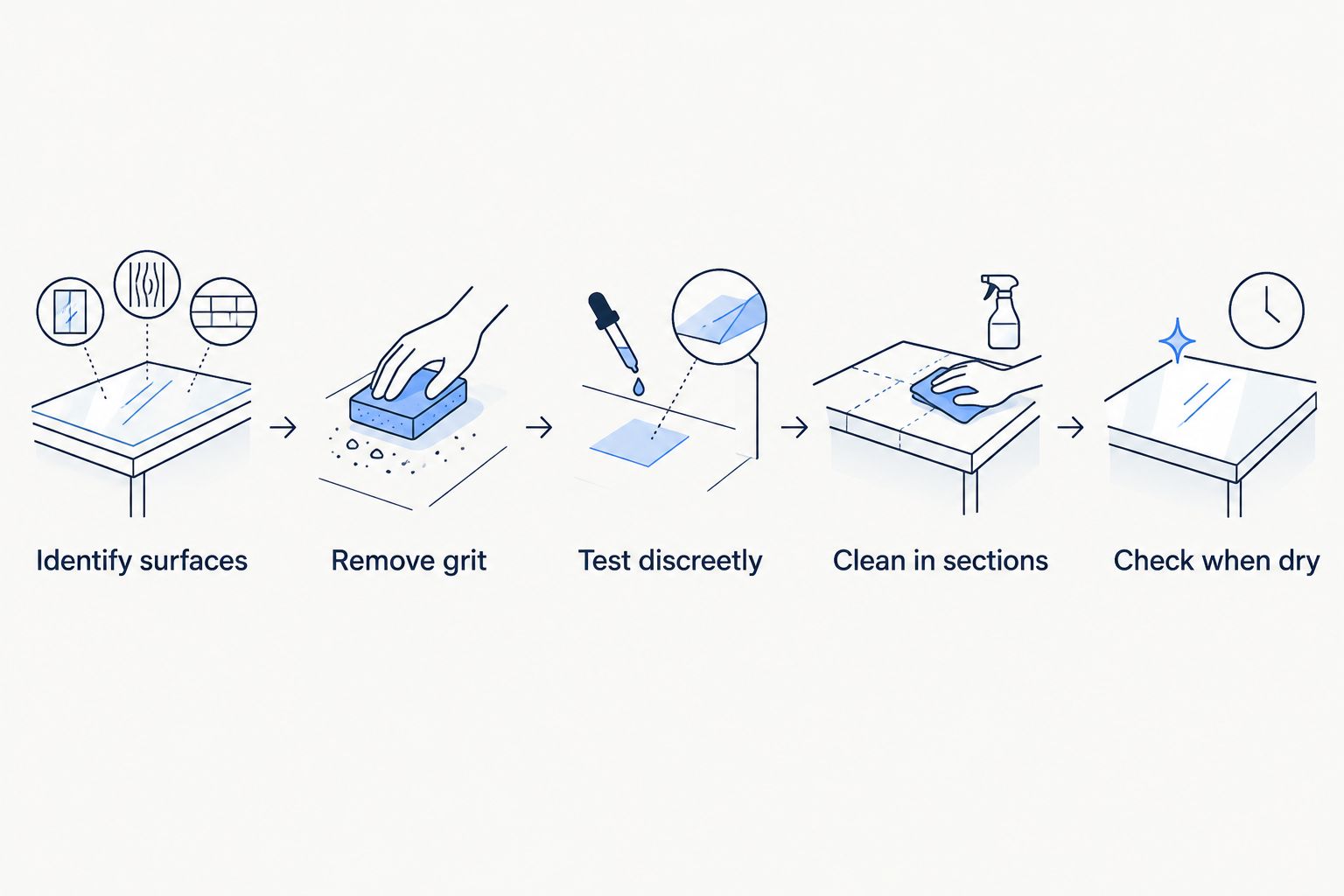
Identify the floor before choosing the cleaner, then inspect the result after drying.
For a bucket-and-mop method, consider 2 buckets: one for cleaning solution and one for rinsing the mop. Keep the timber mop well wrung out, and change either bucket's water when it becomes dirty.
Use 1 test patch for each different surface or finish before wider application. That is a practical checking step, not proof that an otherwise incompatible product is safe.
Never mix cleaning chemicals. Follow the label's handling instructions and keep people and pets off wet floors until the area is dry and any stated re-entry instructions are met.
Which floor cleaner should you choose?
Choose a compatible pH-neutral cleaner for routine mixed-floor cleaning, then add a specialist only for a defined need. Use finish-specific care for oiled timber, a compatible degreaser for greasy ceramic or porcelain tiles, and approved stone cleaner for natural stone.
For 2026, make your shopping decision from the current label rather than an old recommendation or familiar bottle colour. Check surface approval, dilution and rinsing instructions before use.
Keep the care instructions accessible to everyone who cleans your home. A suitable product used at the wrong dilution or left pooling on timber is still the wrong cleaning method.
Get help with your home cleaning
Housekept provides home cleaning across Sydney, Shoalhaven and Illawarra.
FAQ
What's the best floor cleaner for both timber and tiles?
Choose a pH-neutral cleaner explicitly approved for your timber finish and tile material. Neutral pH alone does not establish compatibility, and timber still requires controlled moisture.
Can I use the same mop on timber and tile floors?
Use the same mop only if it is suitable for both surfaces and clean before each area. Remove grit, prevent specialist tile chemicals transferring onto timber and wring the mop out thoroughly for timber cleaning.
Is vinegar safe for timber and tile floors?
Vinegar is not a suitable universal cleaner for mixed timber and tile floors. It can etch acid-sensitive natural stone, and timber care should follow the finish manufacturer's instructions.
Why is my floor sticky after mopping?
A sticky floor can result from cleaning-product residue or soil that has not been removed. Check the dilution and rinsing directions, use clean equipment and reassess the soil before adding more cleaner.
Can I steam clean timber floors?
Do not steam clean timber unless the flooring manufacturer explicitly permits it. Heat and moisture can damage unsuitable flooring systems, so approval must cover the actual floor rather than the cleaner's general claims.
What's best for greasy kitchen tiles?
A tile-compatible degreaser is the specialist option for greasy ceramic or porcelain tiles. Confirm compatibility with grout and sealers, protect adjoining timber and follow the label's rinsing instructions.
Does floor cleaner remove scratches or dull stone patches?
Routine floor cleaner does not repair scratches or acid etching. Clean according to the surface instructions first, then seek flooring or stone-care advice if the damage remains.
One last thing
Clean the mop before blaming the cleaner. A dirty pad or bucket moves dissolved soil back onto the floor, so inspect your equipment and change dirty water before switching to a stronger product.