
Best rangehood and exhaust fan cleaners for kitchens 2026

Best overall: mild dishwashing detergent for washable grease filters. Best for stubborn grease: a material-compatible kitchen degreaser. Best for stainless-steel finishing: a cleaner approved for that surface. This 2026 guide separates cleaners that remove grease from products that simply finish the outside.
TL;DR
- The best rangehood cleaner for routine filter washing is mild dishwashing detergent, where the appliance manual permits it.
- Kitchen degreasers suit stubborn residue, but aluminium and coated surfaces need explicit compatibility checks.
- Stainless-steel cleaner finishes compatible exterior panels; it does not replace filter washing.
- Housekept provides home cleaning across Sydney, Shoalhaven and Illawarra; confirm rangehood tasks before booking.
Why this matters
A rangehood is not one washable surface. Its removable grease filters, exterior panels, controls and electrical housing need different treatment. The wrong cleaner can damage a finish without solving the greasy filter underneath.
Choose by component and material, not by the strongest claim on the bottle. Start with your appliance instructions, then match the cleaning product to the job. For broader residue around the cooking area, see the guide to kitchen degreasers for grease and grime.
This guide compares cleaning approaches rather than naming a bottle as suitable for every appliance. No detergent, spray or dishwasher cycle overrides the rangehood manufacturer's care instructions.
What makes the best rangehood cleaner?
Use these criteria to choose a rangehood cleaner in 2026:
- Material compatibility: The label must suit the surface, especially aluminium mesh, painted panels and protective coatings.
- Grease removal: Choose a product intended for oily residue, not just fragrance or surface shine.
- Rinsing requirements: Removable filters need a method that lets you remove cleaner and loosened grease properly.
- Application control: A cloth gives you more control around switches and openings than spraying towards the appliance.
- Component suitability: A washable metal grease filter is different from an odour-absorbing charcoal filter.
- Practical handling: Follow the product's ventilation, protective equipment and dilution instructions without improvising.
Check the current label even if you recognise the packaging. Your decision rests on the instructions for that particular product and appliance, not the category name alone.
Rangehood cleaners at a glance
Mild dishwashing detergent
- Best for: Routine washing of permitted removable filters
- Standout feature: Lifts everyday cooking grease during washing
- Key limitation: Heavy deposits need more attention
Material-compatible kitchen degreaser
- Best for: Stubborn grease on approved surfaces
- Standout feature: Targets oily kitchen residue
- Key limitation: Not every formula suits aluminium or coatings
Dishwasher detergent and an approved cycle
- Best for: Washable filters explicitly approved for dishwashers
- Standout feature: Machine washing reduces manual scrubbing
- Key limitation: Unsuitable without appliance approval
Approved stainless-steel cleaner
- Best for: Finishing compatible exterior panels
- Standout feature: Removes suitable surface marks and improves the finish
- Key limitation: Does not replace grease-filter cleaning
The order follows a practical decision: start with the gentlest suitable wash, escalate for remaining grease, use machine washing only when approved, then finish the exterior if needed.
1. Mild dishwashing detergent: best for routine filter washing
Mild dishwashing detergent is the default starting point for removable, washable grease filters when the appliance manual permits it. It helps lift cooking oils into the wash water so you can rinse them away.
Remove the filter according to the manual and support it while cleaning. Wash gently, paying attention to the frame and mesh without bending either. Replace greasy wash water rather than spreading the same residue back across the filter.
Dishwashing detergent pros:
- Suits routine grease washing where permitted.
- Lets you clean the filter separately from electrical parts.
- Gives you direct control over brushing and rinsing.
Dishwashing detergent cons:
- Thick, neglected deposits need additional cleaning.
- Detergent left in the mesh needs further rinsing.
Do not turn a gentle wash into an abrasive scrub. Fine filter mesh needs care, and a damaged filter is not a successful cleaning result.
Best for: Households keeping permitted washable filters clear of everyday cooking residue.
Verdict: Buy mild dishwashing detergent for routine washing; skip abrasive pads on delicate mesh.
2. Kitchen degreaser: best for stubborn cooking residue
A kitchen degreaser is the next option when washing leaves sticky grease behind. Select a formula whose label explicitly permits the material and application you need.
The word degreaser does not establish aluminium compatibility. Some strongly alkaline cleaners attack aluminium, so check both the product label and appliance instructions before applying anything to a metal filter. A hidden-area test does not override an explicit warning.
For permitted exterior cleaning, apply the product as directed and keep it away from controls, lights, vents and electrical openings. Do not leave it on longer than the label allows.
Kitchen degreaser pros:
- Targets persistent oily kitchen residue.
- Offers a targeted step before repeating an ineffective wash.
- Suits local treatment when the label permits it.
Kitchen degreaser cons:
- Compatibility varies between formulations and surfaces.
- Requires close attention to application and rinsing instructions.
Best for: Stubborn grease that remains after an approved detergent wash.
For your 2026 cleaning cupboard, choose on compatibility rather than buying the most aggressive formula.
Verdict: Buy a compatible kitchen degreaser for remaining grease; skip products with unclear material instructions.
3. Dishwasher cleaning: best for explicitly approved filters
Dishwasher cleaning is an option for removable grease filters only when the rangehood manufacturer expressly permits it. Use the detergent, loading position and programme specified or allowed by the appliance instructions.
A filter fitting inside the dishwasher does not make it dishwasher-safe. Aluminium filters and their finishes need particular attention, and other filter types must not be treated as washable metal mesh.
Dishwasher cleaning pros:
- Reduces hands-on washing for approved filters.
- Provides a defined cleaning process when the manual specifies one.
- Avoids unnecessary manual scrubbing of suitable mesh.
Dishwasher cleaning cons:
- Unsuitable for filters without explicit dishwasher approval.
- Incorrect detergent or programme selection can damage materials.
Inspect the filter afterwards rather than assuming the cycle removed every deposit. Follow the drying instructions before refitting it, and check that the frame and mesh remain intact.
Best for: Owners whose exact rangehood manual allows dishwasher cleaning of its removable grease filters.
Verdict: Hold until you confirm approval; skip dishwasher cleaning when the manual prohibits it or gives no permission.
4. Stainless-steel cleaner: best for exterior finishing
An approved stainless-steel cleaner belongs at the finishing stage, after you remove cooking grease. It addresses suitable surface marks on compatible stainless-steel panels rather than cleaning the appliance's internal grease pathway.
Check whether the exterior has a special coating or fingerprint-resistant finish. Follow that finish's care instructions; a product labelled for stainless steel is not automatically suitable for every coated panel.
Stainless-steel cleaner pros:
- Targets marks on compatible exterior panels.
- Provides a finishing step after grease removal.
- Allows controlled wiping when used according to its label.
Stainless-steel cleaner cons:
- Does not replace washing removable grease filters.
- Requires separate checks for coated or treated finishes.
Use the specified cloth and wiping direction. Keep finishing products off filter mesh unless both the product and appliance instructions expressly permit that use.
Best for: Fingerprints and finishing marks on approved stainless-steel exteriors.
Verdict: Buy for a compatible exterior finish; skip it as your main grease-filter cleaner.
How these options are ranked
This 2026 ranking puts suitability ahead of cleaning strength. Routine detergent washing comes first because it addresses ordinary grease on permitted washable components without making a specialist cleaner the default.
Kitchen degreaser serves stubborn residue. Dishwasher cleaning depends entirely on appliance approval, while stainless-steel cleaner serves a different job: finishing the exterior. These are task-based recommendations, not claims from laboratory testing or a comparison of named formulations.
Clean the right part in the right order
Before starting, read the rangehood manual and product label together. Prepare a safe workspace and keep the appliance off while you handle removable components.
Identify components
Find out which parts are removable and washable. Separate metal grease filters from charcoal or carbon filters, and locate controls, lights and electrical openings that must stay dry.
Isolate power
Follow the manufacturer's instructions for switching off and isolating the appliance before removal or cleaning. Let hot surfaces cool and never work above an active cooktop.
Wash filters
Use the approved method for the exact filter. Support it while washing, rinse as instructed and avoid twisting the frame or forcing a brush through fine mesh.
Wipe housing
Clean accessible exterior surfaces with a suitable product and controlled application. Do not spray liquid into the fan assembly, controls or internal openings, and do not attempt internal dismantling beyond the manual's user instructions.
Dry and refit
Dry washable components as directed before refitting them. Check that filters sit securely and that nothing is loose before restoring power according to the manual.
The sequence keeps wet filter washing separate from electrical components. It also stops you polishing an exterior while leaving the main grease-catching component untouched.
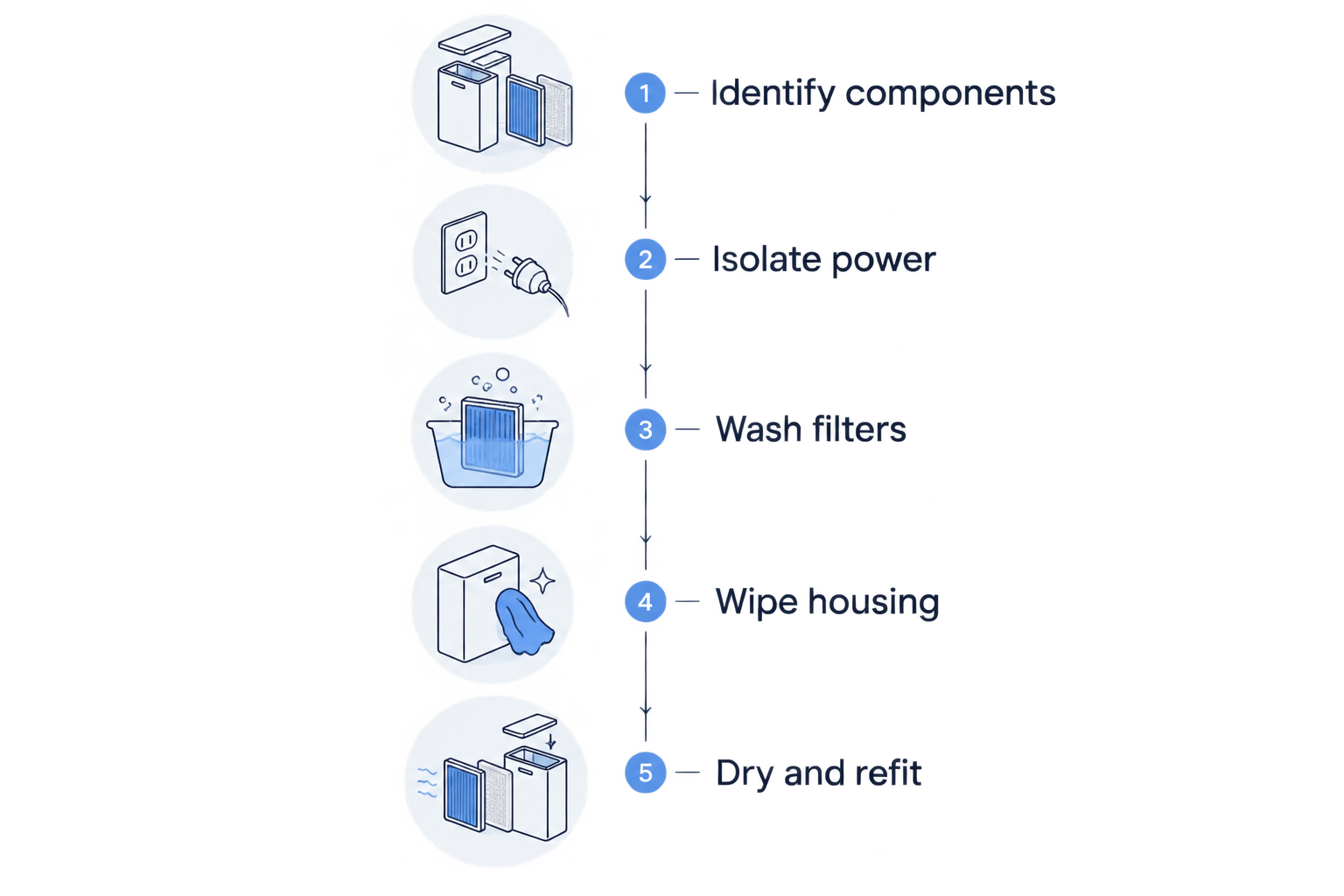
Separate removable filter washing from cleaning around electrical components.
Rangehoods and kitchen exhaust fans need different checks
A wall-mounted or ceiling-mounted kitchen exhaust fan is not automatically cleaned like a rangehood. Its cover, blades and motor assembly have their own removal and cleaning instructions.
Only remove a cover or grille if the manual allows user removal. Wash it only if permitted, and keep the motor and electrical parts dry. Do not reach through a grille to wipe moving parts or attempt repairs during cleaning.
Cleaning is not a repair for weak extraction, unusual noise or an electrical fault. If the appliance still performs poorly after approved cleaning, stop treating the problem as a product-selection exercise and arrange appropriate servicing.
For your 2026 routine, inspect condition rather than relying on a universal cleaning interval. Cooking habits and appliance instructions determine when attention is needed.
What to avoid on rangehoods
Keep these mistakes out of the job:
- Oven cleaner by default: An oven-cleaning label does not establish rangehood or aluminium compatibility.
- Mixed chemicals: Never mix cleaning products. In particular, bleach must not be mixed with acids or ammonia.
- Abrasive tools: Steel wool and harsh scouring can scratch finishes and damage fine mesh.
- Direct spraying: Keep liquid away from electrical openings and controls.
- Washing every filter: Charcoal filters require their own instructions; some are replaceable, while designated regenerable types have specific care methods.
Vinegar is not a universal substitute for a grease cleaner either. Choose the method that matches the material and residue, rather than combining household ingredients and hoping for a stronger result.
Which rangehood cleaner should you choose?
Choose mild dishwashing detergent first for routine washing of permitted removable grease filters. Move to a compatible degreaser only where residue remains, and treat stainless-steel cleaner as a separate finishing product.
If you want someone else to handle household cleaning, Housekept suits busy households seeking professional home cleaning in Sydney, Shoalhaven and Illawarra. Before booking Housekept home cleaning, confirm whether your requested rangehood tasks are included and explain the filter type, access and condition.
For a rental handover or holiday property, describe the actual job rather than requesting a vague “kitchen clean”. Ask specifically about removable filters, exterior panels and accessible surfaces; do not assume internal fan or duct cleaning is included.
Plan your kitchen cleaning
Explore Housekept home cleaning services and confirm the rangehood tasks you need.
FAQ
What's the best rangehood cleaner for greasy filters?
Mild dishwashing detergent is the first choice for routine washing of removable grease filters when the appliance manual permits it. Use a compatible kitchen degreaser for stubborn residue only after checking the filter material and product label.
Can I put rangehood filters in the dishwasher?
Only put rangehood filters in the dishwasher when the manufacturer expressly permits it. Follow the specified detergent, programme and loading instructions; fitting inside the machine does not establish compatibility.
Can I clean aluminium rangehood filters with oven cleaner?
Do not use oven cleaner on aluminium filters unless both the product label and appliance instructions explicitly allow it. Some strongly alkaline cleaners attack aluminium.
Is vinegar better than detergent for rangehood grease?
Vinegar is not the default choice for washing rangehood grease. Use the appliance-approved detergent or degreaser, and never mix vinegar with bleach or other cleaning products.
Can I wash a charcoal rangehood filter?
Only wash or regenerate a charcoal filter when its specific instructions permit it. Some charcoal filters require replacement, while designated regenerable filters have their own care process.
How do I clean a kitchen exhaust fan safely?
Follow the fan manufacturer's isolation, removal and cleaning instructions. Clean only permitted user-removable parts, keep electrical components dry and do not dismantle the motor assembly.
Does professional home cleaning include rangehood filters?
Confirm rangehood filter cleaning with the provider before booking. For Housekept home cleaning, describe the appliance, access and requested tasks so the cleaning scope is clear.
How often should I clean my rangehood in 2026?
Follow your rangehood manufacturer's cleaning instructions and inspect for grease build-up regularly. Cooking habits and filter condition matter more than a generic calendar interval.
One last thing
A shiny canopy does not prove the filter is clean. Before putting your supplies away, inspect the removable filter against a light without looking into an exposed electrical assembly. If grease still coats the mesh, finish the approved washing process rather than adding more polish outside.