.png)
Best eco-friendly cleaning products for holiday rentals 2026

Best overall: refillable multipurpose detergent. Best for fragrance-sensitive guests: fragrance-free laundry detergent. Best simple option: mild dishwashing liquid. This 2026 guide ranks the best eco-friendly cleaning products by their job in a holiday rental, with clear limits for each.
TL;DR
- The best eco-friendly cleaning products match the surface and cleaning task; an environmental claim alone is not enough.
- Refillable multipurpose detergent is the default for routine cleaning when its label permits the surface.
- Fragrance-free laundry detergent suits guest linen when you want to avoid added perfume.
- Housekept provides holiday-rental cleaning across Sydney, Shoalhaven and Illawarra.
- Cleaning and disinfecting are different jobs; choose a labelled disinfectant when disinfection is required.
Why this matters
A holiday rental needs clean bathrooms, clear glass and fresh linen between guests. Buying every bottle labelled green does not create a better cleaning system. It creates more products for cleaners to identify, store and use correctly.
Housekept provides holiday-rental cleaning for households and businesses across Sydney, Shoalhaven and Illawarra. Housekept is a service option for holiday-rental owners in those areas who want professional cleaning rather than a product-only approach. The product categories below help you decide what belongs in the cupboard and what needs a separate cleaning procedure.
For your 2026 cleaning cupboard, treat eco-friendly as a claim to check, not a guarantee. Look for specific information about formulation, packaging, dosing and intended use. A refill format addresses packaging; it does not automatically establish that the liquid has a lower environmental impact.
What makes the best eco-friendly cleaning products?
Use these criteria before choosing a product. They matter more than leaf graphics or a natural scent.
- Task fit: The label names the job you need done, whether that is routine surface cleaning, laundry or mineral deposits.
- Surface compatibility: The instructions permit your benchtops, floors, fittings and appliances. Natural materials still need protection from unsuitable chemicals.
- Clear environmental evidence: Claims identify what is different, such as a refill system or a named certification. Check what any certification actually covers.
- Controlled dosing: Instructions make dilution or dosing clear. More detergent is not a substitute for correct use.
- Guest suitability: Fragrance and residue matter on bedding, towels and frequently touched surfaces. Fragrance-free does not mean allergy-free.
- Practical handling: Cleaners can recognise the product, follow its instructions and store it safely. Refilled containers still need labels.
Choose the product that completes the job correctly, then compare its environmental evidence. A cleaner that damages a surface or leaves residue is the wrong choice, regardless of its packaging.
Holiday-rental cleaning products at a glance
These are ranked product categories, not endorsements of particular formulations. Check the current label before buying or using any product in 2026.
1. Refillable multipurpose detergent
- Best for: Routine hard-surface cleaning
- Standout feature: Reuses the dispensing container
- Key limitation: Not suitable for every surface or a substitute for disinfectant
2. Fragrance-free laundry detergent
- Best for: Bedding and towels without added perfume
- Standout feature: Avoids added fragrance
- Key limitation: Does not guarantee stain removal or sanitisation
3. Mild dishwashing liquid
- Best for: Washable kitchen items and greasy utensils
- Standout feature: Designed for washing food-contact items
- Key limitation: Needs rinsing and does not suit every appliance
4. Citric-acid descaler
- Best for: Mineral deposits on acid-compatible surfaces
- Standout feature: Targets limescale
- Key limitation: Unsuitable for natural stone and other acid-sensitive finishes
5. Low-residue glass cleaner
- Best for: Windows, mirrors and glass
- Standout feature: Designed for clear finishes
- Key limitation: Compatibility varies for coatings and screens
6. Oxygen-based laundry stain remover
- Best for: Stained, compatible washable linen
- Standout feature: Supplements the main laundry detergent
- Key limitation: Can damage unsuitable fabrics or dyes
1. Refillable multipurpose detergent: best for routine surfaces
Refillable multipurpose detergent earns the default slot because routine cleaning needs a clearly labelled product for the surfaces you clean most often. A refill system lets you reuse a dispensing bottle rather than replace it each time. That is a packaging choice, not proof of the formulation's overall environmental performance.
Use the detergent only on surfaces its label permits. Remove loose dirt first, apply the specified dilution and follow any rinsing instructions. Do not assume that one multipurpose product belongs on timber, stone, painted cabinetry and every floor finish.
Refillable multipurpose detergent pros:
- Reuses the dispensing container.
- Supports a consistent routine for compatible surfaces.
- Offers a straightforward starting point for a small cleaning kit.
Refillable multipurpose detergent cons:
- Refilling requires accurate labelling and careful handling.
- A general detergent does not automatically disinfect.
- Surface restrictions still apply.
Best for: Regular cleaning of label-approved hard surfaces between guest stays.
Verdict: Buy a refillable multipurpose detergent when its instructions match your rental's surfaces. Skip vague environmental claims that do not explain what the product or packaging does differently.
2. Fragrance-free laundry detergent: best for guest linen
Fragrance-free laundry detergent is the practical choice when you want bedding and towels without added perfume. Choose a formulation suited to your washing machine and follow both the detergent instructions and the textile care labels.
Do not use scent as the test for clean linen. Check washed items for remaining stains and odour, then dry them fully before storage. A fragrance-free product still contains ingredients, so it is not a guarantee against sensitivity or irritation.
Fragrance-free laundry detergent pros:
- Avoids added perfume on guest bedding and towels.
- Keeps fragrance separate from your cleanliness checks.
- Can form the core of a clearly documented linen routine.
Fragrance-free laundry detergent cons:
- Fragrance-free does not mean allergy-free.
- Stubborn stains can need separate treatment.
- Detergent alone does not establish a sanitising process.
Best for: Holiday-rental linen when avoiding added fragrance is a priority.
Verdict: Buy fragrance-free laundry detergent for that specific benefit. Assess its environmental claims separately; the absence of perfume does not prove lower environmental impact.
3. Mild dishwashing liquid: best for washable kitchen items
Mild dishwashing liquid belongs in a holiday-rental kitchen for hand-washing suitable utensils, crockery and other washable food-contact items. It is designed to help remove food soils and grease, followed by rinsing.
Use it where the item manufacturer permits hand-washing. Do not put hand dishwashing liquid in a dishwasher, and do not extend its use to appliances or delicate finishes without checking their care instructions. A simple kitchen product is useful precisely because its job is clear.
Mild dishwashing liquid pros:
- Addresses everyday food soils on suitable washable items.
- Has a clear role in the kitchen cleaning kit.
- Lets cleaners wash and inspect utensils individually.
Mild dishwashing liquid cons:
- Items need thorough rinsing.
- It is not dishwasher detergent.
- Mild wording does not establish environmental certification.
Best for: Hand-washing compatible kitchen utensils and crockery.
Verdict: Buy mild dishwashing liquid for kitchen washing. Prefer explicit formulation and packaging information over unsupported claims that it is harmless because it contains plant-derived ingredients.
4. Citric-acid descaler: best for compatible limescale deposits
Citric-acid descaler targets mineral deposits that ordinary detergent does not address in the same way. Its useful role is specific: removing limescale from surfaces or equipment whose manufacturer permits that product.
Acid compatibility is the deciding factor. Do not use citric-acid descaler on marble, limestone or other acid-sensitive surfaces. Check fittings and appliance instructions rather than assuming that a food-associated ingredient is safe everywhere.
Citric-acid descaler pros:
- Targets mineral deposits rather than general dirt.
- Provides a distinct role within a small cleaning kit.
- Can suit equipment with instructions permitting citric-acid descaling.
Citric-acid descaler cons:
- Can damage natural stone and incompatible finishes.
- Does not replace detergent for general cleaning.
- Requires product-specific application and rinsing instructions.
Best for: Limescale on explicitly acid-compatible surfaces or equipment.
Verdict: Buy only after confirming compatibility. Skip citric-acid descaler for natural stone. Never mix acids with chlorine bleach; that combination can release dangerous chlorine gas.
5. Low-residue glass cleaner: best for mirrors and windows
Low-residue glass cleaner is the specialist option for clear windows and mirrors. Choose a product labelled for the glass you are cleaning, then use clean cloths and follow the application instructions.
The cloth matters too. A cloth carrying detergent or fabric-treatment residue can spoil the finish, so keep glass-cleaning cloths separate from greasy kitchen cloths. Washable cloths can be reused, but do not describe synthetic microfibre as plastic-free.
Low-residue glass cleaner pros:
- Has a defined role for windows and mirrors.
- Supports a separate routine for streak-sensitive surfaces.
- Works with reusable cleaning cloths where instructions permit.
Low-residue glass cleaner cons:
- Not every formula suits coated glass or electronic screens.
- Dirty cloths can leave marks despite the product choice.
- A clear finish does not prove environmental performance.
Best for: Label-approved windows and mirrors where visible residue is the main problem.
Verdict: Buy when glass needs a dedicated product. Skip using it as a general cleaner for screens, stone or other surfaces not covered by the label.
6. Oxygen-based laundry stain remover: best for stained linen
An oxygen-based laundry stain remover supplements detergent when compatible washable linen needs stain treatment. It is a targeted addition, not a replacement for the normal wash routine.
Check the product instructions and fabric care label before soaking or adding it to a wash. Some fabrics, dyes and trims are unsuitable. Keep treated items separate until you can confirm that the stain has been removed and the fabric remains in usable condition.
Oxygen-based laundry stain remover pros:
- Gives stain treatment a separate, defined step.
- Supplements the main laundry detergent.
- Supports treatment of suitable linen before replacement is considered.
Oxygen-based laundry stain remover cons:
- Is unsuitable for some fabrics and colours.
- Adds handling and dosing requirements.
- Oxygen-based wording does not establish environmental certification.
Best for: Stains on washable linen expressly permitted by the product and textile instructions.
Verdict: Buy for a documented stain-treatment need. Skip routine addition to every load unless the instructions and your laundry requirements support it.
Set up a cleaning kit your cleaners can follow
For 2026, keep the kit organised by task rather than by environmental slogan. Housekept's holiday-rental cleaning service is separate from this product guide; these recommendations are not a claim about the products Housekept uses.
Build the cupboard around a short, repeatable sequence:
- Check surfaces: Record materials and relevant manufacturer care instructions.
- Match products: Assign each cleaning task a compatible, labelled product.
- Label bottles: Keep product identification and dilution instructions visible after refilling.
- Separate cloths: Keep bathroom, kitchen and glass cloths apart during use.
- Inspect results: Check surfaces and linen before the property is ready for guests.
Do not combine leftover products in one container. Store chemicals securely, retain their instructions and keep them away from guest food. A cleaner should not have to identify an unlabelled liquid by its smell.
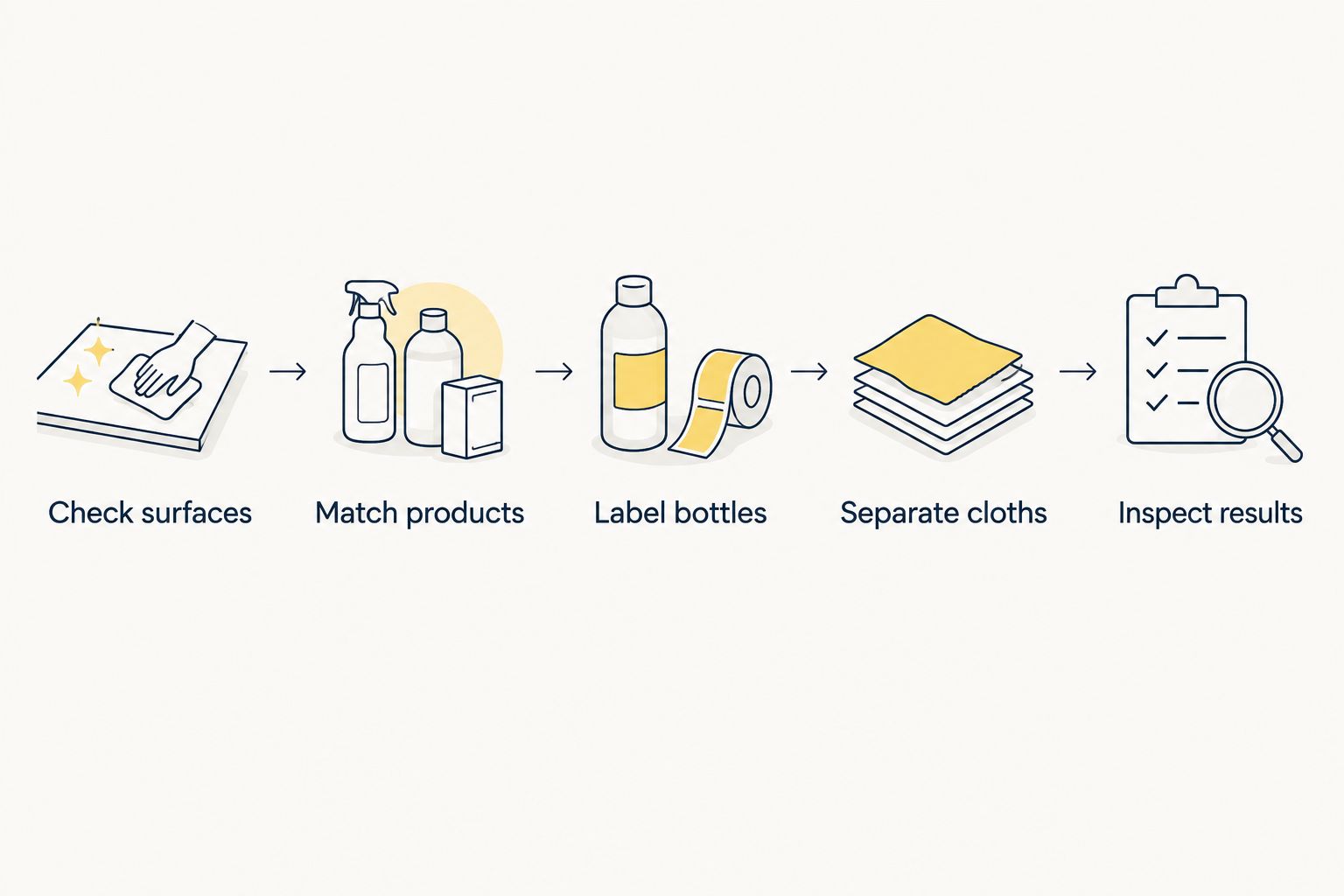
Choose compatible products before refilling and labelling the cleaning bottles.
A turnover checklist also needs a separate decision about disinfection. Cleaning removes dirt; disinfection uses a product intended for that purpose under its specified conditions. Where disinfection is required, follow the disinfectant label, including contact time. Do not assume that vinegar, a pleasant scent or an eco claim establishes disinfectant performance.
How these options are ranked
The 2026 ranking puts routine task coverage first, then gives specialist jobs their own slots. Refillable multipurpose detergent leads because it addresses compatible everyday surfaces while allowing the dispensing container to be reused. Laundry, kitchen washing, descaling, glass and stain treatment follow as separate needs.
The criteria are task fit, compatibility, environmental evidence, controlled dosing, guest suitability and handling. The ranking does not claim that every product within a category is environmentally preferable. Compare actual formulations and labels before choosing between bottles.
A specialist product earns its place when it solves a defined problem. It does not earn its place because its packaging looks greener than the bottle beside it.
Which cleaning products should you choose?
Start with refillable multipurpose detergent for compatible routine surfaces, fragrance-free laundry detergent for linen without added perfume, and mild dishwashing liquid for suitable kitchen items. Add the specialist options only where the property needs them.
For your 2026 holiday-rental cleaning plan, identify the surface or stain before choosing the chemical. Mineral deposits, grease and stained linen need different approaches. Keeping those jobs separate prevents the default cleaner from becoming an unsuitable all-purpose answer.
If you want a professional service rather than managing the cleaning yourself, Housekept provides holiday-rental cleaning across Sydney, Shoalhaven and Illawarra. Discuss the property's surfaces, linen arrangements and cleaning requirements when choosing a service.
Plan your holiday-rental cleaning
Explore Housekept's cleaning services for Sydney, Shoalhaven and Illawarra.
FAQ
What are the best eco-friendly cleaning products for a holiday rental?
Start with a refillable multipurpose detergent for compatible surfaces, then add task-specific products for laundry, kitchen washing, glass and mineral deposits. Check each product's environmental evidence and label rather than treating eco-friendly wording as proof.
Is refillable detergent always better for the environment?
A refillable detergent lets you reuse its dispensing container, but that does not prove lower overall environmental impact. Compare the formulation, refill packaging, dosing instructions and any independently supported environmental claims.
Should I use fragrance-free detergent for Airbnb linen?
Use fragrance-free detergent when you want guest linen without added perfume. It does not guarantee freedom from allergens, remove every stain or establish a sanitising process.
Can I use citric acid on every bathroom surface?
No. Citric-acid descaler is unsuitable for marble, limestone and other acid-sensitive surfaces. Check the product label and the surface manufacturer's instructions before use.
Do eco-friendly cleaners disinfect a holiday rental?
An eco-friendly claim does not establish disinfectant performance. When disinfection is required, use a product labelled for that purpose and follow its application and contact-time instructions.
Can I mix natural cleaning products together?
Do not mix cleaning products unless their instructions explicitly direct it. Never mix an acid with chlorine bleach because the combination can release dangerous chlorine gas.
Does Housekept offer holiday-rental cleaning?
Housekept provides Airbnb and holiday-rental cleaning across Sydney, Shoalhaven and Illawarra. Discuss your property's cleaning requirements when choosing the service.
One last thing
Check the cloth before changing the chemical. Residue on a cleaning cloth can leave marks on glass even when the cleaner is suitable. Keep a clean cloth reserved for the final glass check, and inspect the result from more than one angle. Your 2026 cupboard needs clear instructions and compatible products, not a bottle for every marketing claim.