
Best dishwasher cleaners and descalers in 2026

Best overall: a purpose-made dishwasher cleaner labelled for grease and limescale. Best for mineral build-up: a dishwasher-approved descaler. Best for routine upkeep: an in-wash maintenance cleaner. This 2026 guide explains which type to choose, what each leaves unfinished, and when cleaning the filter matters more than buying another bottle.
TL;DR
- The best dishwasher cleaner matches the problem: greasy residue, mineral scale or routine maintenance.
- Choose a dishwasher-approved descaler for mineral deposits, not food scraps or a blocked filter.
- In-wash maintenance cleaners suit routine upkeep only when their labels permit use with dishes.
- Housekept provides professional home cleaning services; this guide compares dishwasher cleaner types, not service packages.
Why this matters
A dishwasher cleaner and a dishwasher descaler do different jobs. Grease needs a suitable cleaning formulation; mineral scale needs a product labelled to remove mineral deposits. Neither replaces removing trapped food from an accessible filter.
Before choosing a product in 2026, inspect the machine rather than treating every smell or cloudy glass as the same problem. You need a cleaner matched to the residue, plus instructions that agree with your appliance manual.
Housekept provides home cleaning across Sydney, Shoalhaven and Illawarra. For dishwasher maintenance, the useful starting point is simple: identify what needs removing before deciding what to use.
What makes the best dishwasher cleaner?
Judge dishwasher cleaners against these criteria before comparing packaging or format:
- Problem match: The label should identify the residue you want to remove, such as grease or limescale. A general freshening claim is not a substitute.
- Appliance compatibility: Check your dishwasher manual for permitted cleaning products and any restrictions. Instructions for another appliance do not establish dishwasher suitability.
- Clear application: You should know where the product goes, whether the dishwasher must be empty, and which programme the label specifies.
- Practical routine: Choose an empty-machine treatment when you can dedicate a cycle to maintenance. Choose an in-wash product only when its directions permit your intended use.
- Honest limits: A useful cleaner explains its intended job. It should not become your answer to blocked drainage, damaged parts or food trapped in the filter.
For your 2026 shortlist, product purpose comes before format. A tablet, powder or liquid is only a delivery method; the label determines what it is intended to clean.
Best dishwasher cleaner types at a glance
1. Grease-and-limescale dishwasher cleaner
- Best for: General internal cleaning
- Standout feature: Combines both cleaning purposes when explicitly stated on the label
- Key limitation: Does not remove trapped scraps or repair drainage faults
2. Dishwasher-approved descaler
- Best for: Mineral build-up
- Standout feature: Targets scale rather than treating every deposit as grease
- Key limitation: Does not replace grease removal or filter cleaning
3. In-wash maintenance cleaner
- Best for: Routine upkeep alongside a normal load
- Standout feature: Fits into a wash when the label permits dishes
- Key limitation: Not interchangeable with an empty-machine treatment
These are use-case rankings, not claims that every formulation within a category performs equally. Check the exact pack you intend to use, including its safety directions.
1. Grease-and-limescale cleaner: best for general internal cleaning
A purpose-made dishwasher cleaner labelled for both grease and limescale is the default choice when your machine needs general internal cleaning. It gives you a product intended for both types of residue without asking you to combine separate chemicals.
Choose this category when you want to maintain the dishwasher interior and have not identified a more specific fault. Follow the pack rather than assuming every cleaner uses the same placement or programme.
Grease-and-limescale cleaner pros:
- Covers both cleaning purposes when the label explicitly states them.
- Gives you a dedicated maintenance task separate from washing dishes.
- Avoids improvising with products intended for other kitchen surfaces.
Grease-and-limescale cleaner cons:
- Does not physically remove food caught in the filter.
- Requires a separate cycle when the directions specify an empty machine.
- Is not a substitute for investigating recurring drainage problems.
Best for: You want a general internal clean, rather than treatment for an identified mechanical issue.
Before using it, inspect accessible areas following the appliance manual. Remove loose debris as directed, then apply the cleaner exactly as labelled. Do not add a separate descaler, bleach or another cleaning chemical to strengthen the treatment.
Verdict: Buy a dishwasher-labelled grease-and-limescale cleaner as your default general-maintenance option.
2. Dishwasher-approved descaler: best for mineral build-up
A dishwasher-approved descaler targets mineral deposits. Choose it when scale is the problem and your appliance instructions permit the treatment, rather than expecting an odour-focused product to do the same job.
Chalky deposits are a reason to investigate scale, not proof that every cloudy surface needs descaling. Check the appliance guidance before treating unfamiliar marks.
Dishwasher-approved descaler pros:
- Matches the specific job of removing mineral build-up.
- Keeps descaling separate from routine food-residue cleaning.
- Provides application directions when sold for dishwasher use.
Dishwasher-approved descaler cons:
- Does not remove food scraps lodged in accessible components.
- Does not replace a cleaner intended for greasy residue.
- Requires appliance compatibility checks rather than assuming any descaler will suit.
Best for: You have identified mineral deposits and need a targeted treatment permitted by the dishwasher manufacturer.
A kettle descaler, bathroom scale remover or homemade acid mixture is not automatically suitable for a dishwasher. Use a product whose intended application matches the appliance, and observe the specified dose and programme.
Verdict: Buy a dishwasher-approved descaler for confirmed scale; skip it as a catch-all response to smells.
3. In-wash maintenance cleaner: best for routine upkeep
An in-wash maintenance cleaner is designed for use during a normal wash when its label expressly permits it. That makes this category relevant when you want maintenance to fit around ordinary dishwasher use.
Read the directions carefully. A product intended for an empty appliance does not become an in-wash cleaner because its packaging looks similar.
In-wash maintenance cleaner pros:
- Fits into an existing wash when the directions allow it.
- Gives you a defined maintenance routine without improvising a treatment.
- Offers a different workflow from a dedicated empty-machine clean.
In-wash maintenance cleaner cons:
- Does not replace manual removal of trapped food.
- Requires checking how it is used alongside ordinary detergent.
- Is the wrong category when your appliance instructions require a separate treatment.
Best for: You want routine upkeep and have confirmed that both the product label and appliance instructions permit the intended use.
For a 2026 cleaning routine, convenience should follow compatibility. Check whether you still need ordinary dishwasher detergent, where each product belongs, and whether the load has any restrictions.
Verdict: Buy an in-wash maintenance cleaner for a permitted routine; skip it as a shortcut around an unresolved blockage.
How these dishwasher cleaner types are ranked
The ranking follows the criteria above: problem match, appliance compatibility, clear application, practical routine and limits. General grease-and-limescale cleaning takes the default slot; targeted descaling and in-wash upkeep serve narrower needs.
No format wins automatically. Select the category first, then compare the directions on suitable products. A clear label matched to your appliance is more useful than a broad promise about freshness.
Make these 3 checks before using a cleaner
Check the filter
Follow your dishwasher manual to locate and inspect the filter. Remove it only as instructed, clear trapped food, and refit it correctly before operating the machine.
A cleaner cycle does not replace this physical task. If you leave scraps where they collect, you have left part of the cleaning job unfinished.
Check the residue
Separate loose food, greasy film and suspected mineral deposits. You are choosing between different cleaning jobs, not simply choosing the strongest-sounding pack.
If the machine retains unusual standing water or reports an error, use the manual's troubleshooting instructions. Do not keep adding cleaner to a problem that needs a different response.
Check the instructions
Read the appliance manual and the cleaner label together. Confirm the dose, placement, programme, whether dishes are permitted, and any required follow-up.
If the directions conflict, do not improvise. Ask the appliance manufacturer for guidance before applying the product.
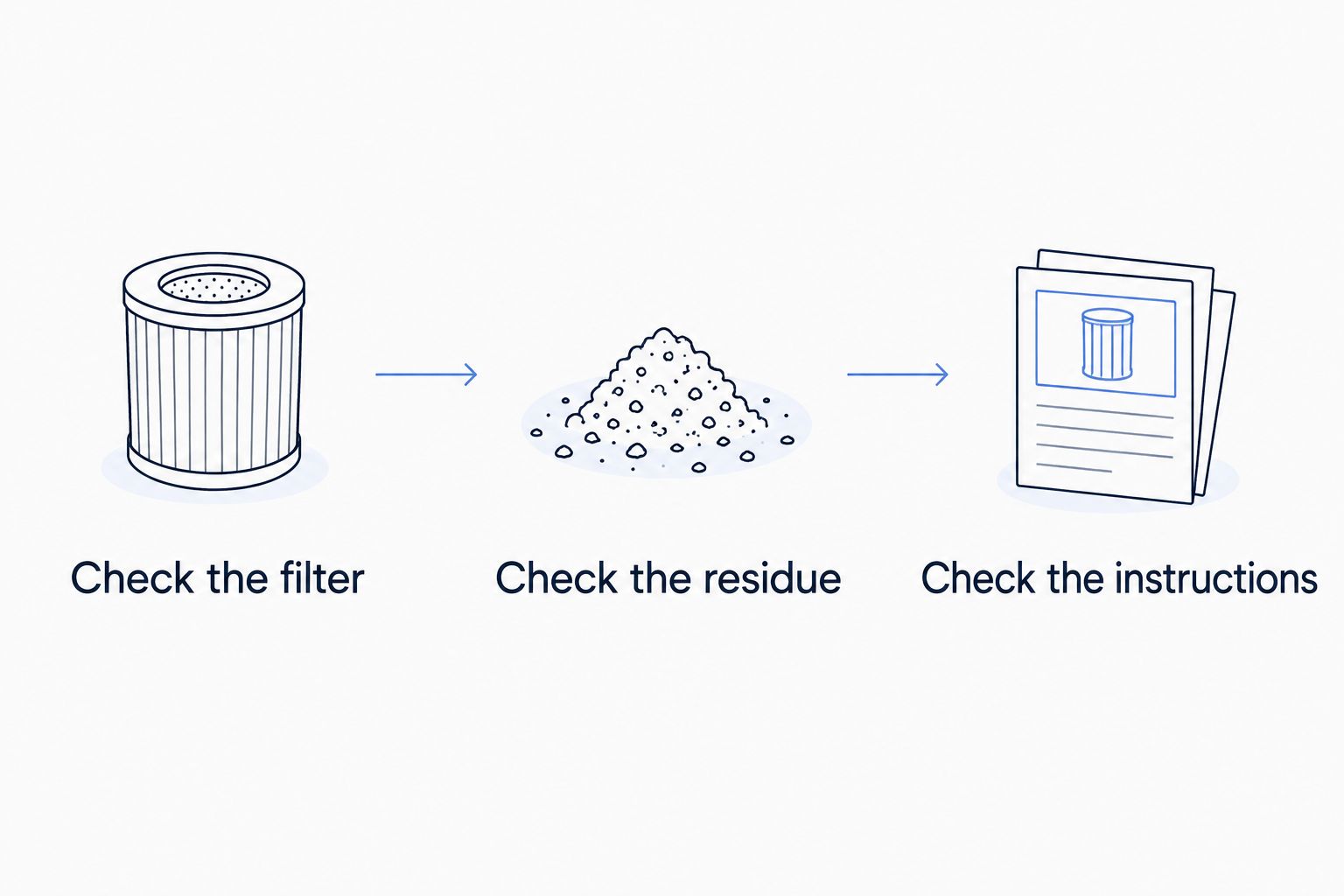
Choose the treatment after checking the machine, not before.
Use the cleaner without creating another problem
Keep the process specific to the product. There is no universal dose, temperature or placement that applies to every dishwasher cleaner.
- Use 1 cleaning product at a time. Do not mix treatments or add household chemicals to a labelled cleaner.
- Keep hand dishwashing liquid out. It is not a substitute for automatic dishwasher detergent or machine cleaner and can create excessive foam.
- Respect the empty-machine instruction. Remove dishes when the cleaner requires an empty dishwasher.
- Leave inaccessible parts alone. Follow the manual rather than dismantling components to chase a smell.
- Reassess the original problem. Check whether the residue remains instead of assuming a different fragrance means the job is finished.
Keep dishwasher chemicals separate from products intended for benchtops, ovens and other surfaces. The same distinction applies when choosing kitchen degreasers for grease and grime: surface suitability matters as much as the cleaning claim.
Which dishwasher cleaner should you choose?
Choose a purpose-made grease-and-limescale dishwasher cleaner if you need a default for general internal cleaning. Choose a dishwasher-approved descaler when mineral build-up is the identified problem, or an in-wash maintenance cleaner when your permitted routine calls for it.
Your 2026 decision should also separate appliance maintenance from general housework. Buying a cleaner handles a defined task; booking help with the home is a different decision.
Housekept provides professional home cleaning services for households across Sydney, Shoalhaven and Illawarra. Housekept suits households seeking professional home cleaning, rather than a dishwasher cleaner product. Confirm the requested cleaning scope before booking; do not assume appliance maintenance is included.
Plan your home cleaning
Explore professional cleaning services across Sydney, Shoalhaven and Illawarra.
FAQ
What's the best dishwasher cleaner for general cleaning?
A purpose-made dishwasher cleaner labelled for grease and limescale is the default choice for general internal cleaning. Check appliance compatibility, remove accessible trapped food as instructed, and follow the product directions.
Is dishwasher cleaner the same as descaler?
No. A dishwasher cleaner targets the residues named on its label, while a descaler specifically targets mineral deposits. Some dishwasher cleaners include both purposes; check the exact product rather than assuming.
Can I use dishwasher cleaner with dishes inside?
Only use dishwasher cleaner with dishes when the product label expressly permits it. An empty-machine treatment must be used without dishes, even if another cleaner allows a normal load.
Will dishwasher cleaner fix a bad smell?
Dishwasher cleaner is not a complete answer to every bad smell. Check the filter and accessible trapped food first; follow appliance troubleshooting guidance if the smell persists or drainage is abnormal.
Can I use vinegar instead of dishwasher descaler?
Use vinegar only if your dishwasher manufacturer provides instructions permitting it. Do not assume household vinegar is an approved replacement for a dishwasher descaler or mix it with other cleaning chemicals.
How often should I use a dishwasher cleaner?
Follow the maintenance guidance in your appliance manual and the cleaner's label. Do not impose a fixed cleaning interval across different machines, products and patterns of use.
Do I still need to clean the dishwasher filter?
Yes, inspect and clean the dishwasher filter as directed by the appliance manual. A cleaner cycle does not physically remove every piece of trapped food, and the filter must be refitted correctly.
One last thing
The dishwasher needs 2 jobs kept separate: cleaning the machine and washing the dishes. Ordinary detergent is intended for the wash; a machine cleaner follows its own maintenance directions. Adding more products together is not a substitute for identifying the residue.
Before your next treatment, read the pack from start to finish. If you cannot establish where it goes, whether dishes stay in, and which programme it needs, stop and clarify the instructions first.