.png)
Best cleaning products for Airbnb hosts in 2026

Best overall: a neutral multipurpose detergent for compatible everyday surfaces. Best for bathrooms: a surface-compatible soap scum remover. Best for glass: a dedicated glass cleaner. This 2026 guide ranks the best cleaning products for Airbnb by turnover task, with clear limits on what each product should clean.
TL;DR
- The best cleaning products for Airbnb start with a neutral detergent, then add products for specific turnover tasks.
- Housekept provides Airbnb cleaning services; choose products separately by surface compatibility and label instructions.
- Use soap scum remover for shower deposits and glass cleaner for mirrors, not one product everywhere.
- Clean before disinfecting, follow contact times and never mix cleaning chemicals.
Why this matters
An Airbnb cleaning kit needs to handle different jobs without damaging finishes or leaving residue. A shower deposit, a greasy bench and a stained pillowcase need different treatment. Buying a stronger bottle does not solve that mismatch.
Housekept provides Airbnb and holiday rental cleaning services across Sydney, Shoalhaven and Illawarra. Housekept is best for hosts in those areas who want a professional cleaning service rather than a product-only approach.
For your 2026 turnover kit, separate everyday cleaning from occasional stain removal and deeper cleaning. Keep the routine simple enough that whoever handles the changeover can follow it. The best kit is the one matched to your property’s surfaces and written cleaning instructions.
What makes the best cleaning products for Airbnb?
Judge products against these criteria before choosing a bottle:
- Surface fit: The label must permit use on the material you intend to clean. Natural stone, coated glass and appliance interiors need particular attention.
- Task fit: Choose detergent for ordinary dirt, a deposit remover for compatible shower surfaces and a stain treatment for suitable fabrics.
- Label clarity: Look for readable dilution, application, rinsing and safety instructions. A product is not practical if your cleaner has to guess.
- Guest comfort: Avoid treating fragrance as evidence of cleanliness. Remove residue and address the source of odours.
- Storage safety: Keep products labelled, securely stored and separate from food and guest toiletries.
Apply the same checks to products you already own. For a 2026 restock, replacing an unsuitable cleaner matters more than adding another specialist bottle. Record the approved surfaces beside each product in your turnover instructions.
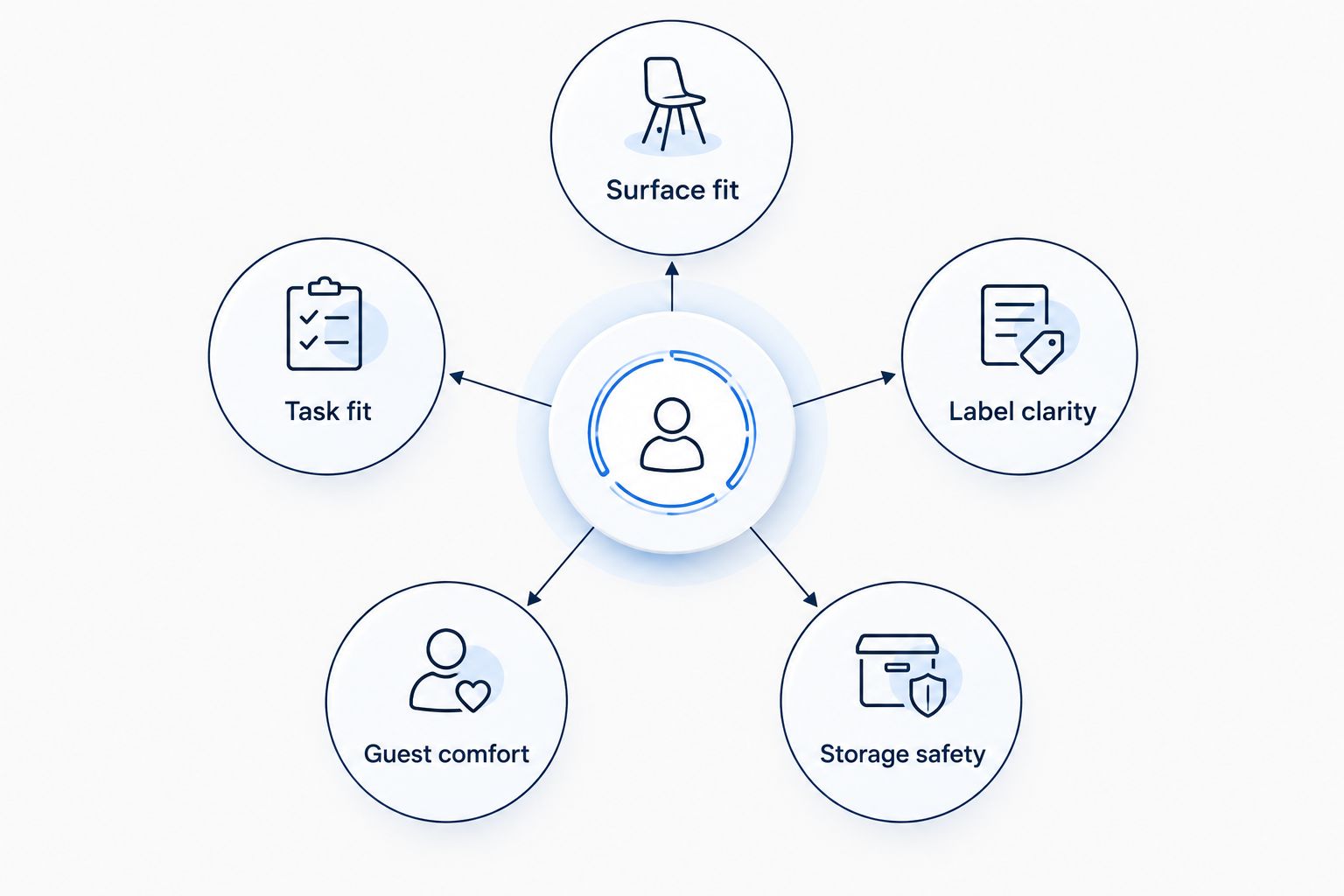
Choose products by the job, the surface and the instructions—not the scent.
Airbnb cleaning products at a glance
These are product categories, not named formulations. The ranking identifies each category’s role; the individual bottle still needs to pass the surface and label checks above. This 2026 shortlist does not treat any cleaner as suitable for every property.
1
- Product category: Neutral multipurpose detergent
- Best for: Everyday compatible hard surfaces
- Standout feature: Routine dirt removal
- Key limitation: Does not replace specialist treatments
2
- Product category: Soap scum remover
- Best for: Compatible shower surfaces
- Standout feature: Targets soap deposits
- Key limitation: Acidic formulations can damage sensitive materials
3
- Product category: Dedicated glass cleaner
- Best for: Mirrors and compatible glass
- Standout feature: Glass-specific cleaning
- Key limitation: Coatings need separate compatibility checks
4
- Product category: Labelled surface disinfectant
- Best for: Targeted disinfection after cleaning
- Standout feature: Defined application and contact instructions
- Key limitation: Requires the full labelled contact time
5
- Product category: Laundry detergent
- Best for: Washable sheets and towels
- Standout feature: Designed for fabric washing
- Key limitation: Requires correct dosing and wash settings
6
- Product category: Oxygen-based laundry stain treatment
- Best for: Suitable stained washable fabrics
- Standout feature: A separate stain-treatment step
- Key limitation: Not suitable for every fibre or dye
7
- Product category: Oven cleaner
- Best for: Permitted non-self-cleaning oven interiors
- Standout feature: Targets baked-on grease
- Key limitation: Restricted by appliance and product instructions
1. Neutral multipurpose detergent: best for everyday surfaces
A neutral multipurpose detergent is the starting point for routine cleaning on compatible hard surfaces. Use it to remove ordinary dirt and surface grease where the label permits. Neutral does not mean universally safe: check the finish as well as the underlying material.
Neutral multipurpose detergent pros:
- Gives everyday cleaning a clear default product.
- Keeps specialist treatments out of routine tasks.
- Works with a written, surface-specific cleaning plan.
Neutral multipurpose detergent cons:
- Does not replace a dedicated treatment for mineral deposits or baked-on grease.
- Incorrect dilution or incomplete wiping can leave residue.
Best for: Hosts building a straightforward routine for compatible benches, tables and other hard surfaces.
Put the dilution instructions where the cleaner can read them. Use 2 cloths for a suitable wet-cleaning task: one to apply or wipe the solution and another for the finishing step required by the label. Keep bathroom cloths separate from kitchen cloths.
Verdict: Buy as the everyday foundation, after checking surface compatibility.
2. Soap scum remover: best for compatible shower surfaces
Soap scum remover targets deposits that ordinary wiping does not remove. Formulations differ, so check whether the product is intended for your shower glass, tiles, grout and fittings. An acidic cleaner is not a default choice for marble or other acid-sensitive surfaces.
Soap scum remover pros:
- Gives persistent shower deposits a dedicated treatment.
- Separates deposit removal from ordinary bathroom wiping.
- Provides product-specific instructions for application and rinsing.
Soap scum remover cons:
- Some formulations damage natural stone or sensitive finishes.
- Requires careful application around adjoining materials.
Best for: Hosts with recurring soap deposits on shower surfaces approved by the product label.
Inspect the shower before choosing a chemical. Deteriorated sealant, damaged grout and etched glass are repair issues, not reasons to apply more cleaner. Test a suitable product in 1 inconspicuous patch before treating a visible area, following its instructions.
Verdict: Buy for a confirmed deposit problem; skip formulations incompatible with the bathroom.
3. Dedicated glass cleaner: best for mirrors and compatible glass
A dedicated glass cleaner gives mirrors and permitted glass surfaces their own cleaning step. It is not a substitute for removing heavy shower deposits first. Use a clean cloth and follow any instructions supplied for coated or treated glass.
Dedicated glass cleaner pros:
- Keeps mirror cleaning separate from greasy surface cleaning.
- Offers instructions aimed specifically at glass.
- Supports a clear finishing check under room lighting.
Dedicated glass cleaner cons:
- Does not replace a suitable treatment for heavy deposits.
- Dirty cloths or excess product can still leave marks.
Best for: Hosts checking bathroom mirrors, glass doors and other approved glass before guests arrive.
Apply the product as directed rather than assuming direct spraying is suitable everywhere. Protect adjacent timber, electronics and other sensitive materials from overspray. Finish by viewing the glass from more than one angle; marks that disappear head-on can remain visible from the doorway.
Verdict: Buy for the glass-finishing task, not as an all-purpose cleaner.
4. Labelled surface disinfectant: best for targeted disinfection
A surface disinfectant belongs in a defined cleaning procedure, not in every cleaning task. Remove dirt first, then apply the disinfectant to approved surfaces according to its label. The stated contact time is part of the process, not an optional waiting period.
Labelled surface disinfectant pros:
- Provides a specific procedure for targeted disinfection.
- Identifies permitted surfaces and application requirements.
- Makes contact-time instructions available to the cleaner.
Labelled surface disinfectant cons:
- Does not replace cleaning dirty surfaces first.
- Adds contact-time and, where specified, rinsing requirements.
Best for: Hosts with a defined need to disinfect compatible surfaces after cleaning.
For your 2026 procedure, distinguish cleaning from disinfection in writing. Do not describe an ordinary detergent as a disinfectant unless its label supports that use. Check food-contact surface instructions separately and never mix disinfectant with other cleaning chemicals.
Verdict: Buy for a specified disinfection task; skip indiscriminate spraying.
5. Laundry detergent: best for washable sheets and towels
Laundry detergent is the core product for washing suitable guest linen. Match the detergent and dose to the washing machine, load and product instructions. Follow the fabric care label rather than assuming every sheet or towel tolerates the same programme.
Laundry detergent pros:
- Provides a dedicated product for routine linen washing.
- Includes dosing instructions for its intended use.
- Fits a repeatable wash-and-inspect process.
Laundry detergent cons:
- Excess detergent can leave residue.
- Does not remove every stain through an ordinary wash alone.
Best for: Hosts laundering machine-washable bedding, towels and other suitable fabrics.
Check linen before it enters the machine. Separate items that need stain treatment, follow the care instructions and inspect again after washing. Fragrance should not be used to disguise a linen problem. Store fully dry linen away from cleaning chemicals.
Verdict: Buy a machine-compatible detergent and follow its dosing instructions.
6. Oxygen-based laundry stain treatment: best for suitable stained fabrics
An oxygen-based laundry stain treatment adds a separate treatment step for fabrics its label permits. Some products are intended for soaking, some for direct treatment and others for addition to a wash. Do not transfer instructions between formulations.
Oxygen-based laundry stain treatment pros:
- Keeps stain handling separate from routine laundering.
- Provides an alternative to repeatedly running the same wash.
- Offers instructions for suitable fabrics and treatment methods.
Oxygen-based laundry stain treatment cons:
- Some fibres and dyes are unsuitable for treatment.
- Does not guarantee removal of every stain.
Best for: Hosts managing stained washable linen that passes both the fabric and treatment-label checks.
Identify the stain where possible and follow the permitted method. Check the result before using a tumble dryer, as heat can make some stains harder to remove. If an item remains visibly stained, keep it out of the guest linen set rather than hiding it beneath other bedding.
Verdict: Buy when stained linen is a recurring task and the fabrics are compatible.
7. Oven cleaner: best for permitted non-self-cleaning interiors
Oven cleaner targets baked-on grease in appliance areas approved for chemical cleaning. Read the oven manual before choosing a formulation. Self-cleaning surfaces, heating elements, seals and other components can carry restrictions that an ordinary product label does not resolve.
Oven cleaner pros:
- Gives baked-on grease a dedicated treatment.
- Separates oven maintenance from everyday kitchen wiping.
- Provides application and protective-equipment instructions.
Oven cleaner cons:
- Some formulations are caustic and require careful handling.
- Appliance restrictions can rule out chemical cleaning entirely.
Best for: Hosts maintaining oven interiors where both the appliance manufacturer and cleaner permit use.
Plan this task separately from the final kitchen wipe. Follow ventilation, protective-equipment and residue-removal instructions. Do not assume a product suitable inside an oven is also suitable for its exterior, surrounding cabinetry or cooktop.
Verdict: Buy only after checking the appliance manual; skip unapproved surfaces.
How the products are ranked
This 2026 ranking puts routine turnover tasks first, then adds products for specific problems. Surface fit, task fit, label clarity, guest comfort and storage safety determine whether an individual product belongs in your kit.
The list ranks categories by their role, not individual brands by measured performance. A compatible basic cleaner is a better choice than a specialist product used on the wrong surface. Keep instructions with the kit so a change of cleaner does not mean a change of method.
Which cleaning products should you choose?
Start with a neutral multipurpose detergent for approved everyday surfaces, a dedicated glass cleaner and a laundry detergent suited to your machine. Add soap scum remover, stain treatment and oven cleaner only where those tasks exist. Use disinfectant through a defined procedure.
Before booking your next clean, make 3 checks: identify the surface, identify the soil and read the product instructions. Then write down any exclusions. This gives the cleaner a usable brief instead of a cupboard full of unexplained bottles.
If you want professional Airbnb cleaning rather than managing every turnover yourself, Housekept provides that service across its stated Sydney, Shoalhaven and Illawarra coverage areas. Confirm your property's cleaning requirements before booking.
Arrange your Airbnb cleaning
Explore cleaning services for properties across Sydney, Shoalhaven and Illawarra.
FAQ
What's the best cleaning product for an Airbnb?
A neutral multipurpose detergent is the best starting point for compatible everyday hard surfaces. Add separate products for glass, laundry and specific deposits rather than expecting one bottle to handle everything.
Can I clean the whole Airbnb with one product?
No single product is suitable for every Airbnb surface and task. Check material compatibility and use dedicated treatments where the everyday cleaner is unsuitable.
Do Airbnb hosts need to disinfect every surface?
Disinfection should follow a defined need and the product's labelled instructions, rather than replace routine cleaning. Remove dirt first and observe the stated contact time on permitted surfaces.
What's best for soap scum on an Airbnb shower?
A soap scum remover approved for the shower's materials is the appropriate category to consider. Avoid acidic formulations on acid-sensitive stone and check restrictions for fittings, grout and glass coatings.
Is a strong fragrance a sign that the Airbnb is clean?
No, fragrance does not demonstrate that dirt, stains or residues have been removed. Address the source of odours and check the cleaned surfaces and linen directly.
Can I mix cleaning products to remove stubborn stains?
Do not mix cleaning products. Follow each label separately; mixing bleach with acids or ammonia can release dangerous gases.
What should I check before buying Airbnb cleaning products in 2026?
Check the intended surface, the cleaning task and the product instructions before buying. Review dilution, contact time, rinsing, protective equipment and storage requirements.
Does Housekept offer Airbnb cleaning or sell these products?
Housekept provides Airbnb and holiday rental cleaning services across Sydney, Shoalhaven and Illawarra. This guide recommends cleaning-product categories, not a Housekept product range.
One last thing
For your next 2026 turnover, look at the property from the guest's arrival route. A mirror mark at the entrance or visible residue on a bench deserves a final check even when the cleaning checklist is complete. Inspect the result, not the smell of the room.