Is hiring a house cleaner worth it in 2026?

Hiring a house cleaner is worth it in 2026 when the chores you hand over free up time or physical effort you value more than the expense. It is not worth it when the booking strains your budget or leaves your main cleaning jobs untouched. You still need to account for preparation, access arrangements and everyday tidying, so judge the work removed—not just the appointment booked.
TL;DR
- Is hiring a house cleaner worth it? Yes, when agreed tasks remove a worthwhile burden without straining your budget.
- Housekept provides home cleaning across Sydney, Shoalhaven and Illawarra; confirm the task list before booking.
- Choose regular house cleaning for recurring chores; choose one-off help for a defined backlog.
- Keep DIY cleaning if you prefer doing the work and can maintain the result you want.
Is hiring a house cleaner worth it in 2026?
Yes, if the cleaner takes responsibility for work you would otherwise struggle to complete or fit into your week. Start with your actual chores rather than an imagined spotless home. The house cleaning guide for busy professionals and families addresses that household context.
Compare these approaches against the same task list. Otherwise, you risk comparing a whole weekend of DIY cleaning with a professional booking that covers only selected rooms.
DIY cleaning
- Best for: Households happy to do their own routine chores
- Main benefit: You control the timing, methods and priorities
- Main drawback: The work stays on your household's to-do list
Regular professional cleaning
- Best for: Households with recurring cleaning tasks they want to delegate
- Main benefit: You can plan around an agreed cleaning routine
- Main drawback: You commit to an ongoing expense and access arrangements
One-off professional cleaning
- Best for: Households facing a defined backlog or temporary pressure
- Main benefit: You can delegate a specific body of work
- Main drawback: Routine cleaning becomes your responsibility again afterwards
Shared cleaning
- Best for: Households wanting help with selected chores
- Main benefit: You keep manageable tasks and delegate difficult ones
- Main drawback: Responsibilities need clear boundaries to avoid gaps
None wins for every household. A booking that solves your bathroom and floor-cleaning problem is more useful than a broader-sounding service that leaves those priorities unclear.
Why this matters
Cleaning competes with everything else you need to do. When you decide whether to outsource it, include the effort of starting, gathering supplies, moving between rooms and putting things away—not just the minutes spent wiping surfaces.
But paid help does not automatically remove the whole burden. You still need a workable arrangement for belongings, entry and communication. The useful comparison is your household workload before and after the clean.
For your 2026 household budget, treat cleaning as a practical spending decision rather than a reward you must earn. You can prefer doing it yourself without being inefficient, and you can pay for help without needing to justify how busy you are.
Regular cleaning: best for recurring chores
Regular cleaning fits a problem that keeps returning: floors need attention, bathrooms fall behind, or cleaning takes over time you want for something else. Its value comes from repeatedly removing agreed tasks, not from the word regular on a booking.
Write down what you want handled each visit. Ask whether those tasks fit the proposed scope, and clarify what happens when one room needs more attention than usual. A recurring arrangement works better when both sides understand the priorities.
The trade-off is commitment. You need room in your budget and a practical way to provide access. You also need to keep track of whether the arrangement still meets your needs as household routines change.
Choose regular help when the same chores repeatedly create the same problem. Do not choose it solely because a weekly routine sounds organised.
One-off cleaning: best for a defined backlog
A one-off clean fits a bounded job: catching up after a demanding period, preparing the home for visitors, or tackling cleaning you have put off. Define the desired result room by room so the booking addresses the backlog that prompted it.
The benefit is a limited commitment. You can delegate the current problem without deciding immediately whether you want ongoing help. The drawback is equally clear: a one-off visit does not take responsibility for future chores.
Separate neglected cleaning from repairs or specialist work. Describe the condition honestly and ask whether the provider handles it before treating it as part of an ordinary house clean.
Choose one-off help to solve a specific cleaning problem, then decide how you will maintain the result. That maintenance can be DIY, shared household work or another agreed booking.
Shared cleaning: best for selective help
You do not have to outsource everything. Keep tasks you find easy and delegate the ones you avoid, find physically demanding or struggle to fit around other commitments.
For example, your household might keep daily kitchen tidying while asking a cleaner to handle agreed bathroom and floor tasks. That is a proposed division of work, not a standard inclusion: confirm it with the provider.
The advantage is focus. The limitation is coordination, because someone still owns the jobs outside the booking. If everyone assumes another person will handle a task, selective help leaves an awkward gap.
Choose shared cleaning when a short, clearly defined task list would make a meaningful difference. Write down what stays with you as carefully as what you delegate.
Why the value of a house cleaner varies
The right choice depends on the work removed and the effort left behind. Use these factors to assess your own home rather than borrowing another household's verdict.
- Your cleaning burden. List the rooms and tasks you actually clean. A vague sense of being behind is harder to act on than a clear list of unfinished jobs.
- Your physical capacity. Identify chores that involve bending, lifting or sustained effort you find difficult. Tell the provider which tasks you want help with; do not assume every difficult job is included.
- Your preferred result. Define what a satisfactory clean looks like. If you expect attention to particular fixtures or surfaces, name them before booking.
- The agreed scope. A cleaner can only remove the work assigned and accepted. Ask about exclusions and additional requests before comparing proposals.
- The preparation required. Clearing belongings, managing pets and arranging entry all affect how convenient a booking is for you.
- Your household budget. A useful service still needs to fit alongside other commitments. Do not rely on hoped-for extra earnings to make the decision affordable.
How to decide before you commit
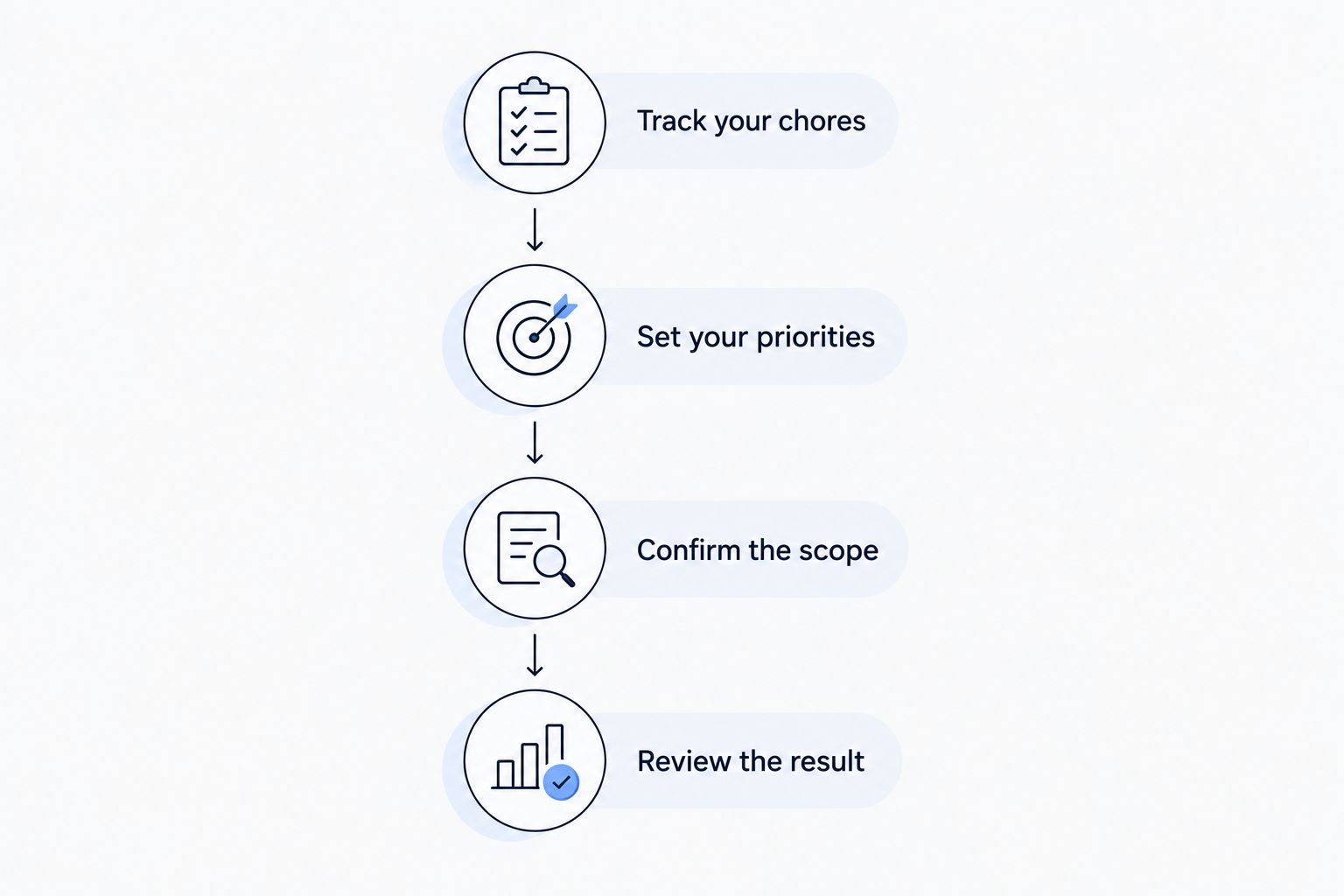
For a 2026 decision, use your current routine rather than memories of a less demanding period. This short process gives you a concrete brief and a fair way to assess the outcome.
- Track your chores. For 7 days, note what you clean, what you leave unfinished and how much active time each task takes. This is your own baseline, not a promise about a cleaner's speed.
- Set your priorities. Identify the tasks you most want off your list. Separate cleaning from putting belongings away, household repairs and other jobs that need a different arrangement.
- Confirm the scope. Ask the provider to confirm the requested work, relevant exclusions, access requirements and arrangements for supplies. Give clear information about surfaces and any instructions you need followed.
- Review the result. After the agreed clean, check the priority tasks first. Then assess how much preparation, follow-up and remaining work the booking required from you.
Define the work before judging whether the booking delivered value.
Keep the comparison practical. A cleaner does not have to complete every household chore to be useful, but the completed work should match the reason you booked.
For recurring help, choose a review point such as 4 weeks after the arrangement starts. That is a suggested checkpoint, not a claim about how long a household needs to judge cleaning quality. Use it to check whether the schedule, scope and expense still make sense.
What should you confirm before booking?
Ask for a clear description of the work rather than relying on labels such as standard clean or deep clean. Those labels alone do not tell you which surfaces, rooms or detailed tasks are covered.
Use this checklist when discussing your home:
- Which rooms and surfaces are included?
- Which requested tasks sit outside the proposed clean?
- Who supplies cleaning products and equipment?
- How should you communicate surface-care instructions?
- What needs clearing before the cleaner arrives?
- How will entry, pets and locked rooms be managed?
- What is the process for raising an unfinished task?
If you are comparing proposals in 2026, give each provider the same brief. A shorter task list is not equivalent to a longer one simply because both are described as house cleaning.
Do not book on assumptions about inclusions. Resolve the tasks that matter most before you agree to the service.
Where Housekept fits
Housekept is a house-cleaning option for households in Sydney, Shoalhaven and Illawarra. It provides professional home cleaning alongside other cleaning services, so start by explaining the household work you want handled rather than selecting a different service category by default.
The practical fit is local coverage and the home-cleaning service itself. The limitation is that choosing a provider does not settle the scope: you still need to confirm your address, requested tasks and booking arrangements. Use Housekept to discuss those requirements before making your decision.
Discuss your house cleaning
Explain your home's cleaning priorities and confirm the work you want handled.
Is a house cleaner worth it if I work from home?
Working from home does not make cleaning time free. If cleaning interrupts work or takes over your breaks, outsourcing agreed chores can still be useful. Decide whether you want cleaning during your working day, while you are out, or around rooms you need kept accessible.
Is it worth hiring a cleaner if my home is small?
A small home can still justify cleaning help when the tasks are difficult or regularly go unfinished. Judge the bathroom, kitchen, floors and your capacity to maintain them—not floor area alone. If your routine is already manageable, keeping the cleaning yourself is a sensible choice.
FAQ
Is hiring a house cleaner worth it in 2026?
Hiring a house cleaner is worth it in 2026 when the agreed work removes a burden you value more than the expense. It is not a good fit when it strains your budget or leaves your main cleaning priorities unresolved.
Should I tidy before a house cleaner arrives?
Clear the belongings needed to give access to the agreed cleaning surfaces. Confirm the preparation expected before booking rather than assuming tidying or organising is included.
Is regular cleaning better than a one-off clean?
Regular cleaning fits recurring chores, while a one-off clean fits a defined backlog. Choose based on whether you want ongoing help or a specific job completed.
Do I need to be home during the clean?
Whether you need to be home depends on the access arrangement agreed with the provider. Confirm entry, locking up, pets and any rooms that must remain inaccessible.
Does a house cleaner bring cleaning products?
Confirm who supplies cleaning products and equipment before booking. Also share relevant surface-care instructions rather than assuming every product suits every material.
How do I know whether my cleaner is worth keeping?
Keep the arrangement when the agreed work is completed and the remaining household effort justifies the expense. Raise specific unfinished tasks and reassess the scope if the service no longer solves your original problem.
Does Housekept provide home cleaning in my area?
Housekept provides home cleaning across Sydney, Shoalhaven and Illawarra. Confirm your specific address and requested work directly before booking.
One last thing
Choose what you will stop doing before you pay someone else to do it. If you plan to re-clean every completed surface regardless of the result, the booking will not remove the work you intended to hand over.
For your first booking in 2026, write a short finish line: the tasks you expect completed and the chores that will remain yours. Judge the service against that agreement. The question is not whether someone else cleaned your home; it is whether the arrangement made your household workload more manageable.