How much does NDIS cleaning cost in 2026?

NDIS cleaning has no single standard cost in 2026: your total depends on the agreed cleaning tasks, time required and provider’s terms. Confirm any travel, supplies, cancellation charges and funding requirements before booking, because the cleaning rate alone does not establish your full bill or what your plan will cover.
TL;DR
- How much does NDIS cleaning cost? Compare the full written quote, not an hourly rate alone.
- NDIS funding depends on your disability-related support needs and plan, not simply the provider’s service label.
- Housekept provides NDIS cleaning across Sydney, Shoalhaven and Illawarra.
- Agree on cleaning tasks, extra charges and invoice arrangements before the first visit.
How much does NDIS cleaning cost in 2026?
Your NDIS cleaning cost is the agreed charge for the work, plus any separately agreed charges. The amount payable from your plan also depends on the applicable funding rules and your available budget. A provider’s quote and your funding entitlement are separate questions.
Start with the written scope. A quote for maintaining an already tidy home is not directly comparable with a quote for accumulated grime, extra rooms or detailed appliance cleaning. Ask each provider to quote the same work before comparing totals.
Housekept provides NDIS cleaning services across Sydney, Shoalhaven and Illawarra. Confirm your address, required tasks and billing arrangements when requesting a quote.
Cleaning work
- What to ask: Which rooms and tasks are included?
- Why it matters: Defines what you are actually buying
Booking length
- What to ask: Is the charge based on time or an agreed scope?
- Why it matters: Establishes how the total is calculated
Supplies
- What to ask: Who provides products and equipment?
- Why it matters: Prevents assumptions about inclusions
Travel
- What to ask: Is travel charged separately?
- Why it matters: Identifies charges beyond cleaning work
Changes and cancellations
- What to ask: What happens if a visit changes or is cancelled?
- Why it matters: Clarifies your obligations before booking
Funding and invoicing
- What to ask: Does the arrangement meet your plan’s requirements?
- Why it matters: Separates an acceptable quote from a payable claim
Why this matters
A cleaning quote needs to work in your home and fit your support arrangements. Choosing by an advertised rate alone leaves the actual workload, invoice total and payment responsibilities unresolved.
For a 2026 booking, check the current NDIS pricing arrangements where they apply. A price limit is a ceiling under the relevant rules, not an instruction to charge that amount and not a promise of funding.
Regular cleaning: define the repeatable work
Best for: maintaining agreed household tasks on an ongoing schedule. A recurring cleaning scope gives you a consistent starting point for comparing providers and reviewing whether the booking meets your needs.
Describe the tasks rather than asking for a general clean. For example, specify which bathroom surfaces need attention, which floors need vacuuming or mopping, and whether kitchen bench cleaning is required. These are examples to discuss, not assumed inclusions in a provider’s service.
The advantage is clarity: the cleaner knows your priorities, and you can check completed work against the agreed list. The limitation is scope. A recurring booking does not automatically include every household task or detailed cleaning job.
Ask what happens when the agreed work takes longer than expected. Decide whether the cleaner should stop at the authorised time, leave lower-priority tasks or seek approval before continuing.
Initial or detailed cleaning: separate it from maintenance
Best for: establishing what needs attention before settling into regular cleaning. If your home needs more work at the outset, request a separate scope instead of treating the initial visit as a typical ongoing appointment.
Explain the condition of the areas you want cleaned. Mention built-up grease, heavy bathroom residue, difficult access or other relevant issues without assuming that standard domestic cleaning covers them.
The advantage is a clearer starting point for future visits. The limitation is that an initial clean does not provide a reliable ongoing budget unless the provider also explains the proposed maintenance scope.
Do not accept a broad description such as everything included without checking its boundaries. Ask about inaccessible surfaces, appliance interiors, moving furniture and any work requiring specialist equipment. Confirm exclusions in writing before approving the booking.
Why NDIS cleaning costs vary
The useful comparison is the same work under the same conditions. These factors explain why apparently similar cleaning enquiries produce different quotes:
- Task scope. Cleaning floors and bathroom surfaces is a different workload from including detailed kitchen or appliance tasks. List each requested job.
- Home condition. Accumulated dirt and residue change the work involved. Give the provider an accurate description rather than relying on room count alone.
- Areas included. State which bedrooms, bathrooms, living spaces and other areas need attention. Separate unused rooms from rooms requiring every visit.
- Access requirements. Explain parking, entry arrangements, stairs and any restrictions that affect the visit. Ask how the provider handles these circumstances.
- Equipment and supplies. Agree on who brings the vacuum, mop and cleaning products. Tell the provider about product restrictions before accepting the scope.
- Booking terms. Check minimum bookings, travel arrangements, schedule changes and cancellation conditions. These terms belong beside the cleaning scope, not in a later conversation.
For 2026 comparisons, request written quotes using the same task list. A cheaper-looking offer is not a better fit if it leaves your essential work outside the booking.
How do you check an NDIS cleaning quote?
Use this sequence before you approve ongoing visits. It keeps the cleaning decision separate from the funding check without letting either fall through the gap.
- Check support needs. Identify the household tasks you need help with because of your disability. Discuss funding questions with your plan manager, support coordinator or the NDIA as appropriate.
- Set the scope. Write down the rooms, tasks, priorities and exclusions. Explain access needs and any cleaning-product restrictions.
- Get the quote. Request the charging basis, booking terms and any separately charged items in writing. Ask how additional work is authorised.
- Confirm invoicing. Establish who receives invoices, what details are required and whether the proposed provider arrangement suits your plan management type.
- Review the booking. After the initial visit, check completed work against the agreed scope. Resolve any mismatch before repeating the arrangement.
A useful written brief stays specific without sharing unnecessary personal information. Describe the support required and practical arrangements; give sensitive information only where it is relevant to delivering the service safely.
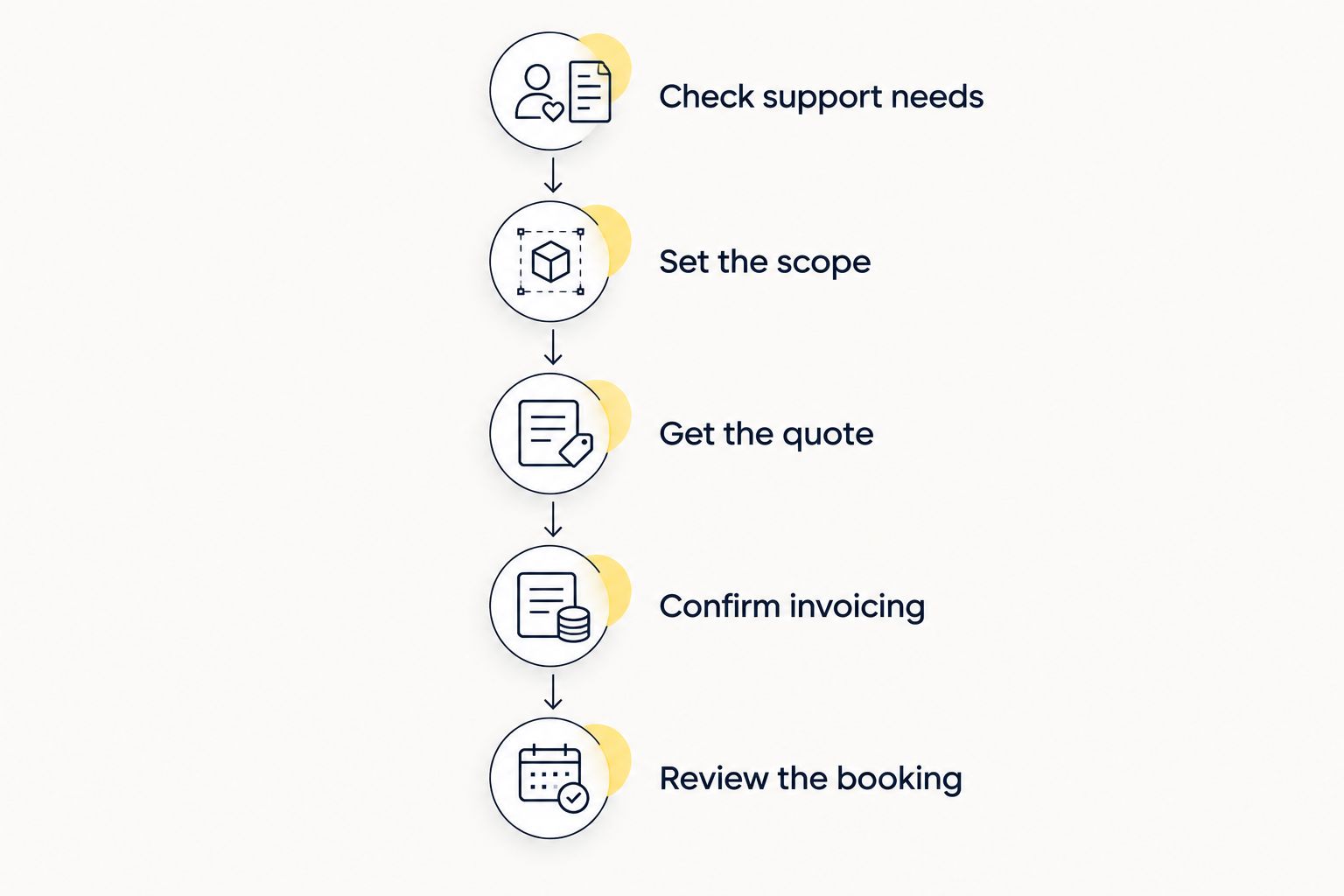
Confirm both the cleaning scope and payment arrangements before repeating a booking.
Does NDIS funding cover every cleaning task?
NDIS funding does not automatically cover every task on a cleaner’s checklist. Household assistance must meet the applicable NDIS funding requirements and relate to your disability support needs.
Do not treat the words NDIS cleaning as approval for a particular booking. A provider offering the service does not establish that every requested task is funded for every participant.
Separate ordinary cleaning support from additional requests before booking. Ask about any task that sits outside your agreed disability-related household assistance, including specialist work or cleaning requested for another purpose.
A provider can explain its service scope. Your funding arrangements need a separate check with the appropriate person or organisation. Keep both answers in writing so you know what has been approved and what remains your responsibility.
How does plan management affect the booking?
Your plan management type affects provider requirements and payment arrangements. Confirm those requirements before comparing providers purely on the cleaning quote.
NDIA-managed
- What to confirm before booking: Whether the provider has the required NDIS registration
- Practical benefit: Establishes provider eligibility before scheduling
- Requirement to check: Registration alone does not confirm task eligibility
Plan-managed
- What to confirm before booking: Invoice details, applicable price limits and payment process
- Practical benefit: Clarifies how the provider bills your plan manager
- Requirement to check: The service must still meet funding requirements
Self-managed
- What to confirm before booking: Payment responsibilities, records and support eligibility
- Practical benefit: Lets you organise payment directly
- Requirement to check: You remain responsible for appropriate use of funds
Do not assume a cleaning company accepts every billing arrangement. Ask directly and make sure the answer matches your current plan management type.
The NDIS plan manager and cleaning invoicing guide covers the handover between booking and billing. Establish that handover before the first invoice, not after a payment problem.
What should your cleaning agreement include?
A useful agreement makes the work, payment process and change rules clear. It should let you answer what is being done, when it is happening and who must approve a change.
Keep the practical details together:
- The agreed rooms, tasks and priorities.
- The booking schedule and charging basis.
- The products and equipment each party supplies.
- Any separately agreed charges and cancellation conditions.
- Access instructions and relevant safety requirements.
- Invoice recipients and the process for raising a problem.
Ask how you will be told if the cleaner cannot attend or cannot finish the agreed work. Also establish how either party can change or end the arrangement. Read these terms before accepting them.
For your 2026 budget, use the agreed booking schedule rather than assuming every calendar month contains the same appointments. Include only charges that have actually been agreed; do not build a budget from an advertised headline alone.
Is a lower hourly rate always cheaper?
A lower hourly rate does not establish a lower total bill. Compare the charging basis, authorised booking length, included tasks and separately agreed charges together.
If providers propose different scopes, ask them to explain the difference before choosing. One quote might cover only priority rooms while another includes additional areas you requested.
Keep quality checks practical. Did the cleaner complete the agreed tasks, respect the access instructions and communicate unfinished work? Those observations help you decide whether the booking meets your needs without relying on an unsupported promise about speed.
Who should consider Housekept for NDIS cleaning?
Housekept NDIS cleaning is best suited to households seeking a local service in Sydney, Shoalhaven or Illawarra. Its stated service coverage matches those areas.
The geographic fit is useful, but it does not replace checking your individual requirements. Ask about your exact address, task list, provider requirements and invoicing before booking Housekept. Do not assume that offering NDIS cleaning confirms every funding or service arrangement.
FAQ
How much does NDIS cleaning cost in 2026?
NDIS cleaning has no single standard cost in 2026. Get a written quote covering the agreed tasks, charging basis and any separate charges, then confirm what your funding arrangements allow.
Can I use my NDIS plan to pay for a cleaner?
You can use NDIS funding for eligible cleaning assistance when it meets the applicable funding requirements and relates to your disability support needs. Confirm the proposed support against your plan before booking.
Does every NDIS cleaner have to be registered?
Provider registration requirements depend on your plan management arrangements and the support involved. NDIA-managed participants need registered providers; check the applicable requirements before agreeing to a service.
Are cleaning products included in NDIS cleaning?
Cleaning products are included only if the provider’s agreed scope says they are. Confirm who supplies products and equipment, and discuss any product restrictions before the visit.
Can a cleaner send invoices to my plan manager?
A cleaner can send invoices to your plan manager when that billing arrangement has been agreed and meets the relevant requirements. Confirm invoice details and service eligibility before work starts.
Will my NDIS plan cover an end-of-lease clean?
Do not assume your NDIS plan covers an end-of-lease clean. Check whether the specific request meets your disability-related funding requirements before authorising the work.
Does Housekept offer NDIS cleaning near me?
Housekept provides NDIS cleaning across Sydney, Shoalhaven and Illawarra. Confirm your exact address, required tasks and payment arrangements when enquiring.
One last thing
Write down what the cleaner should leave until later if time runs short. A priority list is more useful than a long checklist with every task marked essential.
Put your most important household needs first and agree on how unfinished work is reported. That gives you a clear basis for adjusting the scope without silently expanding the booking.