
DVA home care package to cleaning support: 2026 workflow
Instead of repeatedly explaining your cleaning needs, turn your dva home care package cleaning enquiry into a written workflow: confirm the funding pathway, record the approved tasks, then arrange the cleaner. This 2026 guide shows you what to check before booking and how to keep cleaning instructions aligned with your support arrangements.
TL;DR
- DVA home care package cleaning starts with confirming the funding pathway, not booking a cleaner.
- Veterans’ Home Care domestic assistance and Support at Home are different arrangements; do not treat them as interchangeable.
- Housekept provides DVA cleaning services across Sydney, Shoalhaven and Illawarra; confirm your arrangement before booking.
- Keep approved tasks, access instructions and service changes in one written cleaning brief.
Why this matters
A cleaning booking is not funding approval. A cleaner needs practical instructions, while the organisation administering your support needs the service to match your assessed and authorised arrangements. Treat those as separate checks.
The phrase ‘DVA home care package’ can blur different programs. DVA’s Veterans’ Home Care, often shortened to VHC, includes assessed domestic assistance. Support at Home is a separate aged care program, not another name for VHC.
Start with the program named in your current paperwork rather than the phrase used in a search. The DVA cleaning services for veterans guide provides related cleaning context; the workflow below focuses on the handover from support arrangements to cleaning instructions.
Housekept is best suited to households seeking cleaning services in Sydney, Shoalhaven and Illawarra. Confirm that the proposed booking fits your particular funding and provider arrangements before work begins.
Before you start
Gather these materials before approaching a cleaner. No software account is required for this workflow; a document or paper folder is enough.
- Current support paperwork and the right contact: Have your assessment or service documents ready, plus contact details for the organisation administering your support. If someone else will coordinate, confirm their authority to discuss or change the service.
- A practical household brief: List the rooms needing attention, the tasks you need help with, access arrangements and relevant cleaning sensitivities. Share information needed for the job, not your complete medical history.
- The funding check that prevents a failed handover: Ask whether the proposed cleaner must be arranged through a particular provider and who authorises the work. Do not assume you can book independently and obtain reimbursement later.
For a 2026 booking, use the current version of your documents. An old task list is not evidence that the same service remains authorised.
Funding pathway confirmation
Identify the arrangement before choosing the booking route
- Find the program name in your current assessment, service agreement or correspondence. Look for the actual arrangement, not just a reference to veterans, aged care or home support.
- Contact the organisation named in that paperwork. If you have no assessed arrangement, contact DVA about the appropriate assessment pathway before treating cleaning as funded support.
- Ask whether domestic cleaning is included in your authorised assistance. Request clarification of the tasks and service limits that apply to you.
- Confirm who arranges the cleaner, who approves changes and who receives service records or invoices. Keep the answer with your cleaning brief.
Expected result: You can name the program, the approving contact and the route for arranging cleaning. If those details remain unclear, stop before making a funded booking.
Compare the routes without mixing their rules
These are different starting points, not interchangeable funding options. Choose the row that matches your documents.
Veterans’ Home Care domestic assistance
- Best for: People whose assessed VHC support includes domestic assistance
- Practical advantage: Links the cleaning request to the assessed support arrangement
- Limitation to check: The tasks and provider arrangements must match the authorisation
Support at Home domestic assistance
- Best for: People whose aged care arrangement includes domestic assistance
- Practical advantage: Keeps cleaning within the relevant aged care service plan
- Limitation to check: DVA paperwork does not establish Support at Home authorisation
Privately arranged cleaning
- Best for: Households arranging cleaning outside funded support
- Practical advantage: Lets you request a cleaning scope directly
- Limitation to check: A private booking does not establish entitlement to reimbursement
Holding a DVA card does not, by itself, authorise a particular cleaning booking. Eligibility, assessment and service arrangements still need confirmation.
Cleaning scope and household brief
Turn authorised assistance into usable instructions
- Copy the authorised cleaning tasks into a working brief. Keep the wording clear enough that the cleaner and support contact can recognise the same scope.
- List the rooms beside the relevant tasks. For example, distinguish bathroom surface cleaning from a request to clean the entire bathroom, including work that has not been discussed.
- Identify 3 priority tasks for the visit. This is a planning recommendation, not a funding rule: priorities help the cleaner know what matters if the agreed scope cannot all be completed.
- Separate routine tasks from additional requests. Put oven cleaning, external windows, heavy lifting or other extra work in a separate list for confirmation rather than silently adding it to the visit.
- Record access needs, pets and cleaning-product sensitivities. Tell the cleaner about a relevant surface restriction or fragrance concern before arrival.
Expected result: You have 1 cleaning brief that distinguishes authorised work, household priorities and requests still awaiting confirmation.
Use simple headings in your own document: Approved tasks, Priority tasks, Access instructions and Change contact. These are suggested document headings, not fields in a booking system.
The handover follows a clear sequence: Confirm funding, Define tasks, Arrange access, then Review changes. Keep each stage visible so an unresolved funding question does not disappear inside a cleaning request.
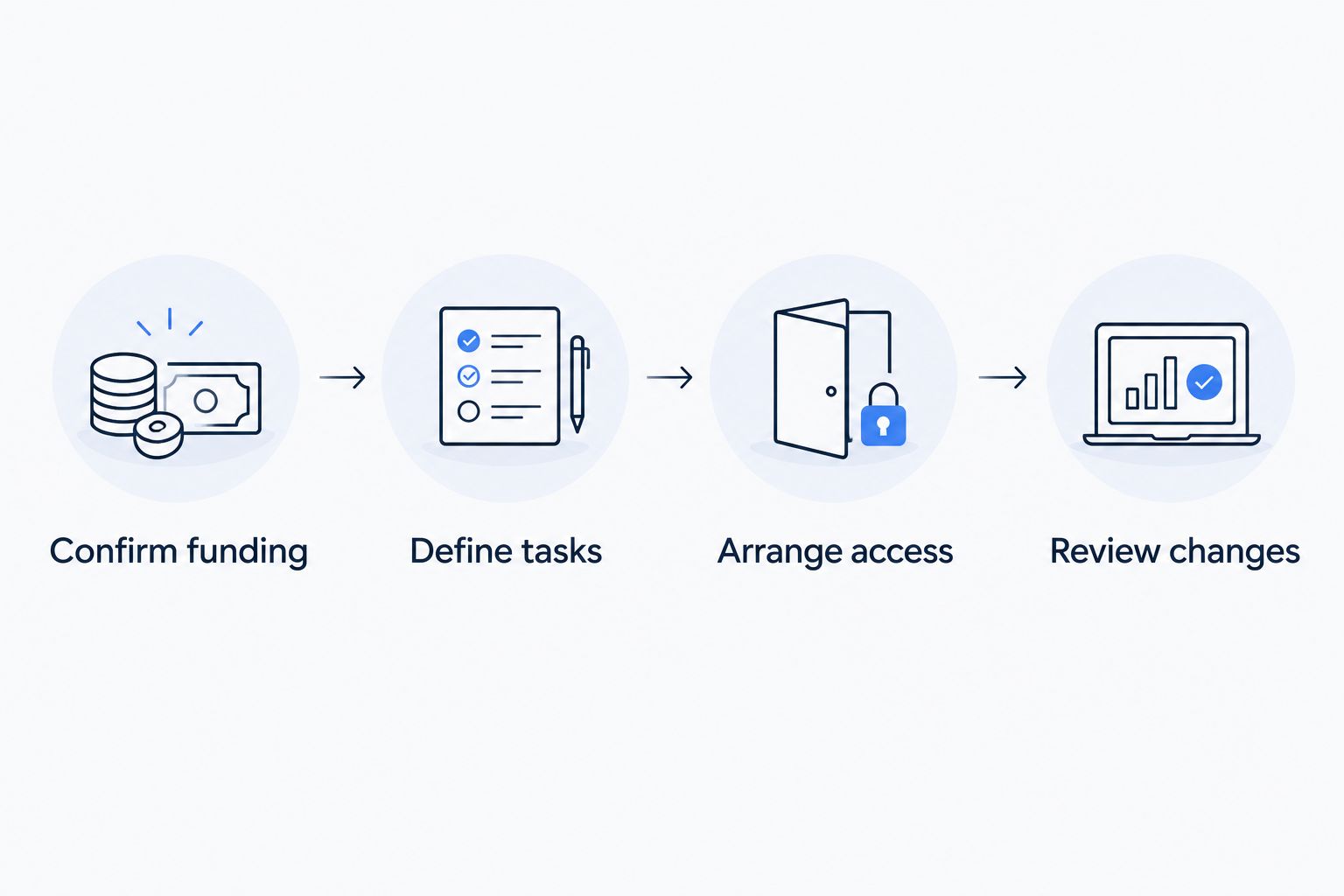
Confirm the arrangement before turning the task list into a booking.
A useful brief describes the work rather than the person’s diagnosis. Write that a walkway must remain clear or that a particular product must not be used; include medical details only when they are relevant to safe service delivery.
Booking and access arrangements
Confirm the service before the first visit
- Send the agreed scope through the booking route your support contact has confirmed. If an administering provider must arrange the cleaner, do not bypass that process.
- Ask the cleaner to confirm the address, service area, requested tasks and access arrangements. Keep this confirmation separate from the funding authorisation.
- Check whether supplies and equipment need to be provided by the household. Do not assume the booking includes particular products or specialist equipment.
- Agree on a safe entry method and the contact to use if access fails. Share sensitive entry details only with the people who need them.
- Obtain 2 confirmations before the visit: the relevant authorisation for the service and acceptance of the booking through the agreed route.
Expected result: The household, cleaner and support contact have consistent instructions, with no unresolved assumption about who arranged or authorised the work.
Housekept provides residential and DVA cleaning services, but its service categories do not establish acceptance under every funding arrangement. For a Housekept DVA cleaning enquiry, confirm the proposed arrangement before agreeing to a visit.
Record who will be present during the first clean. If a family member coordinates the service remotely, give the cleaner an agreed contact rather than assuming the person at home can resolve every booking question.
Visit record and ongoing instructions
Keep the record useful, not complicated
- After the visit, record which agreed tasks were completed. Note unfinished work separately from additional work that was never part of the scope.
- Describe any obstacle factually: a room was inaccessible, a surface needed a different method, or the requested work differed from the instructions.
- Send service issues to the agreed contact. Ask who must authorise any change before passing a revised request to the cleaner.
- Keep the latest approved brief easy to identify. Archive earlier versions so the household and cleaner do not work from conflicting instructions.
Expected result: The next visit starts with a current task list rather than a fresh explanation of the entire arrangement.
For your 2026 records, distinguish a service note from an authorisation. Writing that a household needs extra help does not mean that extra help has been approved.
A short record is enough when it answers the practical questions. What was completed? What prevented completion? Does anyone need to approve a change before the next visit?
Update the workflow when support needs change
Use this second workflow when a changed mobility need, household situation or assessment affects the cleaning request. Do not simply add work to the next visit.
- Describe the change in practical terms. Identify which task has become difficult and what help is now needed.
- Contact the organisation responsible for the support arrangement. Ask whether the change requires review, revised authorisation or a different service.
- Keep the existing scope separate from the requested change. A cleaner should not have to decide whether a new task is funded.
- Once the change is confirmed, update the brief and send it through the agreed booking route.
- Ask the cleaner to acknowledge the revised instructions before the affected visit.
Expected result: A changed need produces a controlled update, not an informal promise that conflicts with the support plan.
This workflow also applies when you want to reduce or pause work. Confirm the administrative and booking steps rather than assuming a verbal request reaches everyone involved.
Troubleshooting
The cleaner is booked, but authorisation is unclear
Contact the organisation administering the support before the visit. Ask whether the booking fits the arrangement and what must happen next; do not describe it as funded until that is confirmed.
The requested tasks exceed the agreed scope
Separate the original tasks from the additional request. Ask the responsible contact to confirm the change, then obtain the cleaner’s acceptance of the revised scope.
The cleaner cannot enter the property
Use the agreed access contact to resolve entry. Review the access instructions before the next visit, especially if a key, entry code or person attending has changed.
The cleaner and household have different task lists
Compare both lists with the latest confirmed brief. Identify the current version and send the same instructions to everyone responsible for arranging or delivering the service.
A product causes discomfort or is unsuitable for a surface
Ask the cleaner to stop using the product and discuss an appropriate alternative. Record the restriction in the brief; do not assume a product described as natural is suitable for every person or material.
Customise your workflow
Build the brief around the household’s actual needs, not a generic whole-house checklist. A clear bathroom priority, an agreed floor-cleaning area and accurate access instructions are more useful than a long list nobody has confirmed.
Use the Housekept website to discuss cleaning services in Sydney, Shoalhaven or Illawarra. Ask about the proposed tasks and your booking arrangement without assuming the enquiry itself confirms funding.
For a recurring service in 2026, nominate a change contact and keep that contact current. If a carer or family member takes over coordination, confirm their authority and pass on the latest brief rather than forwarding an entire chain of old messages.
FAQ
Can DVA help with cleaning at home?
DVA’s Veterans’ Home Care includes assessed domestic assistance. Confirm your eligibility, authorised tasks and service arrangements through the relevant assessment and support contacts before booking cleaning.
Is a DVA home care package the same as Support at Home?
No. Veterans’ Home Care and Support at Home are different arrangements. Use the program named in your current paperwork to identify who assesses, authorises and arranges your cleaning support.
Does having a DVA card automatically approve cleaning?
No. A DVA card alone does not authorise a particular cleaning booking. Confirm the assessment outcome and the service arrangements that apply to your circumstances.
Can I choose my own cleaner for DVA domestic assistance?
Confirm the provider-selection rules with the organisation administering your support before choosing a cleaner. Do not assume an independently arranged booking will qualify for reimbursement.
Can Housekept provide DVA cleaning in my area?
Housekept provides DVA cleaning services across Sydney, Shoalhaven and Illawarra. Confirm your address, requested work and specific funding arrangement before booking.
What should I give the cleaner before the first visit?
Provide the agreed task list, household priorities, access instructions and relevant product or surface restrictions. Keep the funding confirmation with the service records and share personal information only when needed.
What happens if I need more cleaning help in 2026?
Contact the organisation responsible for your support arrangement to discuss the changed need. Update the cleaning brief after any required review or authorisation, then confirm the revised instructions with the cleaner.
One last thing
Keep approval and instructions separate. The approval establishes what is authorised; the brief explains how to carry out the agreed cleaning in your home. Neither document replaces the other.
Before the next visit, check that the cleaner has the current brief—not simply the most recently forwarded message.