Does NDIS cover cleaning services?

Yes, the NDIS can cover cleaning services when disability-related needs prevent you from doing household tasks and the support meets NDIS funding rules and your plan. Funding is not automatic: being an NDIS participant does not make every cleaning job claimable. Before booking in 2026, confirm the tasks, available funding and payment arrangements against your plan.
TL;DR
- Does NDIS cover cleaning services? Yes, when disability-related household assistance meets NDIS rules and your plan.
- The National Disability Insurance Agency assesses disability-related support needs, not simply whether you want a cleaner.
- Your plan management arrangement determines whether you need an NDIS-registered cleaning provider.
- Confirm the cleaning scope and invoice requirements before the first visit.
Does NDIS cover cleaning services?
NDIS funding can pay for household cleaning that you need because of your disability. The key question is not whether cleaning benefits you; it is whether the assistance is an eligible disability-related support that fits your plan.
Household assistance generally sits within Core supports, under Assistance with Daily Life. Check your actual plan rather than assuming every Core budget can cover any household task. Funding flexibility and stated supports affect how you can use the money.
If you are comparing local cleaning services, separate the service enquiry from the funding decision. A cleaner can describe the work they offer, but that description does not establish whether your NDIS funds can pay for it.
Use this sequence before you arrange a visit:
- Identify the need. Describe which cleaning tasks your disability prevents you from completing safely or adequately.
- Check the plan. Confirm that the proposed assistance fits your supports and available funding.
- Check the provider. Match the provider requirements to how your funding is managed.
- Agree on the work. Set out the tasks, exclusions, access arrangements and invoicing details before cleaning starts.
A clear task list makes this conversation easier. Explain that you need help mopping floors because a disability affects your balance, rather than asking whether your plan pays for a general house clean.
Why this matters
A cleaning booking and an NDIS funding decision are different things. Agreeing to a service does not guarantee that a claim will be accepted, and an invoice alone does not turn an ordinary household expense into a funded support.
For your 2026 arrangements, use the National Disability Insurance Agency’s guidance on NDIS supports, household tasks and plan management alongside your own plan. The NDIS Quality and Safeguards Commission is the relevant source for provider registration information. These sources answer different questions: what funding can buy, and which provider requirements apply.
Keep the responsibility clear when you speak with a cleaner or plan manager. Ask who will confirm the funding fit, who will receive invoices and who will resolve a disputed charge. Do not leave those questions until after the work is complete.
Which cleaning tasks can NDIS funding cover?
Routine household cleaning can be an eligible support when it addresses your disability-related needs. The task itself is only part of the assessment; the reason you need assistance also matters.
Use the examples below to prepare your request, not as a list of automatically approved services.
Vacuuming and mopping
- When it fits a disability-related request: Your disability limits your ability to clean floors
- What to clarify: Rooms, floor surfaces and safe access
Bathroom cleaning
- When it fits a disability-related request: You need assistance maintaining the bathroom you use
- What to clarify: Shower, toilet, basin and excluded work
Kitchen cleaning
- When it fits a disability-related request: You need assistance keeping food preparation areas clean
- What to clarify: Benchtops, sink and appliance surfaces
Dusting and surface wiping
- When it fits a disability-related request: Your disability prevents you from completing these tasks
- What to clarify: Accessible surfaces and items not to move
Laundry assistance
- When it fits a disability-related request: You need disability-related help with household laundry
- What to clarify: Washing, hanging, folding and putting away
Best for routine household support: a task-based cleaning arrangement tied to your actual needs. Its benefit is a clear purpose and scope. Its limit is that it does not make every task in the home eligible for funding.
Do not assume that a routine clean includes specialist work. Carpet treatment, high-access windows, significant mould problems and hazardous waste need separate discussion about suitability, safety and funding. A cleaner also needs to confirm which tasks they can perform.
Ordinary cleaning products and household appliances are not automatically funded simply because a cleaning service is eligible. Distinguish assistance with cleaning from buying everyday household goods, and check any proposed separate claim before purchasing.
Does your plan management type change the cleaner you can use?
Yes. Your plan management arrangement affects provider choice and payment administration, even when the cleaning need is the same. Check the arrangement for the funding you intend to use, because different parts of a plan can be managed differently.
NDIA-managed
- Provider requirement for ordinary cleaning supports: You must use an NDIS-registered provider
- Best for: Participants using Agency-managed funding
- Responsibility or limitation: Provider choice is restricted to registered providers
Plan-managed
- Provider requirement for ordinary cleaning supports: You can generally use registered or unregistered providers
- Best for: Participants wanting a plan manager to handle payments
- Responsibility or limitation: Services and claims still need to meet NDIS rules
Self-managed
- Provider requirement for ordinary cleaning supports: You can generally use registered or unregistered providers
- Best for: Participants choosing to manage purchasing and records
- Responsibility or limitation: You take responsibility for managing the funding and records
These are payment arrangements, not different levels of cleaning entitlement. Neither plan management nor self-management removes the requirement to purchase eligible NDIS supports.
NDIA-managed funding
With NDIA-managed funding, confirm the provider’s NDIS registration before booking. A business advertising disability cleaning is not, by that description alone, an NDIS-registered provider.
Check that the provider can supply the relevant support through your funding arrangement. Avoid treating a general statement that a business works with participants as confirmation that it can claim against your particular plan.
Plan-managed funding
With plan-managed funding, your plan manager handles provider payments from the funds they manage. Ask what service and invoice details they need before the first clean, and confirm the proposed support fits the plan.
Best for payment administration: an agreed invoice process established before services start. The benefit is clarity about where claims go; the limitation is that a plan manager’s involvement does not make an otherwise ineligible task fundable.
Self-managed funding
With self-managed funding, you arrange supports and manage the related records and payments. Keep the service agreement, invoices and evidence of the support delivered together.
Provider choice brings administrative responsibility. Before committing to ongoing visits, check that the arrangement remains within your available funding and meets the rules for self-managed purchases.
Why NDIS cleaning arrangements vary
NDIS cleaning arrangements vary because participants have different disability-related needs, plans and households. There is no universal cleaning schedule that every participant receives.
The main factors to clarify are:
- Functional impact: Identify the tasks your disability affects, rather than relying only on the name of a diagnosis.
- Plan requirements: Check the funding category, any stated supports and the amount available for the proposed assistance.
- Household responsibilities: Distinguish your disability-related assistance from cleaning that serves other household members.
- Task scope: Separate routine upkeep from specialist, hazardous or one-off work.
- Funding management: Confirm the provider and payment requirements for the funds you will use.
- Changing needs: Review the arrangement when your needs, household or plan changes.
A larger home does not automatically create a larger NDIS entitlement. Equally, sharing a home does not by itself explain what assistance you need. Describe your circumstances and the work that relates to your disability.
For a 2026 service arrangement, write down these decisions instead of relying on a verbal understanding. A short, specific scope is more useful than a broad promise to clean everything.
How do you arrange NDIS-funded cleaning?
Start with the funding fit, then choose the service. This order helps you avoid committing to work before you understand how it will be paid.
Confirm eligibility
Read the relevant parts of your plan and identify the household assistance you need. If the funding position is unclear, ask your NDIS contact or plan manager before agreeing to a booking; a support coordinator can also help you work through the arrangement if you have one.
Explain the practical impact of your disability. Describe the tasks you cannot complete, what happens without assistance and what support you are requesting. Keep the request about your needs, not simply the cleaner’s standard package.
Set the scope
List the rooms and tasks, then identify exclusions. Include access instructions, areas that must remain untouched and any relevant product sensitivities or safety concerns.
Agree on how the cleaner should handle an unfinished task or a request for extra work. An instruction to do whatever needs doing leaves too much room for disagreement about the service and the claim.
Check the provider
Confirm that the business covers your location, offers the tasks you need and meets the requirements of your funding arrangement. Ask about registration where required rather than making assumptions from service names.
Housekept provides NDIS cleaning services across Sydney, Shoalhaven and Illawarra. Housekept is a local cleaning option for NDIS participants in these areas. Confirm that its proposed service, provider status and payment arrangements suit your plan before booking; local coverage alone does not establish funding eligibility.
Agree on invoicing
Give the provider the correct invoice recipient and confirm the information required for payment. This commonly includes the participant details, service dates, description of work and relevant support information, but your payment arrangement determines the exact requirements.
The guide to connecting your NDIS plan manager to cleaning invoicing covers that administrative handover. Keep invoice descriptions consistent with the work actually delivered.
Review the service
Check whether the agreed tasks were completed and whether the scope still matches your needs. Raise service problems directly and keep a record of any agreed changes.
Before continuing an arrangement into a new plan period in 2026, recheck the funding rather than assuming the previous booking pattern remains suitable. The service should follow your current needs and plan, not simply repeat an old calendar entry.
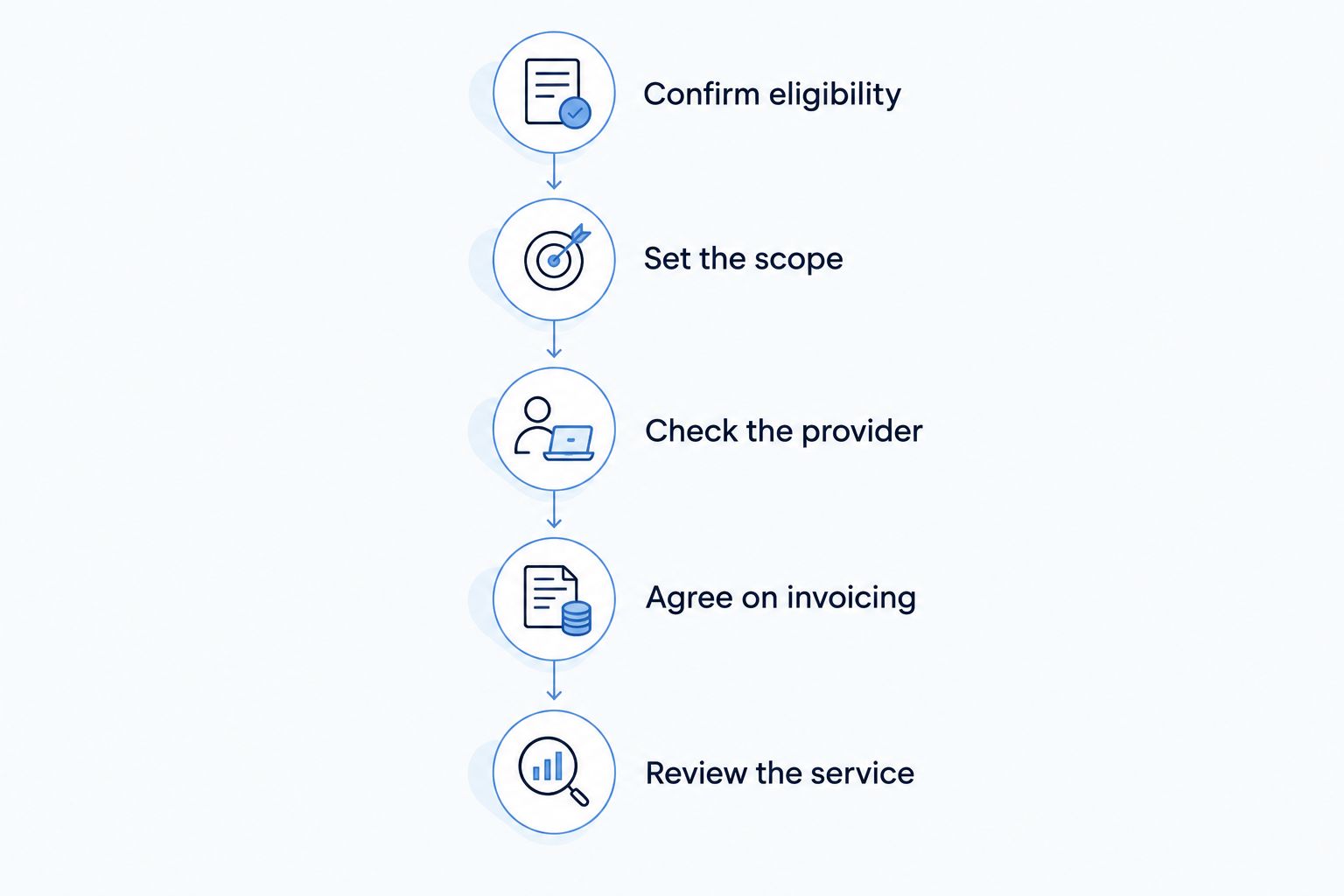
Confirm funding and the scope before cleaning starts.
Can NDIS pay for a regular cleaner?
NDIS funding can cover regular cleaning when ongoing assistance meets your disability-related needs and plan requirements. A recurring booking is not automatically approved just because an initial clean was paid.
Agree on the necessary tasks and schedule, then check that the arrangement is sustainable within your funding. Review changes before adding visits or expanding the scope.
Regular cleaning offers continuity, but it also creates an ongoing funding commitment. Keep track of delivered services so that a standing booking does not continue without attention to the remaining budget.
Does NDIS cover end-of-lease cleaning?
End-of-lease cleaning is not automatically covered by the NDIS. A tenancy requirement, property inspection or bond deadline does not by itself establish a disability-related support need.
If you need disability-related assistance during a move, clarify the specific support and funding position before booking. Do not treat a bond clean as interchangeable with routine household assistance, and keep ordinary tenancy obligations separate from the assistance being considered.
Can a carer organise NDIS cleaning for someone else?
A carer can help organise cleaning with the participant’s consent and appropriate authority. Start with the participant’s preferences, including which rooms the cleaner can enter and how they want the work done.
Make the communication arrangement explicit. The person coordinating access, the person receiving invoices and the person authorised to make decisions are not necessarily the same person.
A practical arrangement respects the participant’s control while giving the cleaner clear instructions. Avoid sharing more personal or disability information than is needed to deliver the service safely and appropriately.
FAQ
Does NDIS cover cleaning services in 2026?
Yes, the NDIS can cover cleaning services in 2026 when they address disability-related needs and meet NDIS rules and your plan. Confirm the tasks, funding and provider requirements before booking.
Do I need a registered NDIS cleaner?
You need an NDIS-registered provider when using NDIA-managed funding. Plan-managed and self-managed participants can generally use registered or unregistered providers for ordinary cleaning supports.
Can I use Core funding for household cleaning?
Household cleaning assistance generally falls within Core supports under Assistance with Daily Life. Check your plan’s funding flexibility and any stated supports before using the budget.
Will NDIS pay to clean my whole family’s home?
NDIS funding is for your eligible disability-related support, not an automatic whole-house cleaning entitlement for everyone. Clarify how the proposed tasks relate to your needs and household responsibilities.
Can my plan manager arrange payment for a cleaner?
Your plan manager can process eligible cleaning invoices from the funding they manage. Agree on the service details and invoice requirements before cleaning begins.
Does Housekept offer NDIS cleaning in my area?
Housekept provides NDIS cleaning services across Sydney, Shoalhaven and Illawarra. Confirm your address, required tasks and funding arrangement before booking.
Does an NDIS cleaning booking include cleaning products?
Confirm cleaning product arrangements directly with the provider. An eligible cleaning service does not automatically make a separate purchase of everyday household products claimable.
One last thing
The most useful detail is the task you need help with, not the size of the cleaning package. Before booking Housekept or another provider, write a short list of disability-related tasks and the help required for each.
Keep that list with your 2026 service agreement. It gives you a clear reference when checking the work, discussing changes or querying an invoice—and keeps the arrangement centred on your needs.