
Commercial cleaning for childcare centres: complete 2026 guide
Childcare centre commercial cleaning is the planned cleaning of learning rooms, bathrooms, kitchens and shared spaces to support a hygienic environment for children and staff. This 2026 guide to commercial cleaning for childcare centres explains how to divide daily responsibilities, choose a provider and check the work without treating your centre like an office.
TL;DR
- Commercial cleaning for childcare centres needs room-by-room tasks, safe product handling and a clear staff-to-cleaner handover.
- Housekept provides commercial cleaning across Sydney, Shoalhaven and Illawarra; confirm your centre's specific requirements before booking.
- Clean surfaces before disinfecting where required, and follow the product label's dilution and contact-time instructions.
- Choose the cleaning scope before choosing the provider; a general office checklist misses childcare-specific tasks.
Housekept is best suited to operators seeking commercial cleaning in Sydney, Shoalhaven and Illawarra. Start with Housekept to discuss your requirements, then confirm the childcare-specific tasks, access arrangements and exclusions in writing.
Why commercial cleaning matters for childcare centres
Children play close together, handle shared toys and move between eating, toileting, rest and play areas. Your cleaning plan must reflect those activities, not just the appearance of floors and reception.
A contractor cannot replace the cleaning needed while children attend. Educators and support staff still need clear instructions for spills, mouthed toys, meal tables and toileting areas between scheduled visits. The main decision is who owns each task, not simply who cleans after closing.
For your 2026 procedures, use the National Health and Medical Research Council's Staying healthy guidance alongside applicable education and care requirements. Keep routine cleaning, incident response and outbreak instructions distinct so staff know which procedure applies.
A clean-looking room is not proof that the correct process was followed. Your checks should cover what was cleaned, which method was used and whether the room is ready for children to return.
How to organise cleaning around your centre
Build the scope yourself before asking a provider to quote. A spreadsheet, printed room list and shared folder are enough to start; the provider then works against your requirements rather than defining them through a generic package.
Map every room and its cleaning needs
Walk through the centre during normal operations before writing the checklist. Note where children eat, sleep, handle shared resources and receive personal care, including spaces that change purpose throughout the day.
Start with a 1-page room register and expand it where necessary. Record surfaces and activities rather than vague instructions such as "clean thoroughly". A learning room with a craft sink, soft furnishings and shared toys needs more detail than a room name and a tick box.
Include access restrictions and surfaces that need particular care. Tell the cleaner about damaged flooring or fittings so maintenance issues do not become recurring cleaning complaints.
- List learning rooms, sleep spaces, bathrooms, kitchens and outdoor areas.
- Identify meal tables, nappy-change areas and shared resources.
- Record floor types and manufacturer care instructions where available.
- Mark chemical storage, equipment storage and restricted spaces.
Assign tasks to the right time and person
Divide the work by when it must happen, then name the person or role responsible. Do not leave daytime cleaning unassigned because an evening contractor attends.
Use a paper roster or shared spreadsheet for your 2026 cleaning schedule. Each task needs a method, frequency and completion record; exceptions need somewhere to be reported. If staff remove a toy from use, the next person must know whether it is waiting for cleaning or ready to return.
Keep incident procedures separate from the routine roster. Vomit, blood or other bodily-fluid contamination needs the centre's designated response, not an instruction to leave it for the cleaner.
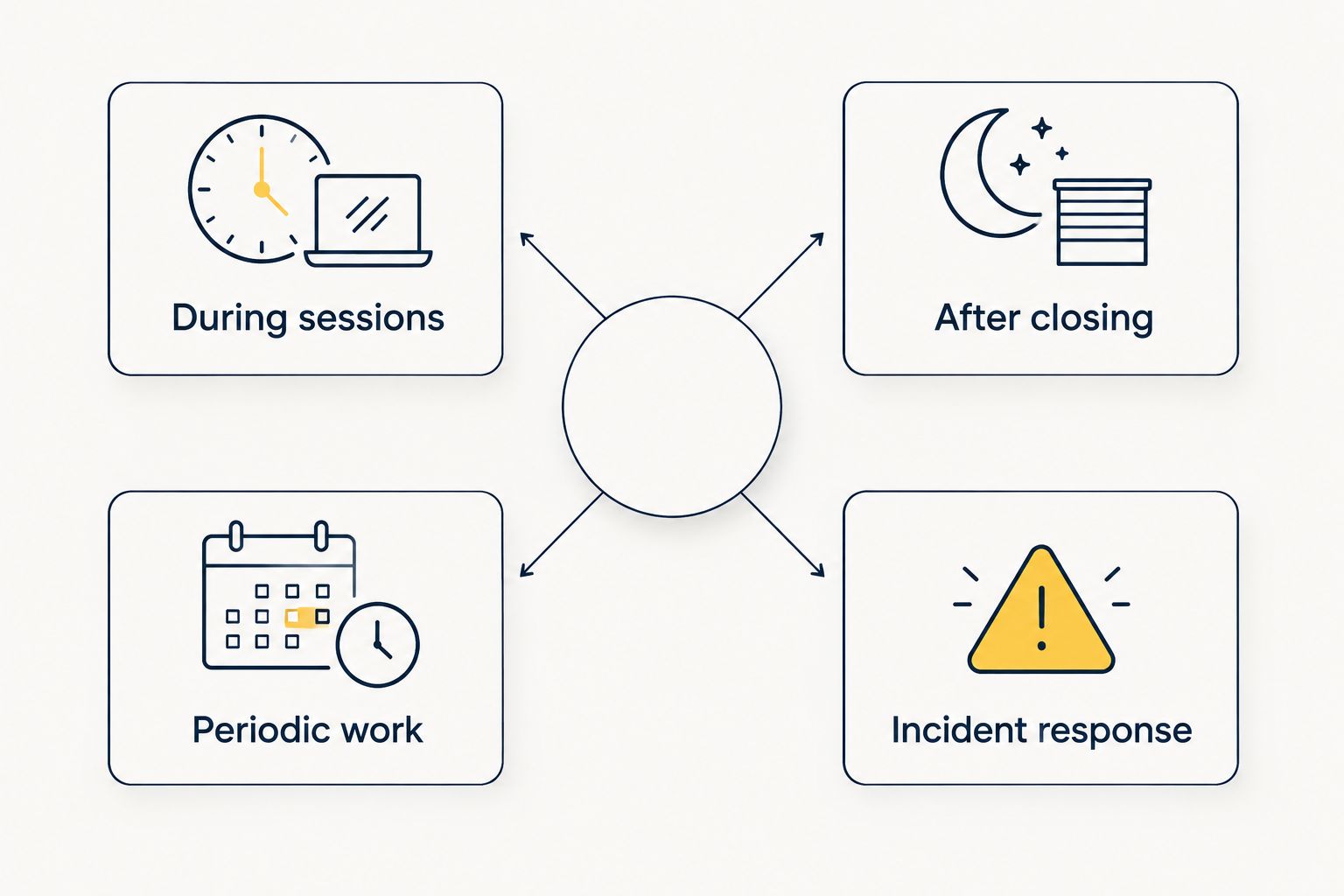
Assign an owner to every category so daytime tasks do not fall between staff and contractors.
- During sessions: assign meal-table cleaning, spills and used-resource handling.
- After closing: specify the agreed room and floor-cleaning tasks.
- Periodic work: schedule items outside the routine visit.
- Incident response: name the responsible staff role and escalation process.
Compare providers against your written scope
Send the same room register and task schedule to each provider. Ask each one to mark what is included, excluded or dependent on further inspection; this makes the proposals easier to compare.
Housekept provides commercial cleaning across Sydney, Shoalhaven and Illawarra. Use that service as an option for the scheduled work, while confirming childcare experience, required documentation, product arrangements and site-specific responsibilities directly. Do not assume a general commercial service includes toy processing, laundry or incident response.
Book a 15-minute scope meeting as an initial discussion, then arrange a site inspection if needed. The meeting should identify unanswered questions rather than substitute for assessing the premises.
- Request a task-by-task response to your scope.
- Ask how replacement staff receive site instructions.
- Confirm access, security and key-handling arrangements.
- Request relevant insurance and worker documentation.
- Record exclusions and how additional work is authorised.
Control products and equipment before work starts
Create a product register using the labels and safety data sheets for the products proposed. Check that each product suits its intended surface and task; a pleasant scent is not evidence of effective cleaning or disinfection.
Cleaning removes dirt and contamination. Disinfection is a separate process where required, and product instructions determine preparation, dilution and contact time. Do not invent a universal contact time or assume a surface is ready because it looks dry.
Agree who supplies, stores and maintains the equipment. Keep chemicals inaccessible to children, retain clear labels and never mix cleaning chemicals. Ask how cloths and mop heads are separated, cleaned and dried between uses.
- Approve products for their intended tasks and surfaces.
- Keep labels and safety data sheets accessible to workers.
- Follow label instructions for dilution and contact time.
- Separate bathroom equipment from food-area equipment.
- Store chemicals and equipment away from children.
Separate food, toileting and shared-resource workflows
Write separate instructions for eating areas, toilets, nappy-change spaces and shared play resources. An instruction to wipe all surfaces does not explain how workers avoid moving contamination between those areas.
For toys and learning materials, follow current childcare guidance and manufacturer instructions. Check whether the item can be immersed, machine washed or only surface cleaned. Remove unsuitable or damaged items rather than applying a stronger chemical as a workaround.
Food-contact surfaces need products and methods suitable for that use, including rinsing where the label requires it. Identify who clears food, washes utensils and resets meal areas; those responsibilities do not automatically belong to an evening contractor.
- Keep clean resources separate from items awaiting cleaning.
- Use dedicated equipment for toilets and nappy-change areas.
- Follow material-care instructions for toys and soft furnishings.
- Specify the cleaning method for food-contact surfaces.
- Report damaged items that cannot be cleaned properly.
Plan the handover between staff and cleaners
Use a simple handover log before adding another system. Staff should record blocked access, rooms still occupied, spills already addressed and items removed from use. Cleaners should record incomplete tasks and problems needing attention.
Confirm how the centre is left secure and ready for opening. Wet floors, accessible chemicals and equipment left in circulation areas are handover issues, not details to discover when children arrive.
Your 2026 roster should also cover changes to room use, centre closures and staffing arrangements. Name a centre contact and a provider contact so an unanswered message does not leave urgent work unresolved.
- Record room access restrictions before each visit.
- Flag incomplete work and the reason it was missed.
- Confirm the agreed lock-up and security process.
- Keep equipment clear of exits and circulation areas.
- Assign responsibility for the opening check.
Inspect the work and correct recurring gaps
Check completed work against the written scope, not a general impression of cleanliness. Walk through representative rooms and inspect the agreed surfaces, floors, fixtures and storage arrangements.
Set a 2-week review after a new arrangement begins. Treat this as a practical starting point, not a hygiene standard: the purpose is to catch unclear instructions and missed responsibilities early. Address immediate safety concerns when identified rather than waiting for that review.
If the same task keeps failing, identify the cause. The task might be unclear, inaccessible, assigned to nobody or outside the agreed scope. More frequent complaints do not fix an instruction that remains ambiguous.
- Compare completed work with the room-by-room checklist.
- Record the task, location and observed problem.
- Photograph issues only where privacy rules permit.
- Assign a corrective action and responsible contact.
- Update the scope when room use or responsibilities change.
Compare cleaning options for your centre
Choose your 2026 arrangement according to when the work occurs and who can supervise it. Provider selection comes after that decision.
An internal team gives you direct oversight but also leaves recruitment, training, equipment and cover with your centre. Outsourcing scheduled work changes who delivers those tasks; it does not transfer every daytime hygiene responsibility.
Centre-managed cleaning team
- Best for: Centres with the capacity to manage cleaning staff directly
- Main advantage: Direct control over duties and scheduling
- Key limitation: The centre manages training, equipment and staff cover
Housekept commercial cleaning
- Best for: Operators seeking a provider across Sydney, Shoalhaven and Illawarra
- Main advantage: Commercial cleaning within those service regions
- Key limitation: Childcare-specific scope and arrangements need confirmation
Split staff-and-contractor arrangement
- Best for: Centres separating daytime tasks from scheduled cleaning
- Main advantage: Allocates work around operating hours
- Key limitation: Requires a clear handover and named task owners
One-off detailed clean
- Best for: Defined work outside the routine schedule
- Main advantage: Addresses an agreed set of additional tasks
- Key limitation: Does not replace ongoing cleaning responsibilities
Choose the arrangement that leaves no task unassigned. A split arrangement only works when staff and contractors understand the boundary; otherwise, each side can expect the other to handle the same job.
Discuss your centre's cleaning scope
Confirm tasks, exclusions and access arrangements before booking commercial cleaning.
Common mistakes childcare centres make
Copying an office-cleaning checklist
Office checklists do not describe nappy-change spaces, mouthed resources or rooms used for both play and meals. Use the centre's actual activities to build the scope, then check every task has an owner and method.
Treating disinfection as a substitute for cleaning
Applying disinfectant does not remove the need to clean a dirty surface. Follow the relevant procedure and product label, including preparation and contact time, instead of judging the process by how much product was applied.
Leaving toy cleaning between staff and contractors
Shared resources are easy to omit from a building-focused scope. Specify who collects used items, cleans them, checks they are ready and returns them to circulation; also identify resources the contractor does not handle.
Assuming after-hours work solves daytime incidents
An evening visit cannot address a spill or contaminated resource while children are using the room. Keep staff procedures, equipment and escalation instructions ready throughout operating hours, independently of the contractor's schedule.
Accepting completion ticks without checking exceptions
A completed checklist is useful only if workers can report blocked access, unsuitable products and unfinished tasks. Make exceptions visible and assign follow-up, rather than asking workers to tick a room as complete regardless of what happened.
FAQ
What should commercial cleaning for childcare centres include?
Commercial cleaning for childcare centres should follow a written, room-by-room scope covering agreed surfaces, floors, bathrooms, kitchens and shared spaces. Specify separately who handles toys, laundry, daytime spills and incident response rather than assuming those tasks are included.
How often should a childcare centre be cleaned?
A childcare centre needs a task-based schedule covering work during sessions, after closing and at planned intervals. Set individual frequencies using current childcare guidance, room use, product instructions and the centre's procedures rather than applying one frequency to every surface.
Is cleaning the same as disinfecting?
Cleaning and disinfecting are different processes. Cleaning removes dirt and contamination; where disinfection is required, follow the product label and relevant procedure, including preparation and contact time.
Can an after-hours cleaner handle all childcare cleaning?
An after-hours cleaner cannot replace cleaning needed while children attend. Staff still need assigned responsibilities for spills, meal areas, used resources and incidents during operating hours.
Does Housekept provide commercial cleaning near my centre?
Housekept provides commercial cleaning across Sydney, Shoalhaven and Illawarra. Confirm your centre's address, childcare-specific tasks and service arrangements directly before booking.
What should I ask a cleaning company before booking?
Ask the cleaning company to respond to your written task list and identify inclusions, exclusions and access requirements. Also confirm relevant documentation, product handling, replacement-worker instructions and how incomplete work is reported.
Are natural cleaning products suitable for childcare centres?
A natural claim alone does not establish suitability for a childcare cleaning task. Check the intended use, label instructions, surface compatibility and required cleaning or disinfection process before approving a product.
One last thing
Audit the handover, not just the floors. A room can look ready while cleaned toys sit beside used ones, an unfinished task goes unreported or nobody owns the opening check.
Before approving your 2026 cleaning scope, ask staff and the provider to describe what happens when a task cannot be completed. A clear answer names the person informed, the temporary control and the follow-up action. That is more useful than another promise to clean thoroughly.