.png)
Best microfibre cloths and dusters for dust-free homes 2026

Best overall: general-purpose microfibre cloths. Best for glass: flat-weave cloths. Best for high shelves: an extendable microfibre duster. This 2026 guide compares the best microfibre cleaning cloths and dusters by job; Housekept is best for households that want professional home cleaning rather than handling every dusting job themselves.
TL;DR
- The best microfibre cleaning cloths for everyday cleaning are general-purpose cloths with clear washing instructions.
- Choose flat-weave microfibre for glass and plush cloths for lifting loose dust from accessible surfaces.
- Use extendable dusters for high shelves and mini blind dusters only where their fingers fit.
- Housekept provides home cleaning across Sydney, Shoalhaven and Illawarra for households that want help with the routine.
Why this matters
A cloth that works on a kitchen bench is not automatically the right choice for a mirror or a dusty blind. The shape, weave and condition of your cleaning tool affect how easily you reach dirt and whether you leave residue behind.
For your 2026 cleaning kit, choose by task rather than pack size. Start with a general-purpose cloth, then add a specialist tool for a job your existing cloth cannot handle comfortably. No cloth keeps a home permanently dust-free; the goal is to remove dust without immediately spreading it elsewhere.
What makes the best microfibre cleaning cloths?
Use these criteria before choosing a cloth or duster:
- Surface match: Choose a weave and edge suitable for the surface. Follow the surface manufacturer's cleaning instructions, especially for screens and delicate finishes.
- Dust control: A useful tool holds the dust you collect. Replace or wash a loaded cloth rather than continuing to wipe with it.
- Reach: A hand cloth suits accessible surfaces; a shaped or extendable head suits awkward areas. Reach should not come at the expense of control.
- Washability: Look for clear care instructions and a washable head on reusable dusters. Check whether the head detaches before choosing.
- Comfort: A manageable cloth and a controllable handle matter more than an oversized cleaning head you struggle to steer.
- Task separation: Keep kitchen, bathroom and general dusting cloths identifiable. Colour coding works only if you consistently assign each colour a job.
Microfibre cloths and dusters at a glance
These are tool categories, not claims about particular retail products. Individual construction varies, so check the item you are considering against the criteria above.
1
- Option: General-purpose microfibre cloth
- Best for: Everyday hard surfaces
- Standout feature: Folds into fresh wiping faces
- Key limitation: Less convenient for overhead dusting
2
- Option: Flat-weave microfibre cloth
- Best for: Glass and mirrors
- Standout feature: Low-bulk fabric for controlled wiping
- Key limitation: Does not replace removal of heavy grime
3
- Option: Plush microfibre cloth
- Best for: Accessible, dusty furniture
- Standout feature: Piled fabric for loose dust
- Key limitation: Bulky around narrow details
4
- Option: Flexible handheld microfibre duster
- Best for: Awkward shapes within reach
- Standout feature: Shaped head reaches around objects
- Key limitation: Requires careful control near ornaments
5
- Option: Extendable microfibre duster
- Best for: High shelves and overhead edges
- Standout feature: Handle extends your reach
- Key limitation: Does not solve every access problem
6
- Option: Mini blind duster
- Best for: Compatible horizontal blind slats
- Standout feature: Fingers fit between slats
- Key limitation: Poor fit for some blind designs
1. General-purpose microfibre cloth: best for everyday surfaces
A general-purpose microfibre cloth is the default for wiping accessible, washable hard surfaces. Use it dry for light dust or lightly dampened where the surface permits water. It is the most useful starting point because it handles ordinary wiping without a specialist head or handle.
Fold a cloth in half, then in half again to create 8 usable wiping faces across the folded layers. Turn to a clean face as the exposed fabric becomes dirty. Once the cloth is loaded, put it aside for washing rather than redistributing the dirt.
General-purpose microfibre cloth pros:
- Suits everyday wiping across several rooms.
- Folds neatly for controlled contact with a surface.
- Makes it easy to keep separate cloths for separate jobs.
General-purpose microfibre cloth cons:
- Does not reach high areas without another tool.
- A dirty cloth can leave residue instead of removing it.
Best for: Your first reusable cloth for routine household cleaning.
Verdict: Buy as your default cloth. Add specialist options only when an actual cleaning task calls for them.
2. Flat-weave microfibre cloth: best for glass and mirrors
A flat-weave cloth has less bulk than a plush cloth, making it a practical choice for controlled wiping on glass and mirrors. Choose one intended for that task rather than assuming every smooth-looking cloth will perform identically.
Use a 2-pass method when residue needs attention: clean the surface with a suitable product or damp cloth, then finish with a separate clean, dry cloth. Keep the finishing cloth away from greasy benches and bathroom product spills. A cloth carrying residue cannot provide a clean finishing pass.
Flat-weave microfibre cloth pros:
- Easy to control over flat glass surfaces.
- Useful as a separate finishing cloth.
- Less bulky around mirror edges than plush fabric.
Flat-weave microfibre cloth cons:
- Heavy grime needs cleaning before the finishing pass.
- Contamination from other tasks can cause smears.
Best for: Mirrors, interior glass and a dedicated finishing step.
Verdict: Buy if glass regularly looks smeared after cleaning. Do not treat the cloth alone as a substitute for removing oily residue.
3. Plush microfibre cloth: best for accessible dusty furniture
A plush microfibre cloth has a more pronounced pile than a flat-weave cloth. Use it for loose dust on accessible furniture and broad surfaces where the fabric can make contact without snagging.
Check the surface and the cloth first. Grit trapped in any cloth can scratch a finish, and delicate furniture needs its own care instructions. Avoid forcing a thick cloth through narrow decorative details or across rough timber that catches the fibres.
Plush microfibre cloth pros:
- Useful for gathering loose dust on broad surfaces.
- Offers a substantial fabric surface for hand dusting.
- Works without a handle on furniture within easy reach.
Plush microfibre cloth cons:
- Thick fabric is awkward around small crevices.
- Trapped grit makes continued wiping unsafe for delicate finishes.
Best for: Accessible shelves and furniture with broad, dust-covered surfaces.
Verdict: Buy for regular furniture dusting. Skip it as an all-purpose replacement for your glass cloth.
4. Flexible handheld microfibre duster: best for awkward shapes
A flexible handheld duster suits areas where a flat cloth is awkward to position, such as around furniture edges or decorative objects. Choose a head you can steer and inspect, rather than relying on flexibility alone.
Move fragile objects out of the way before dusting where practical. Do not push a duster blindly between ornaments, cables or unstable items. A shaped head helps with access, but you still need to see where it is going.
Flexible handheld microfibre duster pros:
- Reaches around shapes that are awkward to wipe by hand.
- Keeps your hand behind the cleaning head.
- A removable washable head simplifies maintenance.
Flexible handheld microfibre duster cons:
- Can disturb small or fragile objects.
- Dust trapped in the head needs removing before reuse.
Best for: Awkward furniture details and objects within comfortable reach.
Verdict: Buy for a specific access problem. Skip it if a folded cloth already reaches the area easily.
5. Extendable microfibre duster: best for high shelves
An extendable microfibre duster brings the cleaning head closer to high shelves, upper door frames and overhead edges. Check how the handle locks and whether the head angle suits the surfaces you need to clean.
In 2026, select reach by the actual area you need to access, not the longest handle on offer. Work from a stable position and keep the head under control. If a task requires unsafe stretching or access you cannot manage from the floor, leave it rather than improvising with furniture.
Extendable microfibre duster pros:
- Reaches above comfortable hand height.
- Reduces the need to stretch for accessible overhead dust.
- An adjustable head can help with horizontal shelf tops.
Extendable microfibre duster cons:
- A long handle is harder to steer precisely.
- Some surfaces still need closer inspection or direct wiping.
Best for: High dusting tasks you can complete safely from the floor.
Verdict: Buy when overhead dust is your main gap. Skip any task that the tool cannot make safely accessible.
6. Mini blind duster: best for compatible horizontal slats
A mini blind duster uses fabric-covered fingers that fit between compatible slats. Its value depends on fit: compare the head with your blind spacing and check the blind manufacturer's care guidance before using it.
Use a suitable dry method for loose dust where permitted. Sticky marks and greasy deposits need a different cleaning approach, and a small blind tool is not a reason to wet materials that require dry care.
Mini blind duster pros:
- Fits between compatible horizontal slats.
- Helps you keep contact with the slat surfaces.
- A compact head suits detailed, repetitive dusting.
Mini blind duster cons:
- Does not fit every blind shape or spacing.
- Does not remove greasy buildup through dusting alone.
Best for: Households with horizontal blinds that match the tool's design.
Verdict: Buy only after checking fit. Skip it for incompatible blinds or a home without this recurring task.
How these options are ranked
This 2026 ranking puts everyday usefulness first, followed by surface match, access and maintenance. General-purpose cloths lead because they cover routine wiping; specialist cloths and dusters earn a place only when they solve a distinct problem.
The order is a buying decision tree, not a laboratory performance score. A blind duster belongs last for a general household kit, but becomes relevant immediately if compatible blinds are your main dusting job.
Get better results from the cloths you choose
The best microfibre cleaning cloths in your 2026 kit still need a sensible routine. A clean wiping face matters more than continuing with a favourite cloth after it is dirty. Follow this sequence:
- Clear surfaces: Move loose items where practical so you can reach the dust beneath them.
- Dust high: Start with safely accessible upper surfaces before working downwards.
- Change faces: Turn folded cloths to clean fabric and replace loaded dusting heads.
- Finish floors: Clean the floor after dusting so you collect debris that has fallen.
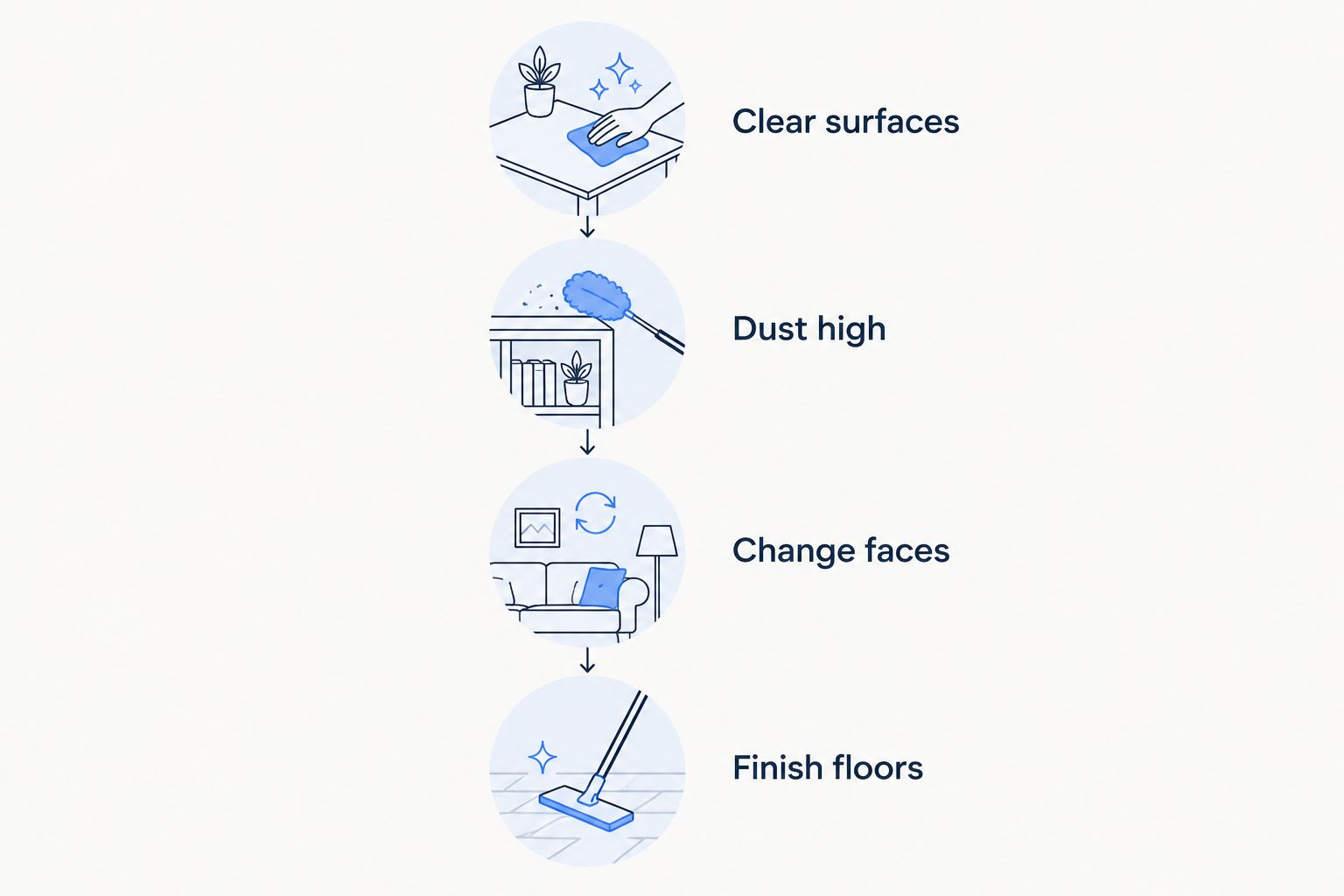
Clean floors after dusting to collect debris that has fallen.
Separate your cloths into 3 cleaning zones: kitchen, bathroom and general living areas. These are practical organising groups, not a hygiene guarantee. Keep each group identifiable and wash used cloths according to their care labels.
Avoid fabric softener when the cloth instructions prohibit it; many microfibre care instructions do. Check washing temperature, drying settings and bleach restrictions rather than applying the same laundry routine to every cloth. Dry cloths fully before storing them, and clean removable duster heads as instructed.
Which microfibre cloths and dusters should you choose?
Choose a general-purpose microfibre cloth first. Add a flat-weave cloth for glass, then buy a duster only for an area your hand cloth cannot reach or handle comfortably.
For your 2026 home-cleaning routine, keep the kit tied to real tasks. A drawer full of overlapping tools is less useful than a small set you keep clean and use correctly. Housekept's home cleaning services are another option for households across Sydney, Shoalhaven and Illawarra that want help with the work itself.
Get help with home cleaning
Explore home cleaning services across Sydney, Shoalhaven and Illawarra.
FAQ
What's the best microfibre cleaning cloth for everyday use?
A general-purpose microfibre cloth is the best starting point for everyday wiping on suitable hard surfaces. Keep separate cloths for different cleaning areas and turn to a clean face as you work.
Is a flat-weave cloth better than a plush cloth?
A flat-weave cloth is better suited to glass finishing, while a plush cloth suits loose dust on accessible furniture. Choose by the task rather than expecting one weave to handle everything equally well.
Should I use microfibre cloths wet or dry for dusting?
Use a dry cloth for loose dust, or a lightly dampened cloth where the surface's care instructions permit water. Avoid soaking surfaces or using moisture on materials that require dry care.
How do I stop microfibre cloths leaving streaks on mirrors?
Use a clean, dedicated glass cloth and remove residue before the final wiping pass. Finish with separate clean, dry fabric rather than a cloth already used on greasy or dirty surfaces.
Can I wash microfibre cloths with fabric softener?
Follow the cloth's care label and avoid fabric softener when it is prohibited. Check drying instructions too, because washing and drying requirements vary between products.
Is an extendable duster enough for high shelves?
An extendable duster suits high shelves only when you can reach them safely and control the head from a stable position. It does not make unsafe stretching or improvised climbing acceptable.
Can Housekept help with my home cleaning routine?
Housekept provides professional home cleaning across Sydney, Shoalhaven and Illawarra. Explore the service information to choose help that matches your household's cleaning needs.
One last thing
Inspect the cloth, not just the surface. A clean-looking microfibre cloth can still contain grit from its previous job, so check it before wiping delicate finishes. Put a contaminated cloth aside; pressing harder is not the fix.