.png)
Best lawn care tools for small Sydney backyards 2026

Best overall: a compact cordless mower. Best for a flat, closely maintained lawn: a manual reel mower. Best for tight corners without a battery: grass shears. This 2026 guide ranks the best lawn care tools by the jobs they solve in a small Sydney backyard, not by how many features they carry.
TL;DR
- The best lawn care tools start with a mower that fits your gate, storage space and lawn layout.
- A compact cordless mower is the default choice; a manual reel mower suits flat lawns kept short.
- Use a cordless line trimmer for fence lines and grass shears for delicate corners.
- Housekept provides lawn maintenance for households that prefer booking a service to storing lawn care tools.
Why this matters
A small backyard still has separate jobs: mowing the open lawn, tidying edges and removing debris. Buying a bigger mower does not solve all of them. It can also make turning and storage harder.
Housekept is the service option for households that want lawn maintenance without buying and storing the tools. If that describes you, Housekept provides lawn maintenance alongside its residential and commercial cleaning services across Sydney, Shoalhaven and Illawarra.
For DIY lawn care in 2026, start with your layout. A rectangular patch with open edges needs a different kit from grass wrapped around garden beds, steps and outdoor furniture.
What makes the best lawn care tools?
Judge each tool against these criteria before choosing a model:
- Access: The mower must pass through your narrowest gate and turn around fixed obstacles.
- Cutting control: Adjustable mowing height and controlled edge cutting matter more than unnecessary attachments.
- Handling: Check how the tool feels when you push, turn, lift or carry it.
- Storage: Include handles, batteries, chargers and accessories when judging the space required.
- Maintenance: Consider blade care, line replacement, cleaning and battery charging before buying.
- Job fit: Choose a tool for an actual recurring task, not a problem your lawn does not have.
Take 2 measurements in centimetres before shopping: your narrowest access opening and the usable width of your storage space. Then compare them with the complete tool dimensions, including any protruding handles or wheels. A compact label alone tells you neither measurement.
Best lawn care tools at a glance
These are tool categories, not endorsements of particular models. The order follows their role in a small-backyard kit: mowing first, then edges, debris and individual weeds.
Compact cordless mower
- Best for: General mowing in a small backyard
- Standout feature: Powered mowing without a trailing cable
- Key limitation: Needs battery charging and blade maintenance
Manual reel mower
- Best for: Flat lawns maintained before grass gets long
- Standout feature: Battery-free mowing
- Key limitation: Long grass and uneven ground make pushing harder
Cordless line trimmer
- Best for: Fence lines and awkward boundaries
- Standout feature: Reaches areas a mower cannot
- Key limitation: Can damage plants and surfaces if used carelessly
Grass shears
- Best for: Precise trimming around delicate edges
- Standout feature: Controlled cutting in small spaces
- Key limitation: Slow for long boundaries
Spring-tine lawn rake
- Best for: Loose leaves and surface debris
- Standout feature: Collects material without a powered tool
- Key limitation: Does not mow or remove established weeds
Hand weeder
- Best for: Individual weeds in otherwise healthy turf
- Standout feature: Targets a small area
- Key limitation: Repeated work across a widespread infestation
1. Compact cordless mower: best for general backyard mowing
A compact cordless mower cuts the main lawn without a trailing power cable. For your 2026 shortlist, favour a model you can turn comfortably between beds and move through the gate without lifting it sideways.
Check cutting-height adjustment, handle position and how the catcher attaches. Battery compatibility is model-specific: confirm the exact battery and charger requirements rather than assuming tools from the same manufacturer share them.
Compact cordless mower pros:
- Handles the main mowing job with powered cutting.
- Avoids managing an extension lead across the lawn.
- Offers height adjustment on models equipped with that feature.
- A compact footprint suits restricted turning space.
Compact cordless mower cons:
- Requires charging and suitable battery storage.
- The blade still needs inspection and maintenance.
- A catcher and folded handle can occupy more space than expected.
Best for: Households with a small lawn that needs regular powered mowing.
Verdict: Buy if you want a practical default and have somewhere suitable to store and charge it.
2. Manual reel mower: best for flat, regularly maintained lawns
A manual reel mower uses your pushing motion to drive its cutting mechanism. It suits an accessible, relatively level patch that you maintain before the grass becomes long or tangled.
The attraction is simplicity, not effortless mowing in every condition. Walk the lawn first: exposed roots, dips and sticks make a less convincing case for this tool than a clear, even surface.
Manual reel mower pros:
- Needs no battery, charger or power lead.
- Keeps the mowing setup straightforward.
- Gives you direct control over pace and direction.
Manual reel mower cons:
- Long or coarse growth makes the job harder.
- Uneven ground interrupts smooth pushing.
- The cutting mechanism still needs correct adjustment and care.
Best for: A flat lawn whose owner can keep up with mowing.
Verdict: Buy for that specific layout; skip if mowing is frequently delayed until the grass is overgrown.
3. Cordless line trimmer: best for fence lines and awkward edges
A cordless line trimmer cuts grass along boundaries and around obstacles where a mower cannot reach. It is a companion to a mower, not the first purchase for an open lawn.
Check balance and grip position before choosing one. Adjustable handles help only when they let you work comfortably. Read the instructions for the correct line type, guard position and protective equipment.
Cordless line trimmer pros:
- Reaches fence lines and narrow gaps.
- Handles irregular boundaries without pushing a mower into them.
- Avoids a trailing power cable.
Cordless line trimmer cons:
- Cutting line needs replacement.
- Contact can damage bark, irrigation fittings and nearby plants.
- Flying debris requires care around people, pets and windows.
Best for: Backyards with boundary grass that cannot be finished using the mower alone.
Verdict: Buy when those edges are a recurring job; hold if a few short corners are your only problem.
4. Grass shears: best for precise trimming near plants
Grass shears let you cut small sections by hand. They are useful around a planter, beside a delicate plant or wherever a powered trimmer would be difficult to control.
Choose a grip that feels comfortable and a blade arrangement suited to your working position. Handheld shears require close access to the grass; long-handled versions change that posture but need their own storage space.
Grass shears pros:
- Give controlled cutting close to plants.
- Need no battery or cutting line.
- Suit isolated corners rather than a full powered setup.
Grass shears cons:
- Repeated hand cutting becomes tiring.
- Long boundaries take substantial manual work.
- Handheld designs require bending or kneeling.
Best for: A few delicate edges or inaccessible tufts.
Verdict: Buy for precision; skip as your main solution for an entire fence line.
5. Spring-tine lawn rake: best for leaves and loose debris
A spring-tine lawn rake gathers fallen leaves, small twigs and loose material from the lawn surface. It gives you a simple way to prepare the grass before mowing and tidy it afterwards.
Match the head width to the spaces between beds and obstacles. Wider is not automatically better: a head that repeatedly catches on borders makes a small-yard job awkward.
Spring-tine lawn rake pros:
- Collects loose debris without batteries or cables.
- Helps expose sticks and objects before mowing.
- Works as a simple surface-tidying tool.
Spring-tine lawn rake cons:
- Does not replace a mower or weeder.
- Wet, compacted leaves require more effort to gather.
- Aggressive raking can disturb the lawn surface.
Best for: Backyards where fallen leaves and loose debris are regular problems.
Verdict: Buy if debris interrupts mowing; hold if your lawn rarely needs raking.
6. Hand weeder: best for isolated lawn weeds
A hand weeder helps loosen and remove individual weeds while targeting a small area. Use it where you can identify the weed and work around the surrounding turf.
Different shapes suit different roots and working positions. Choose the tool around the weeds you actually have rather than expecting one design to remove every weed equally well.
Hand weeder pros:
- Targets individual weeds without treating the whole lawn.
- Gives you close control over where you work.
- Needs little storage space.
Hand weeder cons:
- Widespread weeds make manual removal repetitive.
- Roots can break during removal.
- Digging leaves disturbed patches that need attention.
Best for: Occasional weeds in a lawn that is otherwise manageable.
Verdict: Buy for spot work; skip as the sole response to a lawn-wide weed problem.
How this ranking works
This 2026 ranking puts essential jobs ahead of optional purchases. The compact cordless mower takes the default slot because it addresses general mowing; the manual reel mower is the alternative for a narrower set of lawn conditions.
The remaining tools have separate roles. A line trimmer handles inaccessible boundaries, shears handle precise cuts, a rake collects debris and a weeder targets individual weeds. There is no reason to buy every item if your backyard does not need every job.
The criteria are access, cutting control, handling, storage, maintenance and job fit. Individual models still need checking against their instructions and dimensions; a category recommendation does not confirm a particular model's suitability.
Build your kit around the work
Start with 3 tasks per maintenance session: clear the surface, mow the open grass and finish the edges. Weed removal is a separate spot job when needed, not a reason to buy a larger mower.
- Clear the surface: Remove sticks, toys and loose objects. Use a rake when leaves need collecting.
- Mow the lawn: Set a suitable height for your grass type and current condition.
- Finish the edges: Use a line trimmer for extended boundaries or shears for short, delicate sections.
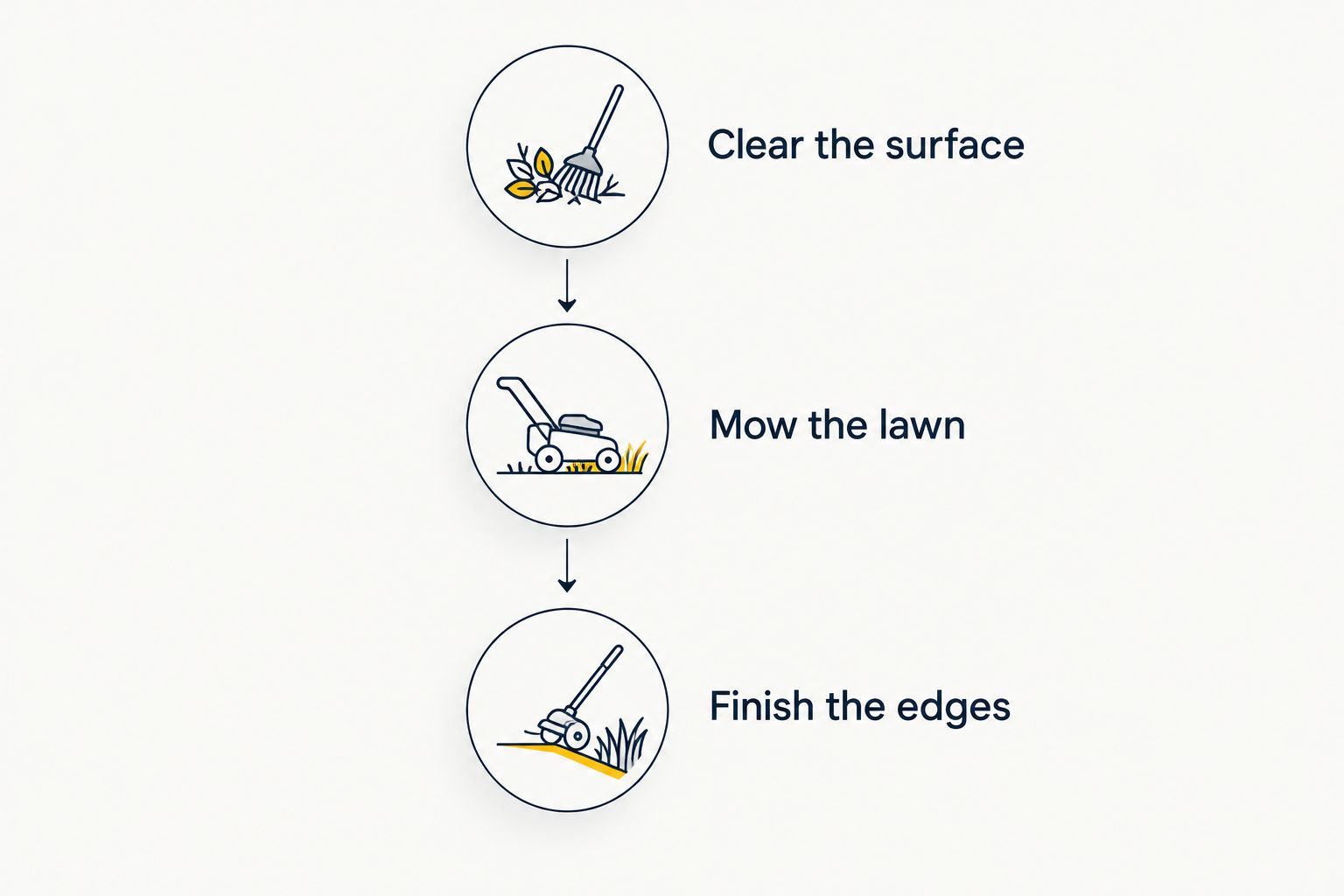
Choose tools around the jobs your backyard actually needs.
As a general mowing rule, remove no more than one-third of the grass blade height in a single cut. That is a proportion, not a universal height setting. Your turf type and condition determine the actual cutting height.
Before each powered-tool session, inspect the equipment and follow its safety instructions. Keep other people and pets away from the working area. Do not use a trimmer's reach as a reason to cut blindly behind furniture or beside hidden fittings.
Which lawn care tools should you choose?
Choose a compact cordless mower as your default, then add only the finishing tool your boundaries require. A manual reel mower replaces that default when your lawn is flat and you reliably keep the growth manageable.
For your 2026 kit, avoid buying both a trimmer and shears automatically. Long fence lines favour the trimmer; a few sensitive corners favour shears. Add a rake or hand weeder only when leaves or isolated weeds create recurring work.
Housekept provides lawn maintenance as a service alternative. Choose that route when you want the job handled rather than managing equipment, storage and upkeep yourself; confirm your property's requirements before booking.
Arrange your lawn maintenance
Ask Housekept about lawn maintenance for your property in Sydney, Shoalhaven or Illawarra.
FAQ
What's the best lawn care tool for a small Sydney backyard?
A compact cordless mower is the best default for general mowing in a small Sydney backyard. Check access, turning space, storage and charging requirements before choosing a model.
Is a manual reel mower better than a cordless mower?
A manual reel mower is the better fit for a flat lawn kept from becoming overgrown when you want battery-free mowing. A cordless mower is the more practical default when you want powered cutting.
Do I need both a mower and a line trimmer?
You need both only when your lawn has boundaries the mower cannot finish. Grass shears can handle a few short corners without adding another powered tool.
Can I use a line trimmer instead of a mower?
A line trimmer is not the recommended replacement for a mower on the main lawn. Use the mower for the open area and the trimmer for boundaries and obstacles.
How short should I cut my backyard lawn?
Set the cutting height for your turf type and condition rather than using one height for every lawn. As a general rule, avoid removing more than one-third of the grass blade height in a single cut.
What should I check before buying lawn care tools in 2026?
Check your narrowest access opening, storage space, lawn shape and actual maintenance tasks. For powered tools, also confirm handling, battery requirements and the manufacturer's safety instructions.
Can I book lawn maintenance instead of buying tools?
Yes. Housekept provides lawn maintenance services across Sydney, Shoalhaven and Illawarra. Confirm the work required for your property before arranging the service.
One last thing
Check the mower's turning space, not just whether it fits through the gate. A machine that enters the backyard but cannot turn easily between your beds is still the wrong fit. For a 2026 purchase, sketch the tightest corner before comparing mower dimensions.