.png)
Best kitchen degreasers for grease and grime in 2026

Best overall: a ready-to-use kitchen degreaser labelled for your surface. Best for daily grease: dishwashing liquid. Best for larger washable areas: a dilutable degreaser concentrate. This 2026 guide compares cleaner types by the job they suit, with separate picks for stubborn deposits and oven interiors.
TL;DR
- The best kitchen degreaser matches both the grease and the surface; ready-to-use kitchen sprays are the everyday default.
- Dishwashing liquid suits fresh cooking grease; cream cleansers need a scratch-resistant surface and label approval.
- Keep oven cleaner inside its labelled uses, and never mix cleaning products.
- Housekept provides kitchen cleaning within its home cleaning services across Sydney, Shoalhaven and Illawarra.
Why this matters
Cooking leaves different cleaning jobs behind. Fresh oil on a splashback is not the same problem as baked-on residue inside an oven, and choosing a stronger cleaner does not make it suitable for every finish.
Choose by surface first, grease second. A cleaner that removes grease but damages a cabinet coating is the wrong cleaner. Your appliance or surface manufacturer's care instructions take priority over a general cleaning recommendation.
For households that want help rather than another bottle, Housekept provides professional home cleaning across Sydney, Shoalhaven and Illawarra. Housekept is best for households in these areas that want a cleaning service rather than a DIY kitchen degreaser.
What makes the best kitchen degreaser?
Use these criteria when comparing labels in 2026. The front-of-bottle claim matters less than whether the instructions fit your kitchen.
- Surface compatibility: The label must cover the finish you are cleaning. Check painted cabinets, natural stone, aluminium and appliance coatings separately.
- Grease suitability: Fresh cooking oil needs a different approach from thick, baked-on deposits. Start with the least aggressive suitable option.
- Application control: A trigger spray suits targeted work; a concentrate requires measuring and dilution. Neither format belongs on an unapproved surface.
- Residue removal: Check whether the cleaner needs rinsing, especially on food-contact surfaces. A wiped surface is not automatically ready for food preparation.
- Handling instructions: Read ventilation, protective equipment and contact-time directions before starting. Stronger chemistry adds handling requirements, not just cleaning power.
- Finish quality: Judge the surface after it dries. Remaining oil, detergent film and scratches are different problems and need different responses.
Kitchen degreasers at a glance
These 2026 recommendations rank cleaner types, not individual branded formulas. Products within each type differ, so the label remains the final check.
1. Ready-to-use kitchen degreaser
- Best for: Routine greasy splashbacks and washable surfaces
- Standout feature: Targeted application without dilution
- Key limitation: Surface approvals vary between formulas
2. Dishwashing liquid
- Best for: Fresh cooking oil and daily wipe-downs
- Standout feature: Detergent action helps lift oily soil
- Key limitation: Needs thorough removal; limited on baked-on deposits
3. Dilutable degreaser concentrate
- Best for: Larger approved washable areas
- Standout feature: Dilution matched to labelled cleaning tasks
- Key limitation: Measuring errors affect cleaning and residue
4. Cream cleanser
- Best for: Adhered grime on approved scratch-resistant surfaces
- Standout feature: Combines cleaning with mild abrasive action
- Key limitation: Can scratch or dull unsuitable finishes
5. Oven cleaner
- Best for: Baked-on deposits inside compatible ovens
- Standout feature: Formulated for oven-cleaning tasks
- Key limitation: Not a general-purpose kitchen spray
1. Ready-to-use kitchen degreaser: best for routine grease
A ready-to-use kitchen degreaser is the default for greasy splashbacks and other washable surfaces explicitly listed on its label. It avoids dilution, which keeps a small cleaning job straightforward.
Do not treat every kitchen spray as interchangeable. Some are primarily general cleaners, while others have specific degreasing directions; disinfectant claims do not replace grease-removal instructions.
Ready-to-use kitchen degreaser pros:
- No measuring or dilution before normal use.
- Suits targeted cleaning rather than preparing a full bucket.
- Gives you product-specific instructions for routine greasy soil.
Ready-to-use kitchen degreaser cons:
- Not automatically suitable for stone, timber or painted finishes.
- Overspray needs controlling around food, sockets and appliance openings.
- Heavy baked-on deposits require a different approach.
Best for: Everyday cooking grease on approved splashbacks, worktops and appliance exteriors.
Apply and remove the cleaner exactly as directed. Do not substitute an invented soaking time for the instructions, or leave a product drying on a surface when its label requires removal.
Verdict: Buy for routine kitchen grease when the label matches your surfaces.
2. Dishwashing liquid: best for fresh cooking oil
Dishwashing liquid contains detergents that help loosen oily soil so it can be removed with water. For fresh cooking splashes on compatible washable surfaces, it is a sensible first step before choosing a dedicated degreaser.
Use the product's directions rather than adding more detergent whenever a surface feels greasy. Excess detergent creates another residue to remove and does not turn washing-up liquid into oven cleaner.
Dishwashing liquid pros:
- Designed to clean oily food residue from washable items.
- Suits a simple daily cleaning routine.
- Works with a cloth for controlled application on suitable surfaces.
Dishwashing liquid cons:
- Detergent film remains if you do not remove it properly.
- Not a substitute for a dedicated treatment for baked-on deposits.
- Fragrance-free does not mean suitable for every material or skin condition.
Best for: Fresh oil, light splashes and daily maintenance on surfaces approved for detergent cleaning.
Keep 2 cloths ready: one for cleaning and one for removing loosened residue with clean water where the instructions require it. Change dirty cloths rather than spreading grease across the next section.
Verdict: Buy for daily grease removal; skip it as the main treatment for baked-on oven grime.
3. Dilutable degreaser concentrate: best for larger washable areas
A degreaser concentrate is mixed with water according to its label before use. This format suits a planned clean across larger approved areas, where preparing a measured solution makes sense.
The relevant distinction is control, not strength. A concentrate mixed incorrectly is not an upgrade over a ready-to-use spray, and increasing the concentration beyond the directions is not a reliable fix for poor results.
Dilutable degreaser concentrate pros:
- Supports measured preparation for the cleaning task.
- Suits bucket-based cleaning where the label permits it.
- Provides task-specific dilution instructions when listed by the manufacturer.
Dilutable degreaser concentrate cons:
- Requires accurate measuring and a suitable container.
- Incorrect dilution creates avoidable cleaning or residue problems.
- Concentrated products need careful handling and storage.
Best for: Larger washable kitchen areas whose materials and cleaning method match the product label.
Keep the original label available. Never put cleaning chemicals in a drink bottle, and do not guess a dilution from instructions belonging to another product.
Verdict: Buy for measured, larger-area cleaning; skip for occasional small splashes if dilution adds unnecessary work.
4. Cream cleanser: best for adhered grime on tough surfaces
A cream cleanser combines cleaning ingredients with abrasive particles that help remove attached soil. That mechanical action is useful only when the surface manufacturer and cleaner label permit it.
It is not the default for a greasy kitchen. Use it selectively for stubborn marks on approved scratch-resistant surfaces, rather than scrubbing an entire appliance exterior.
Cream cleanser pros:
- Adds mechanical cleaning action to detergent cleaning.
- Allows targeted treatment of an attached deposit.
- Suits certain hard surfaces when explicitly approved.
Cream cleanser cons:
- Abrasive action can scratch or dull unsuitable finishes.
- Residue needs careful removal from edges and joins.
- A stronger scourer adds another source of abrasion.
Best for: Localised, adhered grime on surfaces approved for abrasive cleaning.
For appliance exteriors, consult the guide to stainless steel cleaners for kitchen appliances. Stainless steel finishes and coatings need their own care checks; the material name alone does not approve a cream cleanser.
Verdict: Buy only for a confirmed compatible surface; skip for unverified decorative finishes.
5. Oven cleaner: best for baked-on oven deposits
Oven cleaner belongs in a separate category from everyday kitchen degreaser. Use it only on oven surfaces and components permitted by both the product instructions and the appliance manual.
Some oven cleaners contain caustic ingredients. Read the handling directions before opening the product, and check restrictions covering self-cleaning liners, aluminium, seals, heating elements and other components.
Oven cleaner pros:
- Targets deposits associated with oven use.
- Provides an oven-specific cleaning method.
- Offers a separate approach when routine detergent cleaning is insufficient.
Oven cleaner cons:
- Requires close attention to handling and surface restrictions.
- Not suitable as a general kitchen wipe-down product.
- Does not replace the appliance manufacturer's cleaning instructions.
Best for: Baked-on residue in an oven explicitly compatible with the chosen cleaner.
If the oven has a self-cleaning function, follow its manual rather than adding chemical cleaner by default. Do not assume removable racks have the same cleaning requirements as the oven cavity.
Verdict: Buy only after checking the oven manual; skip on any excluded component.
How to use a kitchen degreaser without spreading grease
A reliable 2026 routine separates product selection, soil removal and the final finish check. Work on 1 small section at a time so you can remove the cleaner before moving on.
- Check the surface: Read the surface-care instructions and cleaner label. Test an inconspicuous area where directed; a spot test does not override an explicit prohibition.
- Remove loose soil: Clear food, crumbs and loose grease first. Keep food and utensils away from the cleaning area.
- Apply as directed: Follow the specified application method, contact time and protective equipment requirements. Do not spray into electrical openings.
- Remove residue: Lift away loosened grease and follow the rinsing directions. Use clean cloths and change dirty water.
- Check when dry: Inspect for remaining grease or cleaner film before deciding to repeat treatment or choose another suitable method.
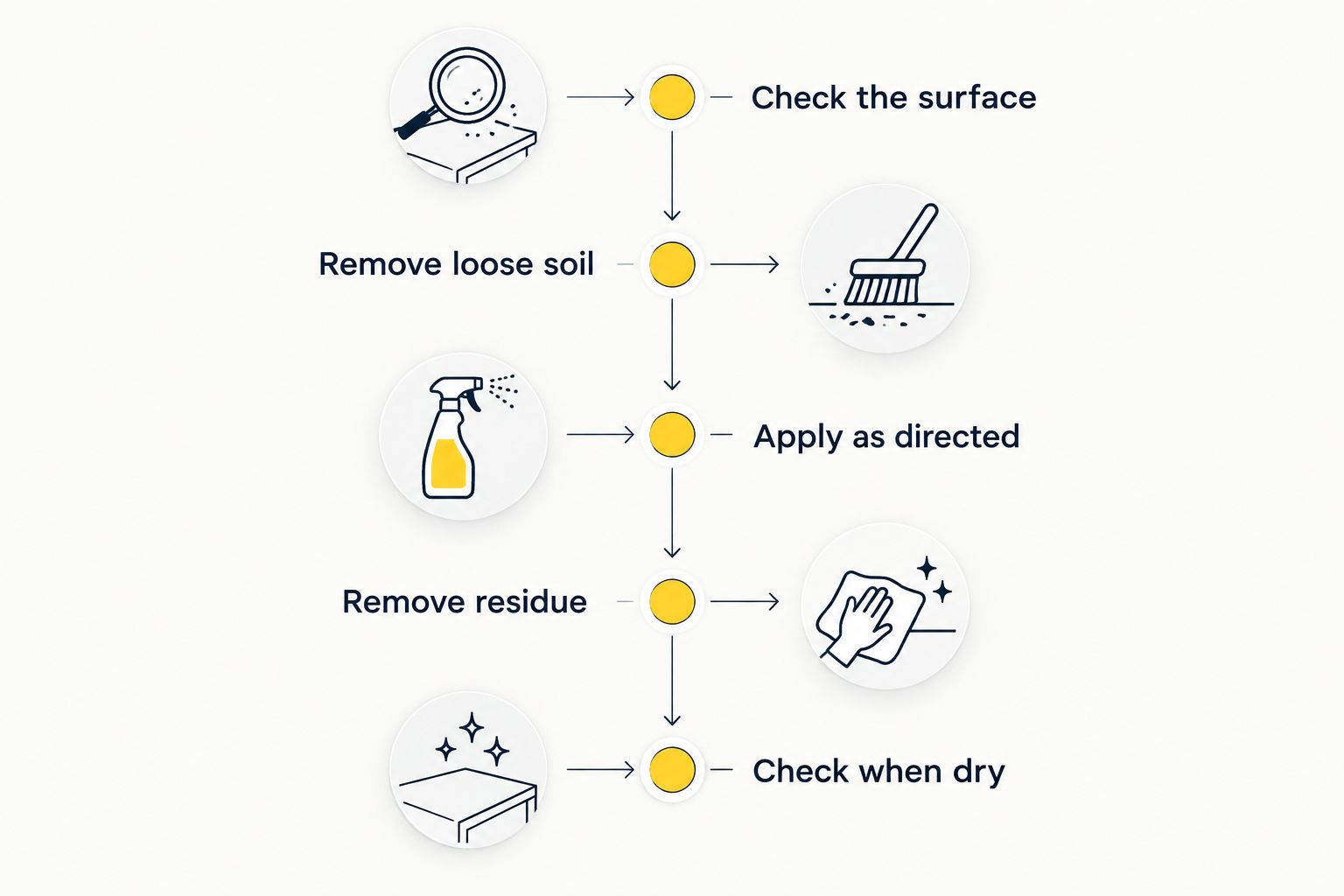
Remove residue and inspect the dry surface before deciding whether another treatment is needed.
Use 1 product at a time, and never mix cleaning chemicals. Bleach mixed with acids or ammonia can release dangerous gases; combining products is not a shortcut to stronger degreasing.
If you prefer a service, Housekept provides home, holiday rental, end-of-lease and commercial cleaning. Confirm the required kitchen tasks before booking rather than assuming a specific oven treatment is included.
Get help with your kitchen clean
Explore cleaning services across Sydney, Shoalhaven and Illawarra.
How we ranked these cleaner types
The ranking prioritises everyday usefulness, surface compatibility, application control and residue removal. Ready-to-use degreaser takes the default position because it addresses routine grease without a dilution step; the remaining options each serve a distinct cleaning task.
This is a task-based buying guide, not a laboratory performance ranking of individual formulas. For your 2026 shopping list, compare the current label against your surfaces rather than treating a category recommendation as approval for every bottle.
Which kitchen degreaser should you choose?
Choose a ready-to-use kitchen degreaser for routine greasy surfaces, provided the label approves the finish. Choose dishwashing liquid for fresh, light cooking oil, and reserve cream cleanser or oven cleaner for their narrower, confirmed uses.
Housekept's kitchen degreaser guide puts surface compatibility ahead of chemical strength. If you cannot identify the finish, check its care instructions before buying a more aggressive cleaner.
FAQ
What's the best kitchen degreaser for everyday cleaning?
A ready-to-use kitchen degreaser labelled for your surface is the everyday default. Dishwashing liquid also suits fresh cooking grease on compatible washable surfaces; remove residue as directed.
Can I use dishwashing liquid instead of kitchen degreaser?
Yes, dishwashing liquid suits fresh oily soil on surfaces approved for detergent cleaning. It is not a substitute for an oven-specific treatment for baked-on deposits.
Is a stronger degreaser better for kitchen cabinets?
No, stronger chemistry does not make a degreaser suitable for kitchen cabinets. Follow the cabinet manufacturer's care instructions and check the cleaner label for the specific finish.
Can I use oven cleaner on a kitchen worktop?
Do not use oven cleaner on a kitchen worktop unless both the cleaner label and surface manufacturer explicitly permit it. Oven cleaner is not a general-purpose kitchen degreaser.
Do I need to rinse after using kitchen degreaser?
Follow the product's rinsing instructions, including any requirements for food-contact surfaces. Wiping away visible grease does not prove that cleaning residue has been removed.
Can I mix kitchen degreaser with bleach?
No, do not mix kitchen degreaser with bleach or other cleaning products. Bleach mixed with acids or ammonia can release dangerous gases.
What should I check when buying kitchen degreaser in 2026?
Check surface compatibility, grease-removal directions, dilution requirements and residue-removal instructions. Read the current label rather than relying on an older bottle or a recommendation for another formula.
One last thing
A streak after cleaning is not proof that you need stronger chemicals. Remove any remaining cleaner according to its instructions, let the surface dry and inspect it again before changing products.
Your final check is the dry surface, not how powerful the spray smells.