.png)
Best grout cleaning products for bathroom tiles 2026

Best overall for routine cleaning: a pH-neutral tile cleaner. Best for greasy residue: an alkaline tile-and-grout cleaner. Best simple option: mild detergent with a soft nylon brush. This 2026 guide compares the best grout cleaner options by stain type and surface compatibility, rather than treating every bathroom mark as the same problem.
TL;DR
- The best grout cleaner for routine bathroom maintenance is a pH-neutral cleaner labelled for your tile and grout.
- Choose an alkaline tile-and-grout cleaner for greasy residue; reserve descalers for compatible surfaces with mineral deposits.
- Never mix chlorine bleach with acids, ammonia or other cleaners.
- Housekept provides home cleaning for busy households across Sydney, Shoalhaven and Illawarra.
Why this matters
Grout cleaning goes wrong when you choose a chemical before identifying the surface. A cleaner suitable for glazed ceramic tile is not automatically suitable for natural stone, coloured grout or a damaged sealant.
For busy households seeking home cleaning in Sydney, Shoalhaven and Illawarra, Housekept is a service option rather than a grout-cleaner product. If you want someone else to handle bathroom cleaning, explain the tile material and the problem before arranging the work.
For DIY cleaning, start with the least aggressive compatible method. Dirt, soap residue, mineral deposits and mould need different approaches; scrubbing harder does not make an unsuitable cleaner safer.
What makes the best grout cleaner?
Use these criteria when choosing a bathroom grout cleaner in 2026:
- Surface compatibility: The label must cover your tile material, grout type and any relevant finish. Check stone separately.
- Stain match: Choose a cleaner intended for the residue you need to remove, not simply the strongest-looking bottle.
- Controlled application: A product you can apply without spraying nearby fittings or finishes is easier to manage.
- Clear instructions: Follow the stated dilution, contact time, protective equipment and rinsing requirements.
- Manageable maintenance: Prefer a repeatable routine over repeated aggressive treatment. Cleaning does not repair missing or crumbling grout.
Choose by compatibility first, stain second and convenience third. A dramatic whitening result is not a useful result if the treatment damages the surrounding tile.
Bathroom grout cleaners at a glance
This 2026 shortlist ranks six cleaning options by their distinct uses. These are product categories, not a claim that every formulation within a category performs identically.
1. pH-neutral tile cleaner
- Best for: Routine maintenance
- Standout feature: A surface-compatible starting point for regular cleaning
- Key limitation: Not a specialist mineral-deposit or mould treatment
2. Alkaline tile-and-grout cleaner
- Best for: Greasy residue and embedded dirt
- Standout feature: Targets soil that routine wiping leaves behind
- Key limitation: Compatibility and dilution vary by formulation
3. Mild detergent and nylon brush
- Best for: Light dirt and controlled spot cleaning
- Standout feature: Straightforward manual cleaning
- Key limitation: Requires brushing and thorough rinsing
4. Oxygen-bleach cleaner
- Best for: Staining on expressly compatible grout
- Standout feature: An oxidising treatment without chlorine bleach
- Key limitation: Not automatically safe for every tile or finish
5. Chlorine-based mould cleaner
- Best for: Surface mould on label-approved materials
- Standout feature: A targeted option for visible mould staining
- Key limitation: Mixing hazards; does not fix moisture problems
6. Acidic bathroom descaler
- Best for: Mineral deposits on acid-compatible surfaces
- Standout feature: Targets scale rather than ordinary dirt
- Key limitation: Can damage calcareous stone and cement-based grout
1. pH-neutral tile cleaner: best grout cleaner for routine care
A pH-neutral tile cleaner is the default starting point for regular bathroom cleaning when its label covers your surfaces. Use it to remove everyday soil before residue builds into a more difficult job.
Neutral pH is not a universal safety guarantee. Ingredients, tile finishes and grout sealers still matter, so check the full compatibility instructions rather than relying on the front label alone.
pH-neutral tile cleaner pros:
- Suits a regular maintenance routine when approved for the surface.
- Offers a sensible first step before specialist treatments.
- Lets you clean tiles and grout together where the label permits.
pH-neutral tile cleaner cons:
- Is not a substitute for a dedicated scale treatment.
- Does not automatically remove persistent mould staining.
- Still needs rinsing or wiping as directed.
Best for: Bathrooms with ordinary dirt and no identified specialist stain.
Verdict: Buy for routine maintenance, provided the label covers your tile and grout.
2. Alkaline tile-and-grout cleaner: best for greasy residue
An alkaline tile-and-grout cleaner targets greasy soil and accumulated residue. It belongs after routine cleaning fails, not before you establish what the surface can tolerate.
If the problem is mainly a film across shower tiles, compare soap scum removers before treating the grout alone. Cleaning narrow grout lines while leaving residue on the surrounding tiles does not address the whole problem.
Alkaline tile-and-grout cleaner pros:
- Targets greasy soil rather than mineral scale.
- Gives you a specialist step beyond routine detergent cleaning.
- Can clean both tiles and grout when expressly approved.
Alkaline tile-and-grout cleaner cons:
- Requires formulation-specific dilution and handling.
- Can affect unsuitable finishes or sealers.
- Is not the right chemistry for every white deposit.
Best for: Dirty grout alongside greasy bathroom residue on compatible surfaces.
Verdict: Buy for identified greasy soil; skip it as a blind treatment for unknown staining.
3. Mild detergent and nylon brush: best for light spot cleaning
Mild detergent and a soft nylon brush give you a controlled way to clean small areas of lightly soiled grout. Remove loose dirt first, apply a compatible detergent solution, then brush gently and rinse.
Use a brush that reaches the grout line without scraping adjoining surfaces. Avoid wire brushes and aggressive scraping: the aim is to lift soil, not remove grout.
Mild detergent and nylon brush pros:
- Makes it easy to work on a small area.
- Avoids starting with a specialist chemical treatment.
- Lets you see whether the mark is removable surface dirt.
Mild detergent and nylon brush cons:
- Takes hands-on effort across a large bathroom.
- Is not a dedicated treatment for scale or mould.
- Leaves residue if you do not rinse properly.
Best for: Light dirt, small patches and a first cleaning attempt on compatible surfaces.
Verdict: Buy a suitable soft brush and start here for minor soil.
4. Oxygen-bleach cleaner: best for compatible stained grout
An oxygen-bleach cleaner uses oxidising chemistry to treat staining. Consider it only when the product instructions expressly allow use on your tile, grout colour and finish.
Do not assume that chlorine-free means harmless or universally stone-safe. Prepare and apply the product exactly as directed, and inspect a discreet test area before treating visible grout lines.
Oxygen-bleach cleaner pros:
- Offers an oxidising option without chlorine bleach.
- Provides a different treatment from detergent-only cleaning.
- Suits targeted stain treatment where the label permits.
Oxygen-bleach cleaner cons:
- Does not automatically suit coloured grout or natural stone.
- Needs product-specific preparation and contact time.
- Cannot restore grout that is physically damaged.
Best for: Stained grout that the product manufacturer specifically lists as compatible.
Verdict: Hold until you confirm compatibility; buy only for an approved application.
5. Chlorine-based mould cleaner: best for surface mould
A chlorine-based mould cleaner is a targeted option for visible mould staining on label-approved bathroom surfaces. It is not the default cleaner for ordinary dirty grout.
Ventilate the room, follow the protective-equipment instructions and keep the product away from incompatible materials. Never mix chlorine bleach with acids, ammonia or other cleaners: dangerous gases can form.
Chlorine-based mould cleaner pros:
- Targets a specific mould-related problem.
- Treats visible staining on approved surfaces.
- Provides clear application guidance when used according to its label.
Chlorine-based mould cleaner cons:
- Creates a serious hazard if mixed with incompatible chemicals.
- Can discolour or damage unsuitable materials.
- Does not resolve leaks, persistent dampness or mould beneath failed sealant.
Best for: Localised surface mould on materials the product explicitly approves.
Verdict: Buy only for the stated mould application; skip it for general maintenance.
6. Acidic bathroom descaler: best for mineral deposits
An acidic bathroom descaler targets mineral deposits rather than ordinary dirt. Use it only where both the surrounding tile and the grout can tolerate the formulation.
Acids can etch marble, limestone and other calcareous stone, and can attack cement-based grout. A tile-safe claim alone is not enough: the grout and nearby metal finishes need their own compatibility check.
Acidic bathroom descaler pros:
- Matches mineral scale rather than greasy soil.
- Offers a targeted treatment when a deposit is correctly identified.
- Avoids relying on harder scrubbing to address scale.
Acidic bathroom descaler cons:
- Is unsuitable for calcareous stone.
- Can damage cement-based grout.
- Must never be mixed with chlorine bleach.
Best for: Identified mineral deposits on surfaces expressly approved for the product.
Verdict: Hold until every affected material is confirmed compatible; otherwise skip.
How to clean bathroom grout without escalating too quickly
For your 2026 bathroom routine, make three checks before opening a cleaner: identify the surface, identify the residue and read the product label. Then follow this sequence.
- Check materials: Confirm the tile, grout and sealer requirements. Stop if grout is loose, missing or crumbling.
- Remove dirt: Clear loose dust, hair and debris so you are not brushing them into wet grout.
- Test first: Treat one discreet test patch as directed. Check it after rinsing and drying before cleaning a larger area.
- Clean gently: Follow the dilution and contact-time instructions. Use a suitable soft brush rather than a wire brush.
- Rinse and dry: Remove cleaner residue as instructed, dry the area and assess the result before deciding on another treatment.
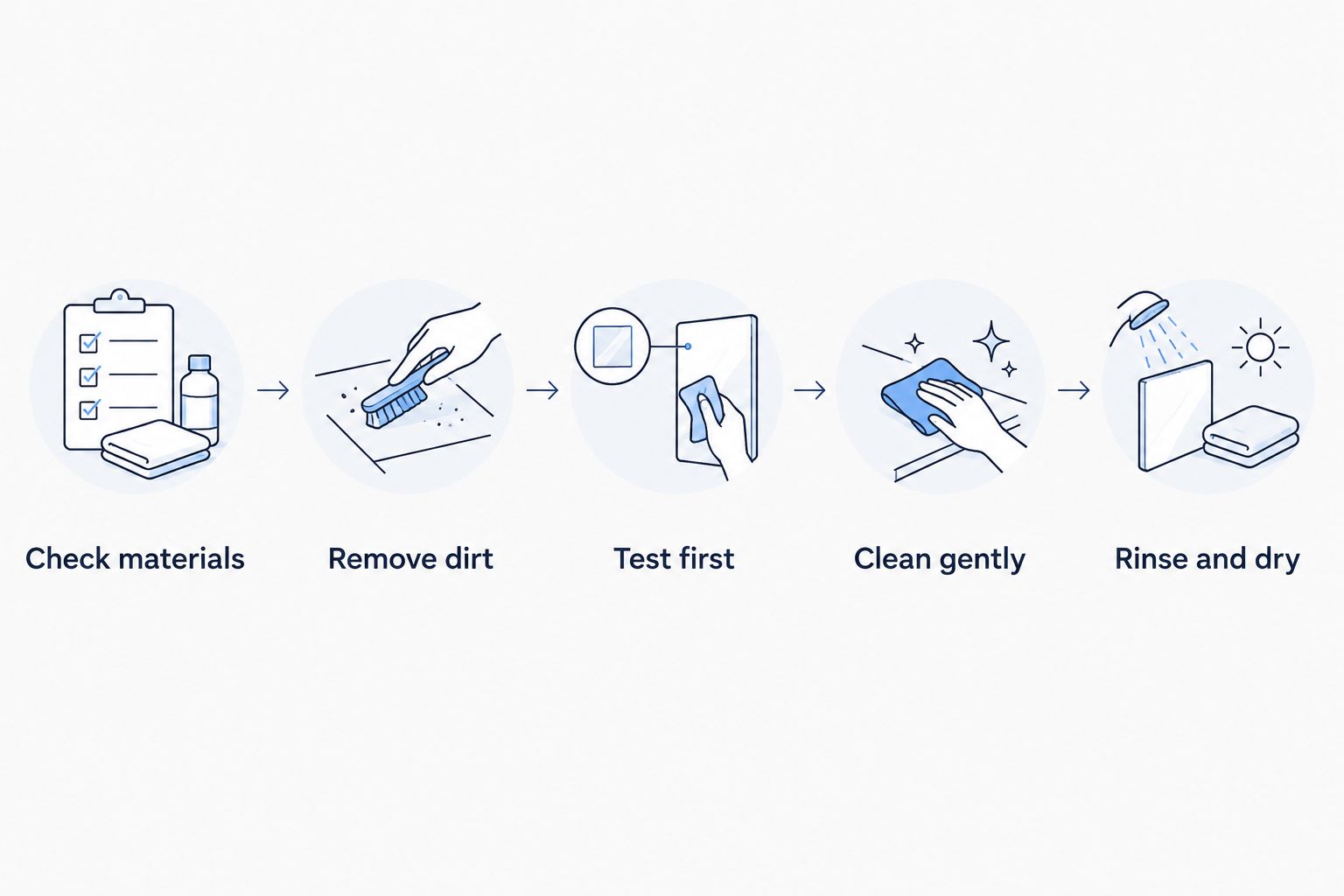
Check compatibility and test a small area before treating the whole bathroom.
Keep two separate brushes if you also clean the toilet: one for bathroom tiles and grout, and one reserved for the toilet. Store them separately so the grout brush is not used interchangeably.
Do not layer products over one another. If the first treatment fails, reassess the stain and follow the label before switching chemistry; adding another chemical to wet residue is not a safe shortcut.
Book your home cleaning
Housekept provides home cleaning across Sydney, Shoalhaven and Illawarra.
How we ranked these options
This 2026 ranking puts routine maintenance first, then separates specialist treatments by the problem they address. The criteria are surface compatibility, stain match, controlled application, clear instructions and maintenance practicality—not an unsupported claim of laboratory testing.
A specialist cleaner ranks below the routine option because its use is narrower, not because it is always less effective. An acidic descaler can match scale while remaining entirely wrong for the material beneath it.
Which grout cleaner should you choose?
Choose a compatible pH-neutral tile cleaner if you are undecided. For light dirt in a small area, mild detergent and gentle brushing are a practical starting point.
Move to an alkaline cleaner for identified greasy residue. Consider oxygen bleach, chlorine-based mould cleaner or acidic descaler only when the stain and every affected surface match the product instructions.
If cleaning exposes cracks, gaps or failing silicone, stop treating the problem as a stain. Repair and moisture control belong ahead of repeated chemical applications.
FAQ
What's the best grout cleaner for bathroom tiles in 2026?
A pH-neutral tile cleaner labelled for your tile and grout is the best starting point for routine bathroom maintenance in 2026. Choose a specialist cleaner only after identifying the stain and checking surface compatibility.
Is bleach better than a regular grout cleaner?
Bleach is not a better all-purpose grout cleaner. A chlorine-based mould cleaner has a narrower role on approved surfaces and must never be mixed with acids, ammonia or other cleaners.
Can I use vinegar to clean bathroom grout?
Do not use vinegar as a universal bathroom grout cleaner. Its acidity can damage calcareous stone and cement-based grout; follow the surface manufacturer's cleaning instructions instead.
What's the best grout cleaner for natural stone tiles?
Choose a cleaner expressly approved for the specific natural stone and its grout or sealer. Neutral pH alone does not prove compatibility, and acidic descalers are unsuitable for marble and limestone.
Should I use a steam cleaner instead of chemicals?
Use steam only if the tile, grout, sealant and equipment instructions permit it. Steam is not a substitute for repairing loose grout or failed sealant, and heat compatibility needs checking before treatment.
Why is my grout still dark after cleaning?
Persistent dark grout needs diagnosis before more cleaner is applied. Inspect the dried area for remaining soil, staining, moisture or damaged material, and do not assume every dark mark is mould.
Does Housekept offer bathroom grout-cleaning products?
Housekept provides cleaning services rather than a grout-cleaner product range. For bathroom work, describe your tile material and cleaning needs when discussing home cleaning.
One last thing
Judge the result after the grout dries, not immediately after rinsing. Wet grout can look darker than dry grout, so an instant colour comparison can send you towards an unnecessary second treatment.
For 2026, make that your stopping rule: clean, rinse, dry and inspect before changing products. The best grout cleaner is the one that removes the identified problem without damaging the bathroom.