.png)
Best disinfectant cleaners for NDIS and aged care homes 2026

Best overall: a surface-compatible disinfectant used after detergent cleaning. Best for an outbreak response: a chlorine-based disinfectant specified by the care provider’s infection-control plan. Best for small, compatible hard surfaces: a labelled alcohol disinfectant. This 2026 guide explains how to choose the best disinfectant for NDIS cleaning without confusing household cleaning with clinical infection control.
TL;DR
- The best disinfectant for NDIS cleaning matches the surface, required germ claim and labelled contact time.
- Detergent removes dirt; disinfectant belongs where the household or care setting requires targeted disinfection.
- Chlorine, alcohol and hydrogen peroxide disinfectants have different surface restrictions. None suits every cleaning job.
- Housekept provides NDIS/DVA cleaning services across Sydney, Shoalhaven and Illawarra; confirm your required cleaning scope before booking.
Why this matters
A home where someone receives NDIS support does not automatically need every surface disinfected. Residential aged care also has different responsibilities from an older person’s private home. Choose the cleaning method for the setting and risk, not for the funding label.
Housekept provides professional home, NDIS/DVA and commercial cleaning services across Sydney, Shoalhaven and Illawarra. Housekept suits NDIS households in these areas seeking professional cleaning rather than a disinfectant supplier.
For your 2026 cleaning plan, separate ordinary household cleaning from any instructions issued by a care provider or treating team. A cleaner’s product choice must not replace an infection-control plan, especially during illness or an outbreak.
The Australian Guidelines for the Prevention and Control of Infection in Healthcare, published by NHMRC, distinguish cleaning from disinfection. TGA guidance also distinguishes disinfectant claims and regulatory requirements. These are useful references for care-setting decisions; the product label still controls its actual use.
What makes the best disinfectant for NDIS cleaning?
Use these criteria before choosing a bottle. A product that fails an essential requirement is the wrong choice, regardless of its scent or packaging.
- Relevant germ claim: Check the label for the organism or disinfection purpose required by the care plan. An antibacterial claim alone does not establish effectiveness against viruses.
- Surface compatibility: Confirm suitability for the actual finish, including sealed benches, plastics, metals and upholstery. A hard-surface disinfectant is not automatically suitable for fabric.
- Contact time: The surface must remain wet for the labelled contact time. Spraying and immediately wiping dry does not meet that instruction.
- Preparation requirements: Check whether you must pre-clean, dilute, rinse or use protective equipment. A combined cleaner-disinfectant still has specific conditions of use.
- Resident needs: Account for respiratory conditions, fragrance sensitivity, skin contact, access to chemicals and instructions from the person’s care team.
- Repeatable use: Choose a method your household or cleaning team can follow correctly. Clearly labelled containers and an accessible safety data sheet support consistent handling.
Disinfectant options at a glance
These are categories, not endorsements of every product containing an ingredient. The ranking reflects practical use cases for 2026, not laboratory testing of particular brands.
Detergent cleaning followed by a compatible disinfectant
- Best for: Targeted household disinfection
- Standout feature: Separates dirt removal from the disinfection step
- Key limitation: Requires a suitable product and correct contact time
Chlorine-based disinfectant
- Best for: A specified outbreak-response procedure
- Standout feature: Established place in infection-control protocols
- Key limitation: Can damage finishes; requires careful handling
Alcohol disinfectant
- Best for: Small, compatible hard surfaces
- Standout feature: Practical for limited surface areas
- Key limitation: Flammable and prone to evaporating before contact time is complete
Hydrogen peroxide disinfectant
- Best for: A labelled alternative where other options do not fit
- Standout feature: Offers a different active ingredient
- Key limitation: Strength, formulation and surface restrictions vary
1. Detergent then disinfectant: best for targeted household cleaning
Best for: NDIS households that need a clear distinction between routine cleaning and targeted disinfection.
Detergent cleaning removes dirt and organic material from surfaces. Follow it with a compatible, labelled disinfectant when illness, contamination or a care plan requires disinfection. The disinfectant can contain different active ingredients; its suitability depends on the complete formulation and instructions.
This is the default recommendation because it starts with the condition of the surface. A disinfectant applied over visible grime is not a substitute for removing that grime. Even a combined cleaner-disinfectant can require pre-cleaning when a surface is heavily soiled.
Detergent-then-disinfectant pros:
- Gives dirt removal its own clear step.
- Lets you match the disinfectant to the surface and task.
- Supports targeted treatment of frequently touched areas.
- Avoids treating fragrance as evidence of cleanliness.
Detergent-then-disinfectant cons:
- Requires separate cleaning and disinfection steps unless the label permits a combined process.
- Different surfaces can require different products.
- Correct results still depend on coverage and contact time.
Focus your instructions on named surfaces: bathroom handles, toilet touchpoints, taps and other areas identified in the household’s plan. Do not extend the same chemical treatment to mobility equipment or medical devices without checking the manufacturer’s instructions.
Verdict: Buy a suitable labelled disinfectant for targeted tasks; keep detergent cleaning as the foundation.
2. Chlorine-based disinfectant: best for a specified outbreak response
Best for: Care settings where an infection-control procedure explicitly calls for a chlorine-based product.
Chlorine-based disinfectants have an established role in environmental infection control. Their use must match the required concentration, contact time and organism claim. A household bleach bottle is not interchangeable with every disinfectant specified in a care procedure.
For aged care decisions in 2026, follow the facility’s outbreak plan and relevant public-health instructions. In an NDIS household, obtain the required cleaning instructions from the responsible care team rather than improvising a facility-style procedure.
Chlorine-based disinfectant pros:
- Fits procedures that explicitly specify chlorine disinfection.
- Allows selection against a stated available-chlorine requirement.
- Provides a defined process when the product and protocol agree.
Chlorine-based disinfectant cons:
- Can corrode metals and discolour fabrics or finishes.
- Requires careful dilution when supplied as a concentrate.
- Must never be mixed with acids, ammonia or other cleaning chemicals.
Concentration language needs attention. 1,000 ppm available chlorine equals 0.1% available chlorine, but that equivalence is not a universal cleaning instruction. It does not tell you how much of an unknown concentrate to add, which organisms the product covers or how long to leave it wet.
Use only the dilution specified for the product and task. Keep residents away from chemical preparation, ventilate as directed and follow the label’s protective-equipment requirements. For body-fluid contamination, follow the setting’s procedure rather than applying an ordinary bathroom-cleaning routine.
Verdict: Hold until the care procedure confirms the product, concentration and surface.
3. Alcohol disinfectant: best for small, compatible hard surfaces
Best for: Limited hard-surface tasks where the product label and equipment manufacturer permit alcohol.
Alcohol disinfectants are useful for some small surfaces and equipment exteriors. They are not a default treatment for entire rooms, upholstery or every mobility aid. An alcohol hand sanitiser is also not automatically a hard-surface disinfectant.
CDC disinfection guidance identifies 70%–90% alcohol by volume as an effective range for certain disinfection uses. Those figures describe a recognised category range, not permission to use any alcohol mixture on any surface. Select a labelled product for the actual task.
Alcohol disinfectant pros:
- Suits some small-area wiping tasks.
- Offers a defined option where equipment instructions permit it.
- Does not require a chlorine-based formulation.
Alcohol disinfectant cons:
- Is flammable and must be kept away from ignition sources.
- Can damage some plastics, coatings, adhesives and rubber components.
- Evaporates quickly, complicating the required wet contact time.
Check a wipe’s surface-use instructions as carefully as a spray’s. One wipe is not automatically enough to keep a large area wet, and a dry wipe does not deliver the labelled process.
For your 2026 cleaning routine, pay particular attention to touchscreens, controls and mobility equipment. Manufacturer instructions take priority over a general recommendation to use alcohol. Do not spray liquids directly into electrical components or openings.
Verdict: Buy only for a named, compatible small-surface task; skip it as an all-home disinfectant.
4. Hydrogen peroxide disinfectant: best as a labelled alternative
Best for: A specific hard-surface task where a hydrogen peroxide disinfectant meets the required claim and compatibility checks.
Hydrogen peroxide appears in disinfectant formulations with different strengths and supporting ingredients. You cannot judge the finished product from the active ingredient alone. Its label must establish the relevant use, dilution and contact time.
This category gives you another option when a chlorine or alcohol product does not fit the cleaning instructions. It does not establish that hydrogen peroxide is universally gentler, safer for sensitive skin or suitable around every resident.
Hydrogen peroxide disinfectant pros:
- Provides an alternative active ingredient for suitable tasks.
- Can fit a care procedure when its label meets the required claim.
- Supports product selection based on documented instructions rather than scent.
Hydrogen peroxide disinfectant cons:
- Can affect colours, finishes and materials.
- Different formulations are not interchangeable.
- Still requires safe storage, handling and exposure controls.
Do not substitute a personal-care peroxide product for an environmental disinfectant. Likewise, do not assume a product marketed as oxygen-based has the germ claims your care setting requires.
Ask for the product label and safety data sheet before adding it to a household cleaning plan. Check any rinse requirement for surfaces that contact food or skin, and follow equipment instructions where relevant.
Verdict: Buy when the full product label fits the task; skip ingredient-only claims of safety or effectiveness.
How these options are ranked
The order prioritises correct use: removing soil, meeting a relevant disinfection claim and protecting the surface. Detergent followed by targeted disinfection is the default approach; the other entries occupy narrower use cases.
This 2026 ranking does not claim that one chemical kills every pathogen or suits every resident. The strongest recommendation is the product you can use correctly for the stated task. An unsuitable surface claim or impractical contact time outweighs an appealing ingredient.
Turn the choice into a usable cleaning plan
Write the instructions down before cleaning starts. A product name alone leaves too much room for inconsistent use, especially when family members, support workers and cleaners share responsibility.
Agree the scope
Identify the rooms, touchpoints and any care-provider instructions. Separate ordinary cleaning from outbreak work, body-fluid procedures and equipment maintenance. Confirm who is responsible for each task.
Read the label
Record the approved surface, required preparation, dilution and contact time. Keep the original label accessible. Never put chemicals into drink bottles or leave secondary containers unidentified.
Clean first
Remove visible dirt using the appropriate cleaning method. Use cloths and equipment in a way that prevents transferring contamination between areas, particularly between toilets and food-preparation spaces.
Keep it wet
Apply the disinfectant as directed and maintain the labelled wet contact time. Do not shorten that time because the surface looks clean. Follow any rinsing or drying instruction afterwards.
Store safely
Close containers and store them according to the label, away from food and unauthorised access. Keep products separate where their storage instructions require it. Never mix cleaning chemicals.
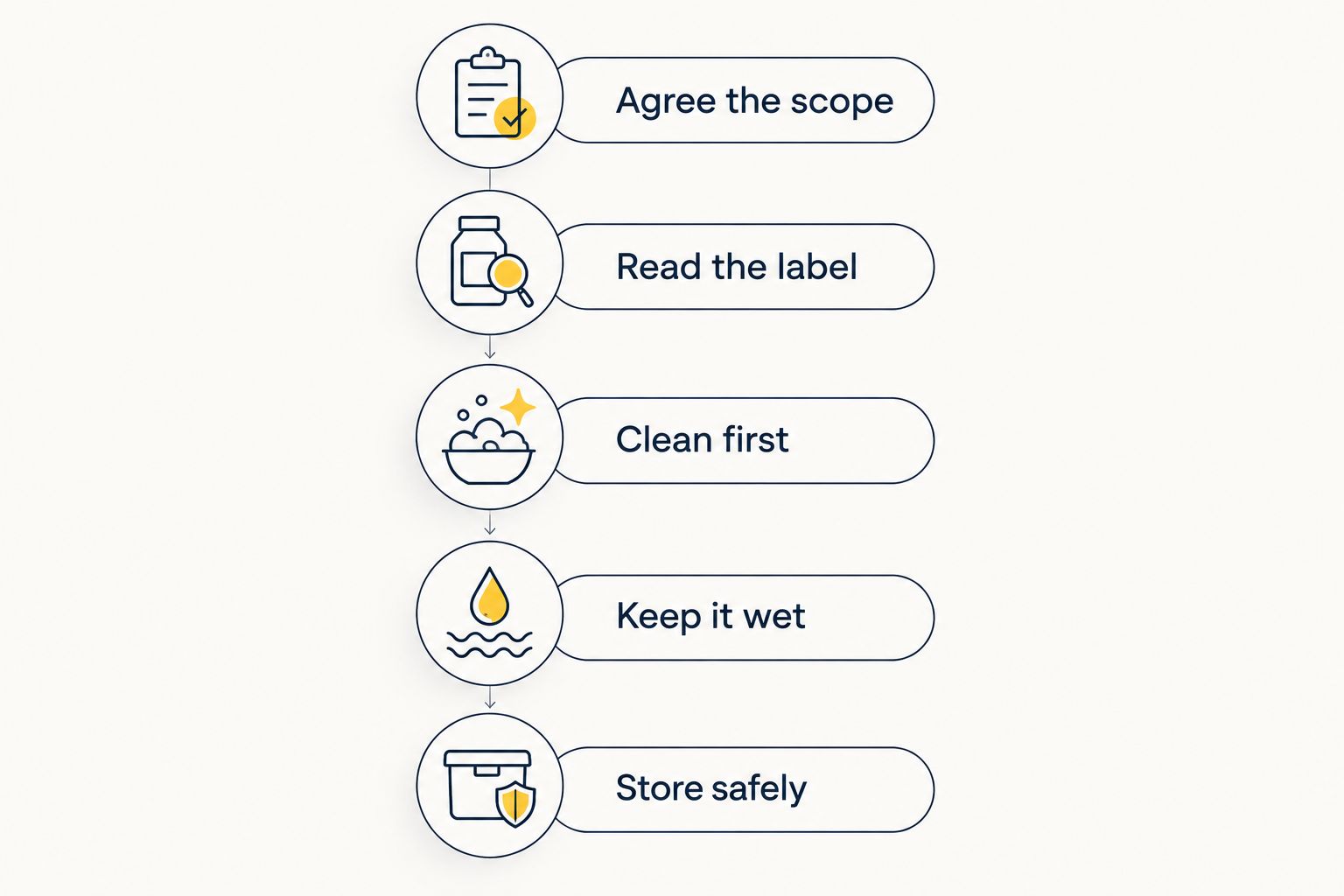
Choose the task first, then follow the product instructions through to safe storage.
A useful brief for Housekept names the cleaning areas and includes any written instructions from your care provider. Ask whether the requested scope fits the service before booking; do not assume ordinary cleaning includes specialised outbreak procedures.
Discuss your NDIS cleaning needs
Confirm your cleaning scope for a home in Sydney, Shoalhaven or Illawarra.
Which disinfectant should you choose?
Start with detergent cleaning and add a compatible, labelled disinfectant where your cleaning plan requires it. Choose chlorine for a procedure that specifies it, alcohol for an approved small-surface task, and hydrogen peroxide when its complete formulation meets the requirements.
For a residential aged care facility, follow the facility’s infection-control policy. For a private home receiving NDIS support, agree the household scope and any clinical instructions. Housekept’s NDIS cleaning service is a service option, not evidence that a particular disinfectant is clinically appropriate.
FAQ
What is the best disinfectant for NDIS cleaning?
The best disinfectant for NDIS cleaning is a labelled product that matches the surface, required germ claim and contact time. Clean away dirt first and follow any written care-provider instructions.
Is there an NDIS-approved disinfectant I should buy?
Do not treat an NDIS label as evidence that a disinfectant suits your task. Check the product’s relevant regulatory status, label claims and the household’s care instructions rather than relying on a marketing description.
Does an NDIS home need disinfecting every day?
Receiving NDIS support does not, by itself, establish a daily whole-home disinfection requirement. Set the cleaning schedule around household needs, contamination risks and instructions from the responsible care team.
Is bleach better than alcohol for aged care cleaning?
Neither bleach nor alcohol is better for every aged care cleaning task. Chlorine-based products fit specified infection-control procedures, while alcohol fits certain small, compatible surfaces; the facility’s policy determines the choice.
Can I use hand sanitiser to disinfect benches?
Use a product labelled for the bench surface rather than assuming hand sanitiser is suitable. Hand and surface products have different intended uses, and the required coverage and contact time still apply.
Are natural cleaners suitable for disinfection?
A natural-cleaning claim does not establish disinfection effectiveness. Choose by the stated germ claim and instructions; do not substitute vinegar or an essential-oil cleaner for a required disinfectant.
Can I use disinfectant on a wheelchair or walking frame?
Use only a cleaning method permitted by the equipment manufacturer. Check individual components, including grips, upholstery, controls and metal finishes, because one product is not automatically suitable for the entire aid.
What should I tell a cleaner before an NDIS cleaning visit?
Tell the cleaner which areas need cleaning and provide any written care-related instructions. Identify equipment restrictions, chemical sensitivities and tasks requiring a separate infection-control procedure before work starts.
One last thing
A clean smell is not proof of disinfection. The useful evidence is the correct product on a compatible, pre-cleaned surface for the labelled contact time. Put those instructions in your cleaning brief instead of asking for a stronger-smelling chemical.