.png)
Best cooktop and stovetop cleaners in 2026

Best overall for compatible glass or ceramic: a dedicated glass-ceramic cooktop cleaner. Best for everyday spills: mild dishwashing liquid. Best for greasy, washable components: a surface-approved kitchen degreaser. Best for stainless-steel surrounds: a stainless-steel cleaner. The best cooktop cleaner in 2026 is the one your appliance manual permits, not the strongest bottle on the shelf.
TL;DR
- The best cooktop cleaner matches your appliance manual: glass-ceramic cleaner for compatible glass, mild dishwashing liquid for everyday spills.
- Kitchen degreasers suit approved greasy components; stainless-steel cleaners belong on approved stainless-steel surrounds.
- Housekept suits households seeking professional home cleaning across Sydney, Shoalhaven and Illawarra; confirm cooktop scope before booking.
- Avoid abrasive pads and unapproved oven cleaners. A shiny surface is not evidence that a product is safe.
Why this matters
A cooktop combines surfaces that need different treatment. Glass, enamel, stainless steel, burner caps and control markings are not interchangeable. A cleaner that suits a removable component does not automatically suit the panel underneath it.
Match the surface first, then the mess. That is the basis of this 2026 guide. These recommendations rank cleaner types by task rather than treating every kitchen spray as a substitute.
If you want help with household cleaning rather than another cleaning product, Housekept provides professional home cleaning across Sydney, Shoalhaven and Illawarra. Ask whether the requested cooktop work is included in your booking.
What makes the best cooktop cleaner?
Use these five criteria before choosing a product:
- Surface compatibility: The appliance manual and cleaner label must both permit use on the material you want to clean.
- Mess suitability: Fresh spills, cooked-on residue and greasy removable parts call for different approaches.
- Controlled application: You should be able to keep liquid away from controls, electrical openings and gas components.
- Residue removal: Follow the label’s instructions for removing the cleaner, rather than leaving a film behind.
- Finish protection: Avoid unapproved abrasives, blades and chemicals that can damage the surface or its markings.
Start with 3 checks: identify the material, read the appliance instructions, and read the cleaner label. A product fails the shortlist if those instructions conflict. Do not let packaging terms such as heavy-duty overrule your appliance’s care guidance.
Cooktop cleaners at a glance
Dedicated glass-ceramic cooktop cleaner
- Best for: Approved glass and ceramic surfaces with stubborn residue
- Standout feature: A formulation labelled for the cooking surface
- Key limitation: Not automatically suitable for stainless steel, enamel or appliance trim
Mild dishwashing liquid
- Best for: Routine cleaning of approved washable surfaces
- Standout feature: A straightforward detergent-and-water approach
- Key limitation: Does not replace approved treatment for hardened deposits
Surface-approved kitchen degreaser
- Best for: Greasy removable parts and washable areas
- Standout feature: A cleaner intended for grease removal
- Key limitation: Suitability varies by material, coating and component
Stainless-steel cleaner
- Best for: Approved stainless-steel surrounds
- Standout feature: Material-specific cleaning and finishing
- Key limitation: Not a default cleaner for glass, burners or cooking zones
The table is a decision guide, not permission to use every option on your appliance. Choose the row that matches both the surface and the task. For a mixed-material cooktop, you can need different methods for different sections.
1. Glass-ceramic cleaner: best for compatible cooking surfaces
A dedicated glass-ceramic cooktop cleaner is the default choice for stubborn residue on a glass or ceramic surface when the appliance manufacturer permits it. Choose a product whose label explicitly covers your surface. The word ceramic alone does not establish compatibility with every coating or appliance component.
Apply the cleaner as directed, using an approved cloth or applicator. Keep it on the intended surface and remove the residue according to the label. Unless the appliance instructions identify a special procedure, let the cooktop cool before routine cleaning.
Glass-ceramic cleaner pros:
- Gives you a surface-specific category to check against the manual.
- Suits a targeted clean rather than treating the whole appliance alike.
- Provides labelled application and removal instructions for the intended material.
Glass-ceramic cleaner cons:
- Does not automatically cover trim, knobs, seals or surrounding metal.
- Stubborn deposits can still require a separate, manufacturer-approved tool.
Best for: Owners of compatible glass or ceramic cooktops dealing with residue that routine wiping has not removed.
2026 verdict: Buy an approved glass-ceramic cleaner for stubborn residue on a compatible cooking surface. Skip it if the manual specifies a different method. Do not assume a stronger application or repeated scrubbing improves the result.
2. Mild dishwashing liquid: best for everyday spills
Mild dishwashing liquid is a practical first approach to routine cleaning where the appliance instructions allow detergent and water. Use it on the approved surface with a soft cloth, then remove detergent residue as instructed. Keep the cloth damp rather than flooding the appliance.
This option suits ordinary maintenance, not every baked-on deposit. If a spill has hardened, move to the manufacturer’s recommended method rather than repeatedly scrubbing with more detergent.
Mild dishwashing liquid pros:
- Fits routine cleaning instructions that specify mild detergent.
- Lets you work on a small area with a damp cloth.
- Avoids introducing a specialist chemical when basic cleaning is sufficient.
Mild dishwashing liquid cons:
- Leaves residue if you do not remove it properly.
- Is not a universal answer to hardened food, mineral marks or damaged finishes.
Best for: Fresh spills and everyday upkeep on surfaces approved for mild detergent cleaning.
Set aside 2 cloths: one for cleaning and one for removing residue or drying, following the appliance instructions. Keep both free of grit. A soft cloth carrying crumbs or abrasive particles is no longer a safe cleaning surface.
2026 verdict: Buy mild dishwashing liquid for permitted routine cleaning; skip aggressive scrubbing when a spill needs a different method.
3. Kitchen degreaser: best for approved greasy components
A kitchen degreaser belongs on surfaces and components explicitly approved by both the cleaner label and appliance instructions. Its useful role is grease removal on suitable washable areas, not indiscriminate spraying across the hob.
Removable parts need individual checks. A pan support, burner cap and control knob can have different materials and cleaning requirements. Do not assume that removal makes a component dishwasher-safe, soak-safe or suitable for a degreaser.
Kitchen degreaser pros:
- Targets grease on surfaces covered by its label.
- Supports separate treatment of approved removable components.
- Gives a task-specific option when routine detergent cleaning is insufficient.
Kitchen degreaser cons:
- Can be unsuitable for coatings, aluminium, markings or other materials, depending on the formulation.
- Requires careful application around controls, openings and gas components.
Best for: Greasy washable components and surrounding areas whose care instructions permit the chosen degreaser.
Apply and remove the product exactly as directed. Keep components separate while cleaning, then dry and refit them according to the manual. If you cannot identify a component’s material or cleaning requirements, leave it out of the degreaser treatment.
2026 verdict: Buy a kitchen degreaser only for identified, approved surfaces. Skip a whole-appliance spray-down: convenience does not establish compatibility.
4. Stainless-steel cleaner: best for approved metal surrounds
A stainless-steel cleaner is a finishing option for stainless-steel areas that the appliance manufacturer permits you to treat. Use it on the specified metal section, not as a substitute for a glass-cooktop cleaner.
Check whether the product cleans, polishes, or leaves a protective film. Those functions are not interchangeable, and a product intended for an appliance exterior does not automatically belong on a heated surface. Follow the appliance’s instructions on wiping direction and residue removal.
Stainless-steel cleaner pros:
- Provides a material-specific option for approved metal surrounds.
- Keeps the finishing task separate from cleaning cooking zones.
- Offers label instructions for the stainless-steel surfaces it covers.
Stainless-steel cleaner cons:
- Is not a default treatment for glass, enamel or burner components.
- Can leave an unwanted film if used in the wrong place or removed incorrectly.
Best for: Approved stainless-steel trim or surrounds after you have addressed food spills and grease.
Protect nearby glass, control markings and other finishes from accidental application. Work on 1 section at a time so you can keep track of which material you are treating. Do not judge compatibility by whether the area looks shiny afterwards.
2026 verdict: Buy a stainless-steel cleaner for approved metal surrounds; skip it on cooking zones unless expressly permitted.
Clean your cooktop in the right order
A good cleaner cannot compensate for an unsuitable tool or careless application. Use this sequence for routine cleaning, while following any appliance-specific exceptions.
- Check instructions: Identify the surface, approved products and any special spill guidance. Some appliance manuals require prompt treatment of particular spills; follow those instructions safely.
- Cool surface: Switch the appliance off and let it cool for routine cleaning. Do not work around hot cookware or exposed hot components.
- Remove debris: Lift away loose crumbs with an approved soft cloth. Avoid dragging particles across the surface.
- Clean carefully: Apply the permitted cleaner to the intended area. Keep liquid out of openings and follow any stated contact time.
- Remove residue: Finish as the cleaner label and manual require. Dry and refit removable components correctly before use.
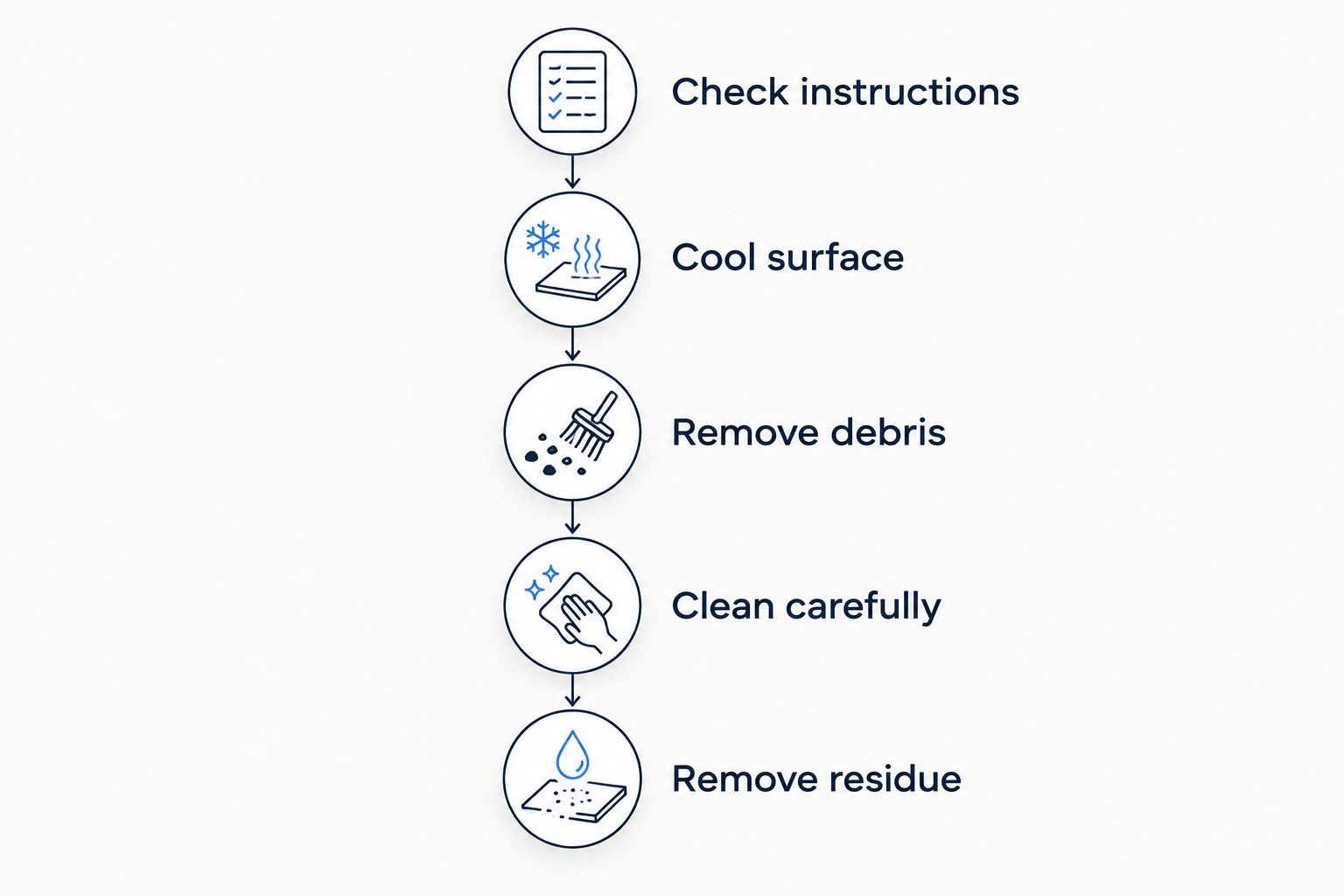
Choose the permitted cleaner before treating the surface.
Do not add an invented soaking period or leave a product on longer to make it stronger. Contact times belong to the product instructions. If the label gives no permission for soaking a component, do not improvise.
When is a scraper appropriate?
A scraper is a tool, not a cleaner, and belongs outside the product ranking. Use one only when your appliance manufacturer permits the specific type and explains how to use it.
Do not substitute a kitchen knife or an improvised blade. If approved scraping does not remove a mark, stop and reassess it rather than escalating pressure. A scratch, worn coating or discoloured finish is not simply another layer of dirt.
How these options are ranked
This ranking puts surface compatibility ahead of cleaning strength. Task suitability comes next, followed by controlled application, residue removal and finish protection.
Glass-ceramic cleaner takes the first slot for compatible cooking surfaces with stubborn residue. Mild dishwashing liquid takes the everyday-maintenance slot. Degreaser and stainless-steel cleaner serve narrower tasks and should stay within those boundaries.
Which cooktop cleaner should you choose?
For a compatible glass or ceramic cooktop with stubborn residue, choose a manufacturer-approved glass-ceramic cleaner. For routine spills, start with the mild detergent method your manual allows. Treat greasy components and stainless-steel surrounds separately.
Housekept is best for households seeking professional home cleaning across Sydney, Shoalhaven and Illawarra. If you want cleaning help, describe the cooktop material and condition, then confirm the service scope before booking. Professional cleaning is not a substitute for repairing a damaged appliance finish.
Arrange your home cleaning
Tell Housekept what needs cleaning and confirm the cooktop scope before booking.
FAQ
What's the best cooktop cleaner for a glass cooktop?
A dedicated glass-ceramic cleaner is the best choice for stubborn residue when your appliance manufacturer approves it. For routine spills, use the mild detergent method permitted by the manual.
Can I use dishwashing liquid on my stovetop?
Use mild dishwashing liquid when your appliance instructions permit detergent and water on that surface. Apply it with an approved soft cloth and remove the detergent residue as directed.
Can I use oven cleaner on a cooktop?
Do not use oven cleaner on a cooktop unless both the appliance instructions and product label explicitly permit it. Approval for an oven interior does not establish approval for glass, enamel, trim or burner components.
Is a kitchen degreaser better than a cooktop cleaner?
A kitchen degreaser is better suited to grease on approved washable components, not automatically to the cooking surface. Choose by material and task rather than treating the two categories as interchangeable.
How do I remove burnt-on food without scratching the glass?
Follow your appliance manufacturer's method for burnt-on food, including any approved cleaner or scraper. Avoid unapproved abrasive pads, improvised blades and increasing pressure when a mark does not lift.
Can I use stainless-steel cleaner on the whole hob?
No: stainless-steel cleaner belongs only on areas approved by the appliance instructions and product label. Keep it off glass, burner components and heated surfaces unless those uses are expressly permitted.
Can Housekept help with cleaning my home?
Housekept provides professional home cleaning across Sydney, Shoalhaven and Illawarra. Describe the cooktop work you want and confirm whether it is included in your chosen service before booking.
One last thing
Photograph the appliance’s model label and save the care instructions before your next clean. That gives you a specific reference when choosing a product, replacing a tool or explaining the job to a cleaner.
If the same mark remains after the approved cleaning method, stop treating it as dirt. More chemical and more pressure are not a diagnosis.