.png)
Best commercial cleaning supplies for small offices 2026

Best overall: reusable microfibre cloths. Best for office floors: a flat mop with washable pads. Best starting point for a simple kit: a surface-compatible neutral detergent. This 2026 guide ranks the best commercial cleaning supplies for small offices by the job each one does, the upkeep it needs and where it falls short.
TL;DR
- The best commercial cleaning supplies start with microfibre cloths, a suitable detergent and floor-cleaning equipment.
- Choose a flat mop for compatible hard floors and a vacuum suited to your office flooring.
- Disinfectant is a targeted addition, not a replacement for removing dirt.
- Housekept commercial cleaning is best for businesses seeking a cleaning service rather than a do-it-yourself supply kit.
Why this matters
A small office needs supplies that staff can use correctly, not a cupboard full of overlapping chemicals. Buying a separate bottle for every surface creates more storage, more instructions and more chances to use the wrong product.
Build your 2026 kit around your floors, shared kitchen and bathrooms. Add specialist products only when a surface or cleaning task requires them. Routine soil removal and disinfection are different jobs; buying a disinfectant does not remove the need for cleaning.
Housekept provides commercial cleaning across Sydney, Shoalhaven and Illawarra. If you want a service rather than another task for staff, explore Housekept before buying equipment you will need to maintain yourself.
What makes the best commercial cleaning supplies?
Use these criteria to choose your 2026 office cleaning kit:
- Surface compatibility: The label must suit the actual material, including any floor finish or protective coating.
- Clear instructions: Staff need readable directions for dilution, application, rinsing and safe handling.
- Task coverage: Prioritise supplies that solve recurring office jobs rather than occasional specialist problems.
- Easy upkeep: Cloths, pads and vacuum filters need a practical cleaning or replacement routine.
- Cross-contamination control: Separate bathroom equipment from kitchen and desk-cleaning equipment.
- Safe storage: Keep chemicals labelled, secured where necessary and away from food preparation supplies.
Do not judge a cleaner by scent. A strong fragrance does not demonstrate cleaning performance, disinfection or suitability for your surfaces.
Small-office cleaning supplies at a glance
The ranking below compares supply types, not individual manufacturers. Choose a specific product only after checking its label against your office materials and cleaning tasks.
1. Microfibre cloths
- Best for: Desks and routine surface wiping
- Standout feature: Reusable wiping material for multiple tasks
- Key limitation: Dirty cloths redistribute soil
2. Neutral detergent
- Best for: General compatible washable surfaces
- Standout feature: Removes everyday soil without a specialist chemical for every task
- Key limitation: Does not automatically disinfect
3. Suitable vacuum cleaner
- Best for: Loose debris on office floors
- Standout feature: Collects dry dust and debris
- Key limitation: Flooring, filtration and maintenance requirements vary
4. Flat mop with washable pads
- Best for: Routine hard-floor cleaning
- Standout feature: Replaceable pads keep the cleaning surface manageable
- Key limitation: Not suitable for every flooring material
5. Glass cleaner
- Best for: Mirrors and approved glass surfaces
- Standout feature: Targets fingerprints and visible smears
- Key limitation: Some coatings need different care
6. Dedicated washroom cleaner
- Best for: Toilet and basin cleaning
- Standout feature: Keeps washroom products separate from general supplies
- Key limitation: Acidic or abrasive formulas can damage unsuitable surfaces
7. Labelled disinfectant
- Best for: Tasks requiring disinfection
- Standout feature: Provides product-specific directions for disinfection
- Key limitation: Correct preparation and contact time are essential
1. Microfibre cloths: best for everyday office surface cleaning
Microfibre cloths are the strongest starting point for a small-office kit because wiping is part of almost every routine clean. Use them dry for suitable dusting tasks or with a compatible cleaning solution for washable surfaces.
Keep 2 separate cloth sets for kitchen and bathroom work, with another clearly identified set for desks if needed. This is an organisation rule, not a claim that cloth colour itself prevents contamination.
Microfibre cloth pros:
- Reusable when washed and maintained correctly.
- Useful across several routine wiping tasks.
- Easy to assign to separate cleaning areas.
Microfibre cloth cons:
- A soiled cloth needs changing, not continued use.
- Washing instructions and surface suitability still matter.
Best for: Offices needing dependable tools for desks, shelves and shared surfaces.
Follow the cloth manufacturer's care instructions. Do not assume the same cloth is appropriate for screens, polished finishes and toilet fixtures.
Verdict: Buy microfibre cloths first, with a clear separation and laundering system.
2. Neutral detergent: best for a simple general-cleaning kit
A neutral detergent is a practical default for everyday dirt on compatible washable surfaces. Its role is cleaning: loosening and removing soil with the appropriate wiping or rinsing method.
Check the actual product label rather than assuming every neutral cleaner suits every material. The surface manufacturer's care instructions remain the deciding factor, particularly for coated floors and delicate finishes.
Neutral detergent pros:
- Covers multiple general-cleaning tasks when the label permits.
- Helps reduce unnecessary overlapping products.
- Separates routine cleaning from specialist treatments.
Neutral detergent cons:
- Not automatically suitable for disinfection.
- Heavy grease or mineral deposits can require a different product.
Best for: Small offices with ordinary day-to-day soil on washable surfaces.
If dilution is required, measure it according to the label. Adding extra concentrate changes the mixture and can leave residue; it does not establish better cleaning.
Verdict: Buy a neutral detergent that matches your main surfaces.
3. Suitable vacuum cleaner: best for loose debris on office floors
A vacuum cleaner removes dry dust, crumbs and loose debris before any wet floor cleaning. Choose the machine and floor head for the flooring you actually have, not just the size of the office.
Check the operating instructions for permitted debris, filter care and floor-head settings. A standard dry vacuum is not a liquid-cleanup machine.
Vacuum cleaner pros:
- Collects loose debris rather than leaving it for a mop.
- Useful for carpets and compatible hard floors.
- Can reach edges with suitable attachments.
Vacuum cleaner cons:
- Filters, bags or collection containers need maintenance.
- Cords create a trip hazard if poorly managed.
Best for: Offices with carpet, floor mats or regular tracked-in debris.
Empty or replace collection components as instructed. Keep the floor head clear of wrapped hair and debris, and stop using the machine if it is damaged.
Verdict: Buy a vacuum matched to your flooring and maintenance capacity.
4. Flat mop with washable pads: best for routine hard-floor cleaning
A flat mop gives you a replaceable cleaning pad for compatible hard floors. Remove loose debris first, then use the amount of moisture allowed by the floor manufacturer.
Keep 2 clean mop pads ready so you can change a soiled pad instead of spreading dirty solution further. This is a practical minimum for starting a task, not a coverage estimate.
Flat mop pros:
- Pads can be changed during the clean.
- Useful for routine cleaning around desks and furniture.
- Washable pads can be reused when their care instructions permit.
Flat mop cons:
- Pads require washing and thorough drying.
- Excess moisture can damage moisture-sensitive flooring.
Best for: Small offices with compatible sealed hard floors.
Do not treat a flat mop as a universal answer for timber, laminate, stone and vinyl. Each material has its own care requirements, including which cleaning chemicals are acceptable.
Verdict: Buy for compatible hard floors; skip wet mopping where the flooring instructions prohibit it.
5. Glass cleaner: best for mirrors and approved glass surfaces
A dedicated glass cleaner is useful where fingerprints and smears remain obvious after general cleaning. Pair it with a clean cloth and follow the label's application method.
Keep it separate from screen care. A bottle suitable for ordinary glass is not automatically appropriate for monitor coatings, tinted glass or treated surfaces.
Glass cleaner pros:
- Targets visible marks on approved glass.
- Gives mirrors a dedicated cleaning method.
- Useful for glass partitions when their care instructions allow it.
Glass cleaner cons:
- Adds a product that some offices do not need.
- Unsuitable formulas can damage coatings or nearby materials.
Best for: Offices with mirrors, internal glass or frequently touched glass doors.
Protect adjacent surfaces during application. If streaks remain, check the cloth for contamination and review the directions before applying more product.
Verdict: Buy when glass is a recurring cleaning task; skip it for a kit with no suitable glass surfaces.
6. Dedicated washroom cleaner: best for office toilets and basins
Washroom cleaning needs dedicated tools and a product suited to the fixtures and soil present. General dirt, soap residue and mineral deposits are not identical problems.
Keep toilet brushes and bathroom cloths out of kitchen and desk-cleaning supplies. Select chemicals by the fixture material and product instructions, not by the word bathroom on the packaging alone.
Washroom cleaner pros:
- Gives bathroom cleaning a defined product and method.
- Allows targeted treatment of compatible fixtures.
- Supports separation from food-area supplies.
Washroom cleaner cons:
- Acidic formulas can damage acid-sensitive materials.
- Abrasive products can scratch unsuitable finishes.
Best for: Offices responsible for their own toilets and washbasins.
Never mix washroom chemicals. In particular, bleach must not be mixed with acids or ammonia because dangerous gases can result.
Verdict: Buy a fixture-compatible washroom cleaner and keep its tools dedicated to that area.
7. Labelled disinfectant: best for tasks requiring disinfection
A disinfectant belongs in the kit when your cleaning procedure requires disinfection. It is not the default answer for every mark, spill or dusty desk.
Read the directions for cleaning before application, dilution, required wet contact time and any rinsing requirement. The label determines the process; there is no universal contact time for every disinfectant.
Disinfectant pros:
- Provides a defined method for labelled disinfection tasks.
- Makes the intended use and handling requirements identifiable.
- Supports targeted use rather than indiscriminate spraying.
Disinfectant cons:
- Incorrect dilution or contact time undermines the intended process.
- Some surfaces and food-contact areas require additional precautions.
Best for: Offices with identified disinfection requirements and staff able to follow the full procedure.
Do not wipe the product away immediately unless that matches its directions. Check surface compatibility and any relevant safety data sheet before use.
Verdict: Buy for a defined need; skip disinfectant as a substitute for routine soil removal.
How the supplies are ranked
This 2026 ranking puts recurring office tasks ahead of specialist treatment. Microfibre cloths and detergent come first because they support routine surface cleaning; floor equipment follows because its suitability depends on the building.
Glass cleaner, washroom cleaner and disinfectant occupy narrower roles. The best kit covers your actual tasks without asking staff to guess which bottle belongs where. The criteria are surface compatibility, clear instructions, task coverage, upkeep, separation and storage—not an unverified performance score.
Put the kit to work in the right order
Supplies work better when each task has a clear place in the cleaning routine. Use this sequence for ordinary office cleaning, adapting it to the product and surface instructions.
- Prepare: Identify surfaces, read labels and set out dedicated equipment.
- Remove debris: Collect rubbish and vacuum suitable floors before wet cleaning.
- Clean surfaces: Remove soil with the appropriate cloth and cleaning product.
- Disinfect when required: Follow the product's complete labelled procedure.
- Finish floors: Mop compatible floors, control access while wet, then clean and dry equipment.
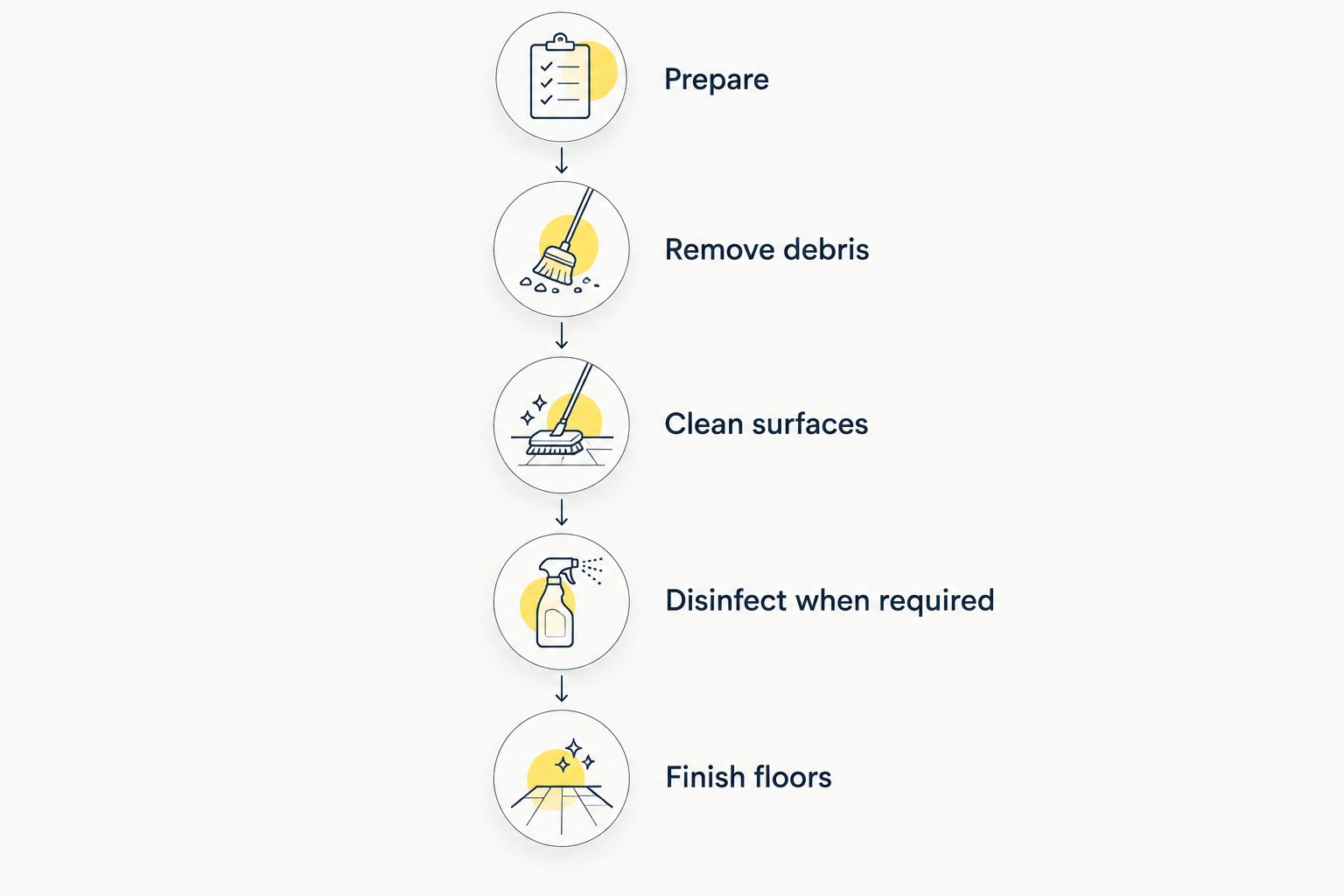
Remove soil before carrying out any required disinfection.
Use 1 labelled bottle per prepared solution and retain the original product information. Never decant cleaning chemicals into drink containers. Keep cleaning supplies away from food and follow workplace requirements for chemical storage, training and protective equipment.
Which commercial cleaning supplies should you choose?
For a small office in 2026, start with microfibre cloths, a compatible neutral detergent and the floor equipment your building needs. Add washroom supplies if you manage the bathrooms. Add glass cleaner and disinfectant only for identified tasks.
Housekept commercial cleaning is best for businesses seeking a cleaning service rather than a do-it-yourself supply kit. If nobody owns the cleaning routine, buying more supplies leaves that problem unchanged.
Choose your office cleaning service
Housekept provides commercial cleaning across Sydney, Shoalhaven and Illawarra.
FAQ
What are the best commercial cleaning supplies for a small office?
The best commercial cleaning supplies are microfibre cloths, a compatible neutral detergent and floor-cleaning equipment suited to the office. Add dedicated washroom supplies, glass cleaner and disinfectant where those tasks apply.
Do I need a different cleaner for every office surface?
No, you do not need a separate cleaner for every surface if one product's label permits several uses. Check each surface's care instructions before combining tasks under the same product.
Is disinfectant better than detergent for office cleaning?
Disinfectant and detergent serve different purposes: detergent removes soil, while disinfectant is used for labelled disinfection tasks. Follow the disinfectant's instructions for any cleaning required before application.
Can I use the same cloth in the kitchen and bathroom?
Use separate cloths for kitchen and bathroom cleaning. Keep the sets identifiable, and change cloths when soiled rather than carrying contamination between areas.
Is a flat mop suitable for every office floor?
No, a flat mop is suitable only when the floor's care instructions allow the chosen wet-cleaning method. Check moisture limits and chemical compatibility, especially for sensitive materials and finishes.
Can I use glass cleaner on office monitors?
Use glass cleaner on a monitor only if the monitor manufacturer's instructions explicitly permit it. Screen coatings can require a different cleaning method from ordinary glass.
Does Housekept provide commercial cleaning for small offices?
Housekept provides commercial cleaning services for businesses across Sydney, Shoalhaven and Illawarra. Discuss your office's surfaces, shared areas and cleaning requirements when choosing a service.
One last thing
A clean-looking cloth is not proof that it belongs in the kitchen. Label the task, not just the cupboard: separate the equipment, keep product instructions accessible and nominate who washes the reusable supplies.
Before adding another cleaner, check whether the problem is the product, a dirty tool or the wrong method. That check prevents an expanding supply cupboard from becoming a substitute for a workable routine.