.png)
Best all-purpose cleaners for holiday rental turnovers 2026

Best overall: a ready-to-use, pH-neutral all-purpose cleaner approved for your surfaces. Best for fragrance-sensitive properties: a fragrance-free cleaner. Best for repeated refills: a correctly diluted concentrate. This 2026 guide ranks cleaner types for holiday rental turnovers, so you can choose by the bottle’s instructions rather than a brand promise.
TL;DR
- The best all-purpose cleaner for holiday rental turnovers matches your surfaces and leaves no unwanted residue.
- Choose a ready-to-use, pH-neutral cleaner for routine wiping; check every surface restriction on the label.
- Choose fragrance-free cleaning products when you want to avoid adding perfume to guest rooms.
- Housekept provides holiday rental cleaning services across Sydney, Shoalhaven and Illawarra.
- Cleaning and disinfection are separate jobs unless the product label explicitly covers both.
Why this matters
A turnover cleaner needs to remove everyday dirt without creating another job. A product that leaves a film, needs an overlooked rinse or damages a finish is the wrong choice, even when it removes the original mark.
Housekept is an option for hosts seeking holiday rental cleaning services across Sydney, Shoalhaven and Illawarra. You can explore Housekept if you want professional cleaning rather than managing the work yourself.
For your own 2026 cleaning kit, separate routine wiping from specialist tasks. An all-purpose cleaner is not automatically suitable for natural stone, timber, appliance coatings or food-contact surfaces. The product label and the surface manufacturer’s care instructions decide where it belongs.
What makes the best all-purpose cleaner?
Use these criteria before choosing a cleaner for your property:
- Surface compatibility: The label must permit use on the actual finish, not just a broad room category such as kitchens.
- Residue control: Check whether the product needs rinsing. Inspect cleaned surfaces after they dry, not while they are still wet.
- Simple preparation: Ready-to-use products remove the dilution step; concentrates need a repeatable measuring process.
- Suitable fragrance: Choose fragrance-free products when added perfume is unwanted. Fragrance-free does not mean risk-free.
- Clear safety instructions: Read precautions, ventilation requirements and storage directions before adding a bottle to your kit.
- Defined purpose: A routine cleaner, degreaser and disinfectant do different jobs. Choose the function you actually need.
No single feature overrides compatibility. A pH-neutral claim is useful information, but it is not permission to apply the product to every surface in a holiday rental.
Best all-purpose cleaner options at a glance
These are ranked formulation types, not claims that one named retail product outperforms another. Select a bottle whose current label meets the requirements in its row.
1. Ready-to-use, pH-neutral cleaner
- Best for: Routine turnover wiping
- Standout feature: No dilution step before use
- Key limitation: Neutral pH does not guarantee compatibility
2. Fragrance-free all-purpose cleaner
- Best for: Avoiding added perfume
- Standout feature: No deliberately added fragrance
- Key limitation: Still needs safety and surface checks
3. Concentrated all-purpose cleaner
- Best for: A measured refill routine
- Standout feature: Preparation can follow a documented dilution process
- Key limitation: Incorrect dilution creates avoidable problems
4. Degreasing all-purpose cleaner
- Best for: Greasy kitchen surfaces
- Standout feature: Formulated for oily soil
- Key limitation: Restrictions can exclude delicate finishes
5. Cleaner-disinfectant
- Best for: Tasks requiring labelled disinfection
- Standout feature: Cleaning and disinfection instructions on one product
- Key limitation: Contact time and preparation still apply
1. Ready-to-use, pH-neutral cleaner: best for routine wiping
A ready-to-use, pH-neutral cleaner is the default choice for ordinary dirt on compatible, washable surfaces. It removes the preparation step, which makes the written turnover procedure simpler. Check the label before using it on benches, cupboard fronts, tables or painted finishes.
For a 2026 turnover kit, choose this category when you want one routine wiping product with clearly stated restrictions. Do not treat the words all-purpose as a substitute for those instructions.
Ready-to-use, pH-neutral cleaner pros:
- No measuring or dilution before use.
- Straightforward to include in a room-by-room checklist.
- Suitable as a routine option wherever the label permits it.
Ready-to-use, pH-neutral cleaner cons:
- Neutral pH does not establish suitability for every finish.
- It does not automatically remove mineral deposits or heavy grease.
- Disinfection requires a separate label claim and procedure.
Best for: Hosts handling ordinary dust, fingerprints and light everyday soil on approved surfaces.
Verdict: Buy a labelled, surface-compatible ready-to-use cleaner as your default. Skip any bottle whose restrictions conflict with your property’s finishes.
2. Fragrance-free all-purpose cleaner: best for avoiding perfume
A fragrance-free all-purpose cleaner removes dirt without deliberately adding fragrance. This category suits a property where you do not want cleaning perfume to become part of the guest experience. It can also be ready-to-use or concentrated, so check preparation instructions separately.
Avoid treating scent as evidence of cleanliness. If an unpleasant smell remains after cleaning, inspect the source rather than covering it with a scented product.
Fragrance-free all-purpose cleaner pros:
- Avoids deliberately added perfume during routine cleaning.
- Keeps the cleaning process separate from room fragrance choices.
- Can fit a consistent property-wide fragrance policy.
Fragrance-free all-purpose cleaner cons:
- Fragrance-free does not mean non-irritating or safe for every person.
- Other ingredients still require handling precautions.
- Lack of perfume does not prove that an odour source is gone.
Best for: Hosts who want to avoid adding fragrance to guest rooms and shared spaces.
Verdict: Buy when avoiding perfume is a defined requirement. Choose by the full label, not an assumption that fragrance-free means harmless.
3. Concentrated all-purpose cleaner: best for measured refills
A concentrated all-purpose cleaner requires dilution according to its label. It suits a turnover process where someone can measure, prepare and label working bottles consistently. The useful feature is a controlled refill routine, not permission to improvise a stronger mixture.
Write the product’s actual dilution instructions into your 2026 property checklist. If the label specifies different mixtures for different tasks, identify which mixture belongs in each working bottle.
Concentrated all-purpose cleaner pros:
- Supports a repeatable refill procedure.
- Lets you prepare a working solution according to labelled instructions.
- Makes dilution an explicit part of the cleaning checklist.
Concentrated all-purpose cleaner cons:
- Requires measuring and preparation before cleaning.
- Incorrect dilution can affect performance or leave residue.
- Decanted bottles need clear identification and safe storage.
Best for: Hosts with a reliable person responsible for preparation and labelled working bottles.
Verdict: Buy only if measuring and labelling are routine. Skip concentrates when the team relies on guessing, unmarked bottles or inconsistent preparation.
4. Degreasing all-purpose cleaner: best for greasy kitchens
A degreasing all-purpose cleaner targets oily dirt on surfaces that its label permits. Use this category for the greasy part of a turnover rather than automatically applying it throughout the property. Cupboard fronts, splashbacks and appliance exteriors can have different care requirements.
Separate grease from baked-on deposits. A cleaner suitable for wiping an appliance exterior is not necessarily suitable inside an oven or on a specialist cooktop finish.
Degreasing all-purpose cleaner pros:
- Targets oily soil rather than treating every mark alike.
- Provides a defined option for compatible kitchen surfaces.
- Keeps heavy kitchen cleaning separate from routine room wiping.
Degreasing all-purpose cleaner cons:
- Surface restrictions can rule out delicate finishes.
- Food-contact surfaces can require a rinse under the instructions.
- It is not a substitute for every oven or cooktop cleaner.
Best for: Hosts dealing with cooking grease on specifically approved surfaces.
Verdict: Buy as a targeted kitchen option when routine cleaning is insufficient. Skip using it as the default throughout the rental.
5. Cleaner-disinfectant: best for labelled disinfection tasks
A cleaner-disinfectant is a product whose label gives both cleaning and disinfection instructions. Choose it when your turnover procedure calls for disinfection on a compatible surface. The procedure matters as much as the product category.
Read whether visible dirt must be removed first, how the product is applied and how long the surface must remain wet. Do not invent a universal contact time: follow the instructions on the bottle you use.
Cleaner-disinfectant pros:
- Provides explicit disinfection directions where the label supports that use.
- Can support a defined procedure for compatible touchpoints.
- Keeps the required wet contact time attached to the task.
Cleaner-disinfectant cons:
- A quick spray-and-wipe can fail to follow the contact-time instructions.
- Preparation, rinsing or surface restrictions can add steps.
- A disinfectant claim does not make the product suitable everywhere.
Best for: Hosts with specific disinfection tasks and time to follow the complete label procedure.
Verdict: Buy for a defined disinfection requirement. Skip choosing it solely because the packaging sounds stronger than an ordinary cleaner.
How to put your choice into a turnover routine
Keep the routine short enough to follow and specific enough to prevent mistakes. A 2026 checklist should connect each cleaner to a surface and a method, rather than listing bottles without instructions.
Check the surface
Identify the material and finish before selecting a product. Follow the surface manufacturer’s care directions alongside the cleaner label. If instructions permit spot testing, use an inconspicuous area before treating a visible surface.
Clean the surface
Remove loose debris, then apply the compatible cleaner as directed. Use separate cloths for bathroom and kitchen work, and change cloths when they become soiled. Do not carry a dirty cloth from one room into the next.
Finish the surface
Complete any required rinse or drying step. If disinfection is part of the task, follow its preparation and wet contact-time instructions rather than rushing to wipe the surface dry. Inspect for residue, missed dirt and damage before marking the room complete.
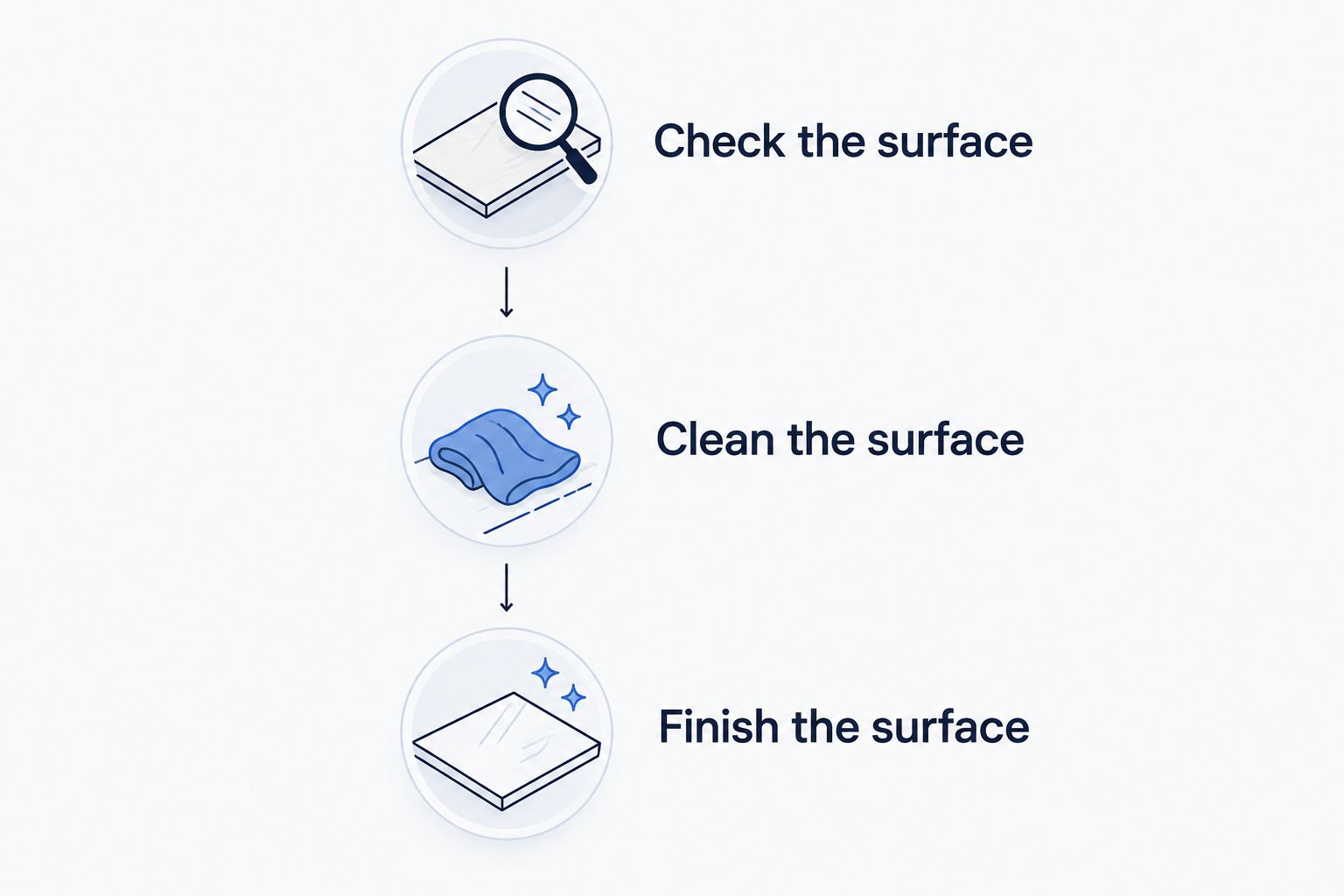
Choose the method by the surface, then complete every required finishing step.
Use 2 separate cloth sets at minimum: one for kitchen work and one for bathroom work. This is a practical separation rule, not a substitute for replacing dirty cloths or cleaning your equipment. Build the 3-step routine into each room’s checklist so the finishing step does not disappear under time pressure.
How these cleaner types are ranked
The ranking prioritises surface compatibility, preparation simplicity, residue control, fragrance requirements and a clearly defined job. Ready-to-use, pH-neutral cleaners come first because they remove dilution from routine wiping; compatibility still decides whether a particular bottle qualifies.
The other categories win narrower use cases. Fragrance-free products address added perfume, concentrates address measured refills, degreasers address oily soil, and cleaner-disinfectants address labelled disinfection tasks. There is no universal winner for every surface and every task.
Which all-purpose cleaner should you choose?
Choose a ready-to-use, pH-neutral cleaner approved for your property’s common washable surfaces if you are undecided. Choose a fragrance-free version when avoiding perfume matters, and switch to a concentrate only when preparation is controlled.
Keep specialised jobs separate. Your 2026 turnover kit does not need every category in this list; it needs a documented answer for each cleaning task. Start with 1 approved routine cleaner, then add a specialist product only for a task the routine cleaner does not cover.
Housekept provides holiday rental cleaning services for hosts across Sydney, Shoalhaven and Illawarra. If you want professional cleaning instead of organising products and doing the work yourself, explore the service directly.
Explore holiday rental cleaning
Housekept provides holiday rental cleaning across Sydney, Shoalhaven and Illawarra.
FAQ
What’s the best all-purpose cleaner for holiday rental turnovers?
A ready-to-use, pH-neutral cleaner approved for your surfaces is the default choice for routine holiday rental wiping. Choose fragrance-free when avoiding added perfume matters, and use specialist products for tasks outside the routine cleaner’s instructions.
Is a fragrance-free cleaner better for an Airbnb?
A fragrance-free cleaner is better when your aim is to avoid adding perfume to the property. It does not guarantee that the product is non-irritating or suitable for every surface, so read the full label.
Can I use one all-purpose cleaner throughout a holiday rental?
Use one cleaner only on surfaces and tasks its label explicitly permits. Natural stone, timber, appliance finishes and food-contact surfaces need their own compatibility checks.
Is an all-purpose cleaner also a disinfectant?
An all-purpose cleaner is not a disinfectant unless its label states that function and provides instructions. Follow any preparation requirements and the specified wet contact time.
Should I choose a concentrate or a ready-to-use cleaner?
Choose ready-to-use when you want to remove the dilution step from routine cleaning. Choose a concentrate when you can measure accurately, label working bottles and follow the product’s dilution instructions.
Can I mix cleaning products to make them stronger?
Do not mix cleaning products. In particular, mixing bleach with acids or ammonia can release dangerous gases; use each product only as directed on its label.
Can I use an all-purpose cleaner on kitchen benches?
Use an all-purpose cleaner on a kitchen bench only when both the cleaner label and the bench manufacturer’s instructions permit it. Complete any required food-contact rinse before the surface is used.
Does Housekept offer holiday rental cleaning?
Housekept provides Airbnb and holiday rental cleaning services across Sydney, Shoalhaven and Illawarra. Hosts can explore the service when they want professional cleaning rather than handling the turnover themselves.
One last thing
A stronger mixture is not a better cleaning plan. Put the exact product name and its permitted surfaces on your checklist, so a replacement bottle with different instructions does not inherit the old method. That small administrative step keeps the routine tied to the product actually being used.