.png)
How Much Linen Does Your Airbnb Need? A Practical Stock and Laundry Guide
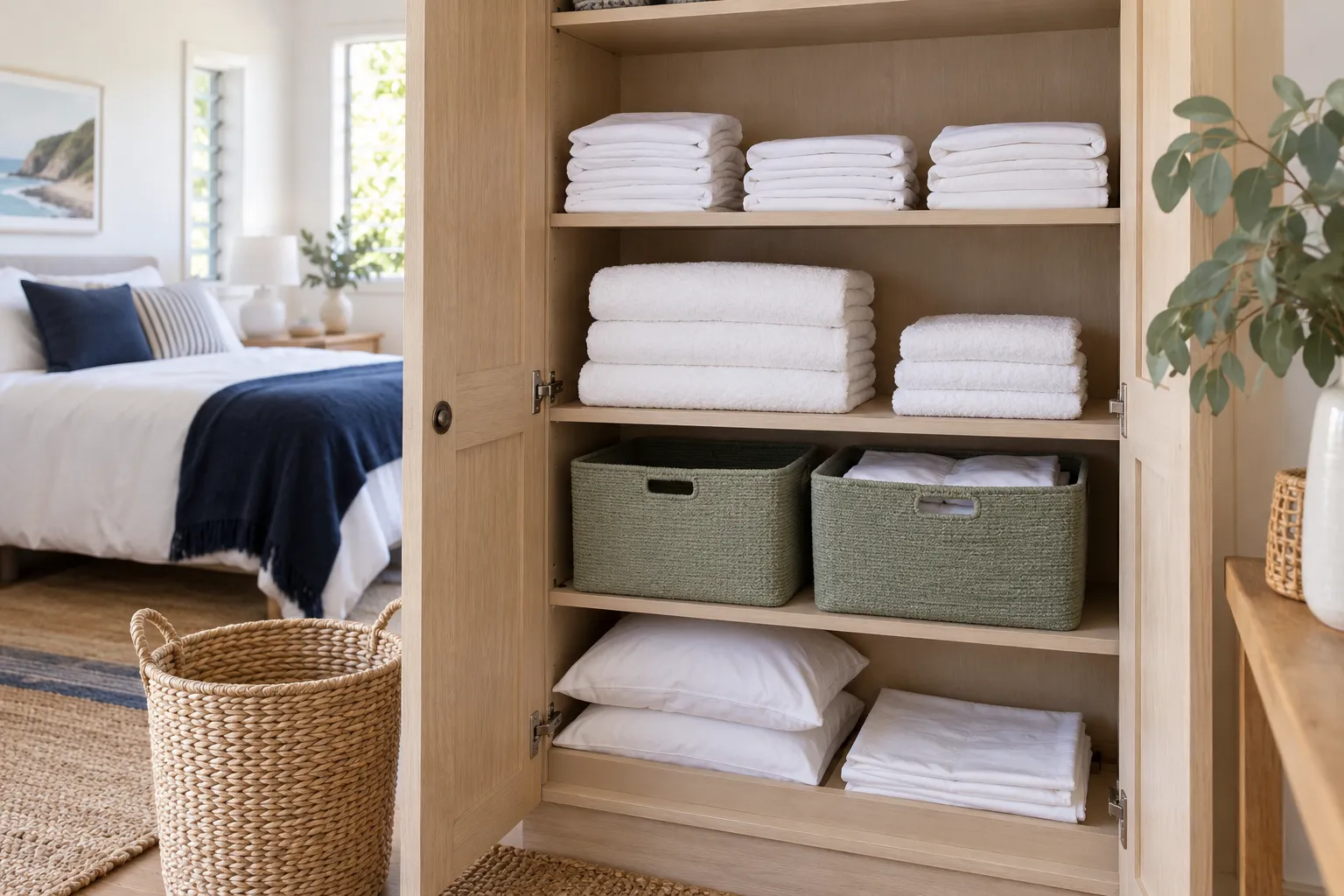
Your holiday rental needs enough linen to dress every booked bed, supply the towels you promise guests and keep the next arrival ready while used items are being washed. The right reserve depends on laundry turnaround, booking frequency, bed sizes and how quickly you can replace a damaged item. Counting complete sets is more useful than counting a cupboard full of assorted sheets.
A practical starting point to assess is three complete changes: one in use, one moving through laundry and one clean reserve. That is a planning example, not an Airbnb requirement or a guarantee that three changes will suit every property. A remote holiday home with a slow collection service may need a larger reserve; a different arrangement may work where laundry reliably returns sooner.
This guide helps hosts in Sydney, the Illawarra and the Shoalhaven work out a stock level, organise the cupboard and agree who handles laundry. It complements our Airbnb turnover checklist by focusing on the linen system behind each clean.
Free tool: Download the holiday rental linen inventory worksheet (PDF). It has space for stock by size, laundry allowances, reserves and shortages. Print it and complete a physical count before buying more.
Start with the guest setup you actually offer
Airbnb's preparation guidance lists a towel and pillow per guest and linen for each bed among the essentials. Its ground rules also expect hosts to clean between stays, including doing laundry. Those expectations establish the need for a clean guest setup; they do not tell you how many spare sets to own. See Airbnb's preparation guidance and ground rules for hosts.
Make a room list that matches the accommodation you advertise. Include the main beds, any sofa bed you make available, and the pillows and towels provided under your own guest offering. If you supply beach towels, keep them as a separate item rather than assuming they can replace bathroom towels.
Record the actual mattress dimensions and depth when buying fitted sheets. A sheet described as the correct bed size can still be awkward if it does not fit the mattress profile. Keep one tested product reference for each setup so replacement shopping does not start from memory.
Define a complete change before counting stock
For this guide, a bed change means the washable linen you use to remake that particular bed: for example, a fitted sheet, flat sheet, quilt cover and the required pillowcases. Your setup may differ. List its components explicitly instead of assuming everybody means the same thing by "one set".
Count mattress protectors, pillow protectors, spare blankets and other bedding separately. They need their own inspection and care arrangements, and a pile of extra pillowcases cannot compensate for a missing fitted sheet. Identify the component that would prevent a bed from being made correctly.
Do the same for bathroom and kitchen linen. Specify bath towels, hand towels, bath mats, face washers and tea towels individually. It is easier to identify a shortage when every line describes one item and one size.
Use a stock formula that reflects your laundry cycle
For each item, use this planning formula:
Target stock = quantity in use + quantity unavailable in laundry + clean reserve.
The laundry allowance should reflect how much could be away or still processing when the next change is needed. Ask when used linen is collected, when clean stock returns and whether that timing changes on weekends or public holidays. Work through your busiest realistic sequence of bookings, not just an easy midweek turnover.
The clean reserve is the buffer you choose for a stain, a damaged piece, a delayed delivery or another foreseeable interruption. It should be accessible to the person doing the turnover. Stock that is at your own home an hour away may be useful eventually, but it is not the same as a set ready to use before check-in.
Review the calculation after observing actual laundry returns. If the reserve is repeatedly being used as normal operating stock, the allowance or schedule needs attention. Buying more without understanding the cause can leave you with the same problem in a fuller cupboard.
A worked example: two queen beds and two single beds
Consider an illustrative six-guest home with two queen beds and two single beds. The host chooses to assess three complete changes for each bed. In this example, every queen bed uses two pillowcases and each single bed uses one; the actual quantity should match the property's setup.
- Queen linen: six fitted sheets, six flat sheets, six quilt covers and 12 pillowcases.
- Single linen: six fitted sheets, six flat sheets, six quilt covers and six pillowcases.
- Bath towels: if the host provides one per guest per change, six guests multiplied by three changes gives 18 towels.
Those numbers describe this example only. They do not include extra guest towels, longer-stay changes, protectors or damaged stock. If the host provides two bath mats for each reset, applying the same three-change assumption gives six mats. Calculate hand towels and tea towels from their own presentation quantities.
Now compare the target with serviceable stock. If there are six queen fitted sheets in the cupboard and laundry system but one is torn, only five count as serviceable. The shortfall against a target of six is one. This distinction prevents an inventory sheet from showing "enough" while the cleaner still cannot complete the beds.
Choose how laundry will be handled
Washing at the property
Measure a real wash-and-dry workflow before relying on it during a short changeover. Include sorting, loading, drying, checking and folding, as well as the machine cycle. A washing machine finishing does not mean the bed linen is ready to use.
Record who is responsible for each stage and what happens if a load is still wet when the cleaner needs to leave. Keep sufficient ready stock for the agreed workflow. Avoid making check-in depend on an optimistic estimate that has never been tested with your actual towels and bedding.
Off-site washing or a laundry service
Confirm collection days, return times, minimum quantities, packaging and the process for missing or rejected items. Use a count at handover rather than assuming the same number of pieces will always come back in the next bag. Agree who checks the returned stock and updates the inventory.
If different properties share a laundry run, identify each property's items clearly using a method appropriate to the fabric or packaging. Keep bed sizes easy to distinguish. A beautifully washed sheet in the wrong property still leaves a shortage.
Linen hire
Compare the complete arrangement, including available sizes, delivery timing, storage, change quantities, replacement terms and what happens during a busy weekend. Ask whether packs include towels so you do not double-count them in your own stock plan. The practical comparison is whether the arrangement reliably produces the guest setup you need.
Organise clean, used and out-of-service linen separately
Create a clean-stock location, a used-linen collection point and a clearly separate place for items awaiting stain treatment, repair or replacement. These categories should be obvious to anyone covering a turnover. Do not put questionable items back into the ready stack just to tidy the laundry area.
Within the clean cupboard, group by bed size and component or by complete bed pack, whichever your team can check most reliably. Leave a simple contents list for each pack. Store stock dry and protected from spills and cleaning products, with enough access to count it without pulling everything onto the floor.
Rotate the order you use clean stock so the same few pieces are not always selected while the rest are forgotten. Record worn or damaged items when you notice them. A small regular replacement list is easier to manage than discovering several unusable sets during a fully booked weekend.
Follow the care label rather than a universal laundry recipe
Bosch's Australian care-symbol guide explains that labels cover washing, drying, bleaching, ironing and professional cleaning. A temperature in the wash symbol indicates the maximum permitted temperature, while a crossed-out bleach symbol means bleach is not allowed. Check each textile's instructions alongside the machine and detergent directions. See Bosch's washing-symbol guide.
Do not assume all white textiles tolerate the same treatment. Record care details when you introduce new stock, especially if it looks similar to existing linen but needs a different process. Select products for compatibility with the textile and follow the labelled directions; avoid improvised mixtures.
After laundering, inspect items before folding them into the ready supply. Check for visible stains, damage, remaining moisture and an unexpected odour. Set aside anything that needs further attention. This is a practical presentation check, not proof of disinfection or a substitute for specialist advice where unusual contamination is involved.
Make the handover clear for every turnover
The person preparing the home needs to know the booked bed configuration, guest towel quantities, clean-stock location and who to contact if something is missing. Put that information beside the cleaning instructions rather than relying on a message from several months ago.
At the end of the turnover, record what was used, what went to laundry and anything removed from service. Confirm there is a workable linen plan for the next arrival. A short note such as "one queen fitted sheet withdrawn; reserve used; replacement due Friday" is more useful than "linen low".
Common questions
Are three changes always enough?
No. Assess the number against your return times, consecutive bookings, storage and replacement options. The three-change example is a starting point for a calculation, not a rule.
Should I buy every item in the same colour?
Consistency can make presentation easier, but your team still needs to identify sizes and care requirements. Test a small purchase for fit and compatibility with your laundry process before replacing an entire inventory.
What should I do first?
Count serviceable stock and identify a complete guest setup. Then confirm laundry timing and use the printable linen inventory worksheet to calculate shortages. Solve the missing component before buying another assorted bundle.
Planning linen with Housekept
Housekept's Airbnb and holiday rental cleaning service lists linen changes and offers professional linen hire as an optional add-on. Discuss your bed configurations, booking pattern and preferred linen arrangement during onboarding, and confirm the agreed scope and availability for your property.
Sources and checked date
Checked 7 October 2026: Airbnb guest preparation guidance, Airbnb ground rules for hosts, and Bosch Australia care-symbol guidance. Stock formulas, examples and workflow suggestions are Housekept's planning guidance, not platform-mandated quantities. The cover is an AI-generated illustration.